
| Project | Summary | Date |
|---|---|---|
| The Syncodex | [WIP] a syncretic essay on language as a spectrum of experience. | ??.26 |
| - | - | - |
| Spellcasting Kayfabe | on kayfabe as spellcast glamour and the rise of neokayfabe. | 09.26 |
| Scripting The Syncodex | devising a numerical system of rating reflective of nervous system response. | 08.26 |
| T|h|e Steins;Gate Re:Boot Re/View | soft-analysis of the Steins;Gate re-release. | 08.26 |
| The Gelnaniad | a fabulous (and) Greek myth examination of Steins;Gate. | 08.26 |
| Here Dead and Not Dead, Character and Reader | reworking of A Fear of Missing Branches with an emphasis on Steins;Gate. | 08.26 |
| We Are More Similar Than Dissimilar | a candid interview exploring a vegetarian's views on empathy towards animals. | 05.26 |
| Signal Robo vs. The Noiz Boyz | album inspired by my childhood. | 04.24 |
| Untitled Chromatic RoboProject #2 | second robo EP - combined with first to make Signal Robo. | 02.24 |
| Untitled Chromatic RoboProject #1 | first robo EP - combined with second to make Signal Robo. | 01.24 |
| Cage in Search of a Bird | life-writing about instances of recent violence. | 07.23 |
| first part to an epic poem unifying Beowulf, The Book of Revelations, and William Blake. | 01.23 | |
| Deliriums | a febrile and ergodic short-story anthology on the titular sensation. | 06.22 |
| how Steins;Gate and Virtues Last Reward provide a paradoxical sense of closure. | 05.22 | |
| Eigenstate;Steinsgate | compilation of Steins;Gate theories and explanations. | 12.22 |
| Mirriad | short story / eulogy involving symmetry, magicians, palendromes, and snakes. | 11.22 |
| Invisible Cities - Thin Beta | Invisible Cities adapted into an interactive demo via Twine. | 11.22 |
| The Spiralling Shell | short prose piece on nausea and spirals. | 10.22 |
| Dayface | a first album, combining two EPs into a low-fidelity expression. | 08.22 |
| Limerence (IUIOIUI) | sombre poetic-equation on limerence. | 05.22 |
| Brokesquerie | second EP - combined with I Once Saw An Apple to make Dayface. | 01.22 |
| I Once Saw An Apple | first EP - combined with Brokesquerie to make Dayface. | 13.21 |
| Organ | organ-centric abridgement of Radiohead's Minidisc's. | 12.21 |
| The Story of a Mother | my first released demo, included in Dayface. | 10.21 |
| Climbing the Chao Garden Mountain | sequel video essay on how modding can overcome limitation through Sonic Adventure 2. | 09.20 |
| The Chao Garden Barrier | juvenile video essay exploring limitation/existentialism through Sonic Adventure 2. | 09.20 |
| Phantasomniphobia: a Tail of Dicatamies | debut novel about dreams, time, dichotomies, consciousness, and letting go. | 12.19 |
| reworking of Second Glance Meadow - finalised with Deliriums. | 08.19 | |
| Composite Elements to Elements of Composition | a soft-analysis of A.K. Ramanujan's Elements of Composition. | 09.18 |
| Freedom From the Carapace and the Argonaut | comparing A Green Crab's Shell and The Paper Nautilus. | 09.18 |
| Evil Vie a Live | social law, Nadsat, moral relativism, and criminal creativity: for college. | 05.18 |
| Rags From the Richest | a scathing essay on inequality and social policy: for college. | 05.18 |
| Manifested Fancy | creation, evolution, typology, stereotyping, and judgement: for college. | 05.18 |
| Suncast Shadows | on moral relativity, autonomy, agency, and judgement: for college. | 02.18 |
| Some Say Sinking Ships Still Sail | paper on romance, love, and monogamy: for college. | 02.18 |
| Playing People | identity and conformity: for college. | 02.18 |
| The Darkest Wood | on melancholia and normality: for college. | 12.17 |
| Brief Sociobiological Explanations For Crime | exploration for why we have 'crime:' for college. | 12.17 |
| a debut anthology, later reworked into Other Obsessions. | 11.17 | |
| Ways to Think About Thinking | dominant psychological paradigms of the 20th-Century: for college. | 09.17 |
| Another Machine | commentary on society as a machine: for college. | 09.17 |
| A Brief Guide to Dominating Man | on social stratification and inequality: for college. | 09.17 |
| debut novella: and the worst available version of the story. | 05.17 |

THE SYNCODEX
Descending a Mythically Syncretic Ladder of Language
(or, a Spectrum of Experience: Prose Surpassing Purple)
'Heterodon Thanatosis: a video of a hognose snake playing dead' by @willrobertsonwildlife (2026).
THIS ESSAY BUILDS UPON A PREVIOUS ESSAY
> CLICK HERE <
INTRODUCING THE SYNCODEX

Introduction - Quantifying and Qualifying
For an artist (or a collective) to conjure the power of will required to create a work of art is a miraculous, awspiring, endlessly humbling process. I'm in love with the artistic spirit and want to reiterate that this system reflects my response to the work, and not some boisterous, arrogant statement on its 'inherent value.' I've recommended to others works featured near-the-middle or sometimes on the lower-end, and I understand a person disagreeing with a higher-placement on the principle it did not affect them the way it did me. Additionally, I am always willing to revisit a work (depending on length) for a reassessment, as I seem to be a different person every few years, the me from a decade ago stranger every moment. If it ever seems we speak in tongues here it is because we are building a Tower of Babel in reverse, but I'll try not to babble too much. This will involve a combination of philosophical, clinical, astronomical, esoteric, and everyday vernacular. For formatting reasons, the footnotes are conveyed through subscript 0 instead of superscript ^0. They are links you can click on for expanded context or definition. The reader is encouraged to read the footnotes as they comprise the bulk of the essay.
[[[[GET THE VERNACULAR PRECISE BY THE END]]]]
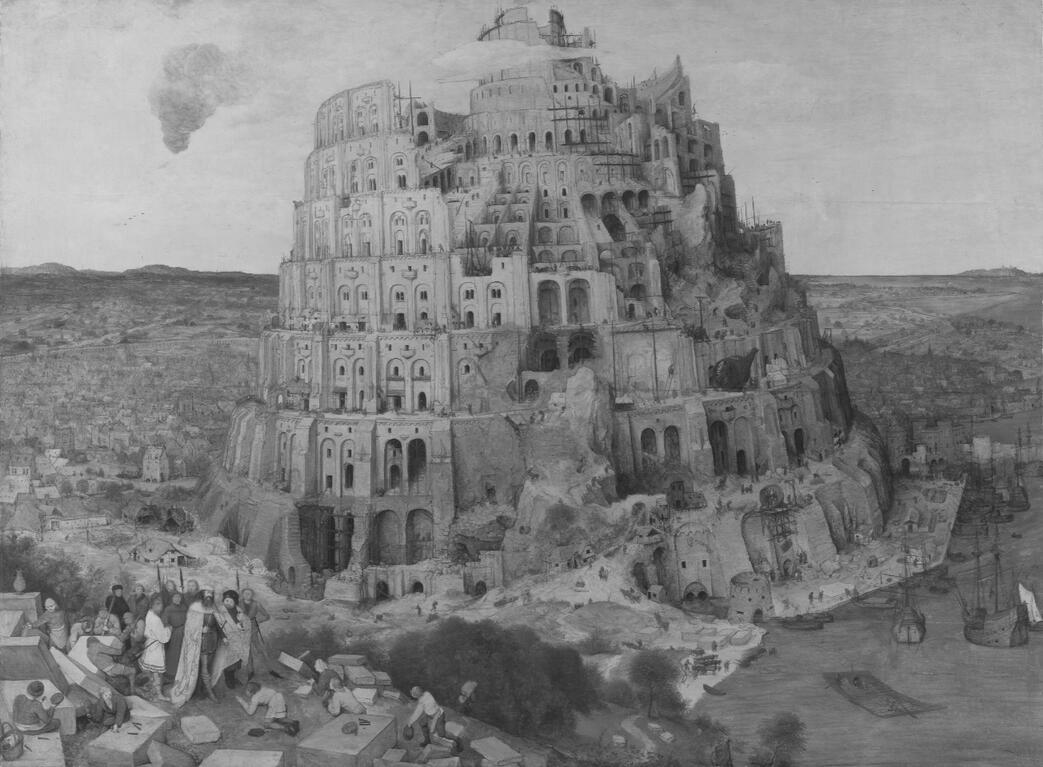
The Tower of Babel (desaturated) by Pieter Bruegel the Elder (1563).
Reality is notoriously slippery to study, a continuous flood of stimuli and unframed moment(s) we cordon off into memories. While art is not directly comparable to 'raw' experience itself, a work can act as a manufactured microcosm of that experience. We artificially bind time, space, intent, idea, spirit, and other forces into an arrested shard of reality. <0> Literature proxies memory via imagination through an internal cadence whereby reader and writer superposition to entangle thought; and the visual arts capture space and light where music signs time. Synthesised, the three make a video game. We can then study artwork's affect upon the nervous system.And we do: our 21st-century contemporary culture is driven by inspiration, creation, consumption, reaction, impression, review, curation, metadata collection, and now the recycling and regurgitation of existent art to capitalise on a previous nervous system response via nostalgia (interestingly once a medical diagnosis: 'homecoming pain,' derived from nóstos and álgos). This has resulted in an over-stimulated populace desperately trying to prove it has felt something. <0.1> In the same way, perhaps it is hardly surprising that some in this self-aware, metamodern culture would turn to post-ironic self-referentiality: they emulates the snake, yet without a tail to follow risk ending up their own ass. But I digress. <0.2>
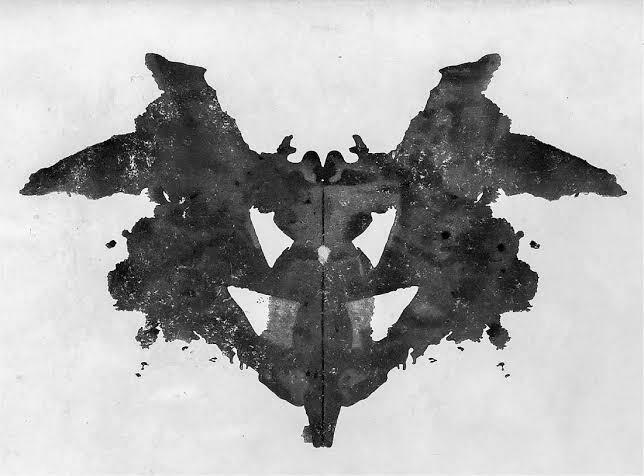
1 by Hermann Rorschach (1921).
Introduction II - Ladder of Language
So, we can consider The Syncodex (and this essay) to possess two objectives.
One: to create a 'ladder of language.' Using adjectives and nouns as rungs, we describe a perceived intensity of sensation (wavelength synchronisation - or vibing) upon the nervous system. We do this by crafting a mythically syncretic 'ladder of language' descending from a zenith to a nadir, communicated through a familiar (and unfamiliar) qualifying lexicon one might employ to quantify the interplay between art (as a proxy for experience) and the observer's nervous system. This means The Syncodex is not just a grading scale but a comprehensive mapping of human consciousness and sensory shock (seismic impact of reality). Therefore, it is perhaps more appropriate to say very little art can be described greater than miraculous, as very little art can rival the spiritual or realised sensations of being. The experience of a perfect day; seeing a newborn for the first time; a life-changing incident; a live performance; a first kiss; a last kiss; irreconcilable despair; dying. Imagine being told you have cancer. Some would rate that experience low; the thanatotic might rate it high. Twenty years later - after remission, after the diagnosis prompted you to actualisation - how do you rate the moment you were diagnosed? We all respond to experience differently. This is why being told "I know exactly how you feel" annoys us at our most precisely sensitive.
Two: to map response to artwork (or artificial constructs across all the arts) upon this ladder of language. Art is the proxy we use to measure this gradient of experience. Literally: no physical construct could be described greater than miraculous, as any adjective greater concerns metaphysics. The Prismatica domain concerns the interaction between meta and physics, ending with miraculous. You could even argue the only artificial constructs rightfully described as stellar (but not celestial and certainly not aphelian) are the artificial objects we've sent into space. The Voyager Golden Record is located about 25.6 billion kilometres from us.

Spinning Dancer by Nobuyuki Kayahara (2003).
These two objectives interacting and clashing might explain any friction felt in the mind of the reader when a book of fiction is described as approaching the 'stature of a god,' or else the interaction of that book upon my nervous system as 'godly' (such books capture a ghost in a machine of ink and semiotics - they worked through me: instigated real-life change, lasting and memorable). When we restrain ourselves to discussing the experience of art upon the observer while continuing to use this ladder of language - with all of its rungs - we fall into the hyperbolic. For instance, constructs belonging to [The Divine] could be considered holy artifacts or 'relative reliquaries.' This glitch arises from using the same system for two purposes (yet it is a glitch shared in our culture: works are regularly described as 'transcendent,' or 'stellar,' or 'cosmic,' or 'enchanting,' or 'disenchanting,' or 'abysmal' and so on). While this is often done out of a linguistic laziness or hyperbolic inflation, I'm consciously trying to pair the real-to-life actual language with spatio-temporal and spiritual precision. I'm not here to desaturate the colourful linguistic tendencies of our species - I like that we describe local experiences with such grandeur. As I'm restrained to English with the occasional loanword or invention, I openly admit the ladder could be missing more appropriate rungs. This is not a book of correspondences a'la 777 by Aleister Crowley (1909). Neither does it propose a new language a'la An Essay Towards a Real Character, and a Philosophical Language by John Wilkins (1668). And it is only superficially similar to Aby Warburg's unfinished Bilderatlas Mnemosyne at first glance. And as we're talking about what it is not: while The Syncodex features an intrinsic hierarch, it does not promote or support supremacism or fascist ideology. The swastika and hakenkreuz are similar symbols with completely different syncratings upon my nervous system due to my predisposition towards their meaning.
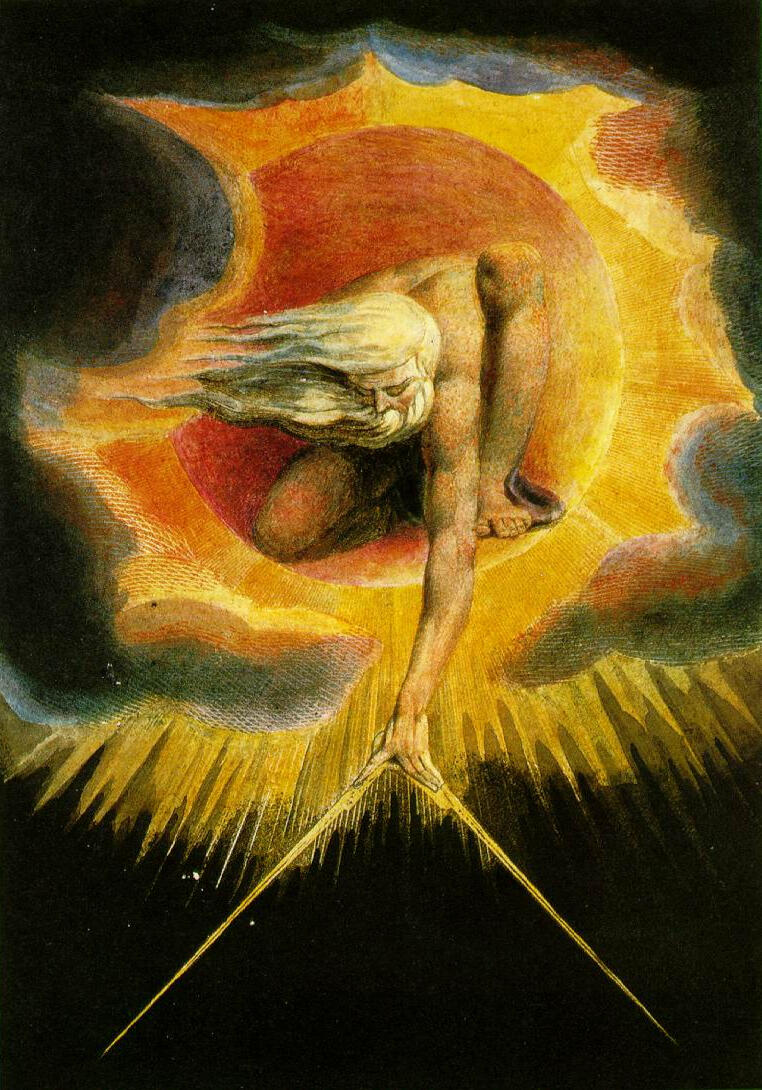
The Ancient of Days by William Blake (1794).
Nonetheless, The Syncodex is an architectonic scale that can be broken down into four occasionally overlapping tier categories - or strata. Important to remember is that almost every entry is in its own way a miracle. Is all of this pedantic? Yes. Meaningless? No. <0.3> Later, we will engage in some 'world-building' to better elucidate all of this. We will treat the domains of experience (and their bands, pivots, and steps) as if they were environments one might experience bodily and/or mentally, or else sensations one can experience. It's difficult to assimilate so many paradigms without mixing metaphors, so please work with me as we do this (for instance: when we talk of 'projections' later we discuss also 'art,' 'light as illusion,' and the outward 'properties of the projector' itself). To better understand these abstractions we will use viscous personification (and occasional anthropomorphism) to render these concepts along a narrative arc. Because we are also treating these evaluative terms as states of nervous system response, many of these words blur the line between descriptors (adjectives/participles) and realms or states (nouns/nominals). As such, the remainder of the essay could be seen to concern an 'adventure' involving a transforming 'main character' who is also 'their environment' (for instance: light, time, space, magic, technology, architecture, food, employment,
[[[[ACTUALLY LIST THE TYPES OF VERNACULAR AND CHARACTERS IN ORDER, HERE]]]]
It's worth noting that the embedded images (in the footnotes or elsewhere) represent their domain through contextual association. For instance, when we discuss the interaction of cobalt, the sun, the sky, the stars, Daedalus, and disaster at the low-900s in the domain of [The Prismatica], we appropriately use an image depicting Icarus by Matisse. Similarly, we use the terminological and visual language of The (Wonderful) Wizard of Oz at the mid-800s in the domain of [The Incantatory]. That does not mean either are afforded those syncratings. The Tower of Babel (above) does not imply an artistic superiority over all images embedded below it. The use was contextually pertinent as we discussed a Tower of Babel. Similarly, the William Blake painting - The Ancient of Days - is used to artistically insinuate a genesis of acute rationality while matching the visual language of what comes after: Altarpiece No.1, Group X and later The Dark Side of the Moon, for instance.
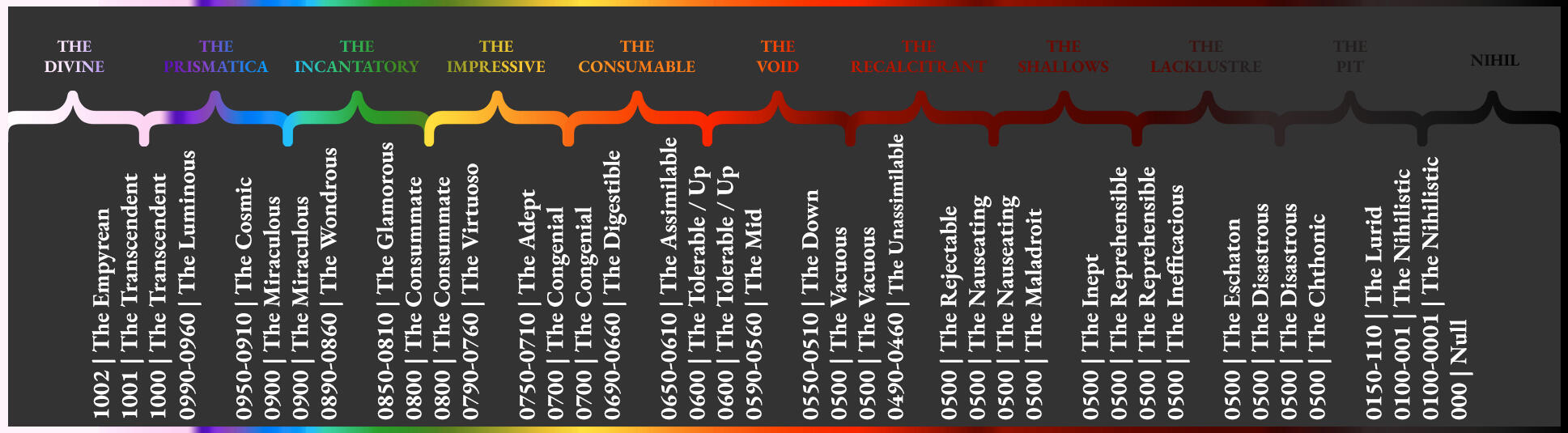
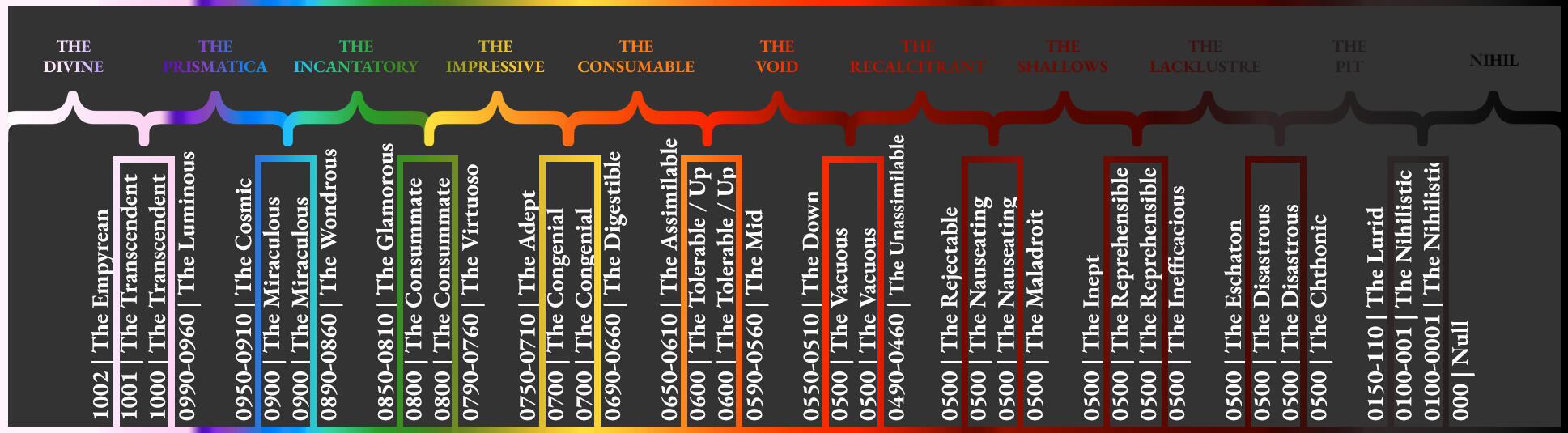
You can think of The Syncodex in terms of literature or television:Domains are (11) books.
Bands are (30) acts;
Pivots are (10) interstitial epilogue and prologue bands,
Steps are (102) chapters.Prepare for some high-level autism. Time to split hairs.
Domains
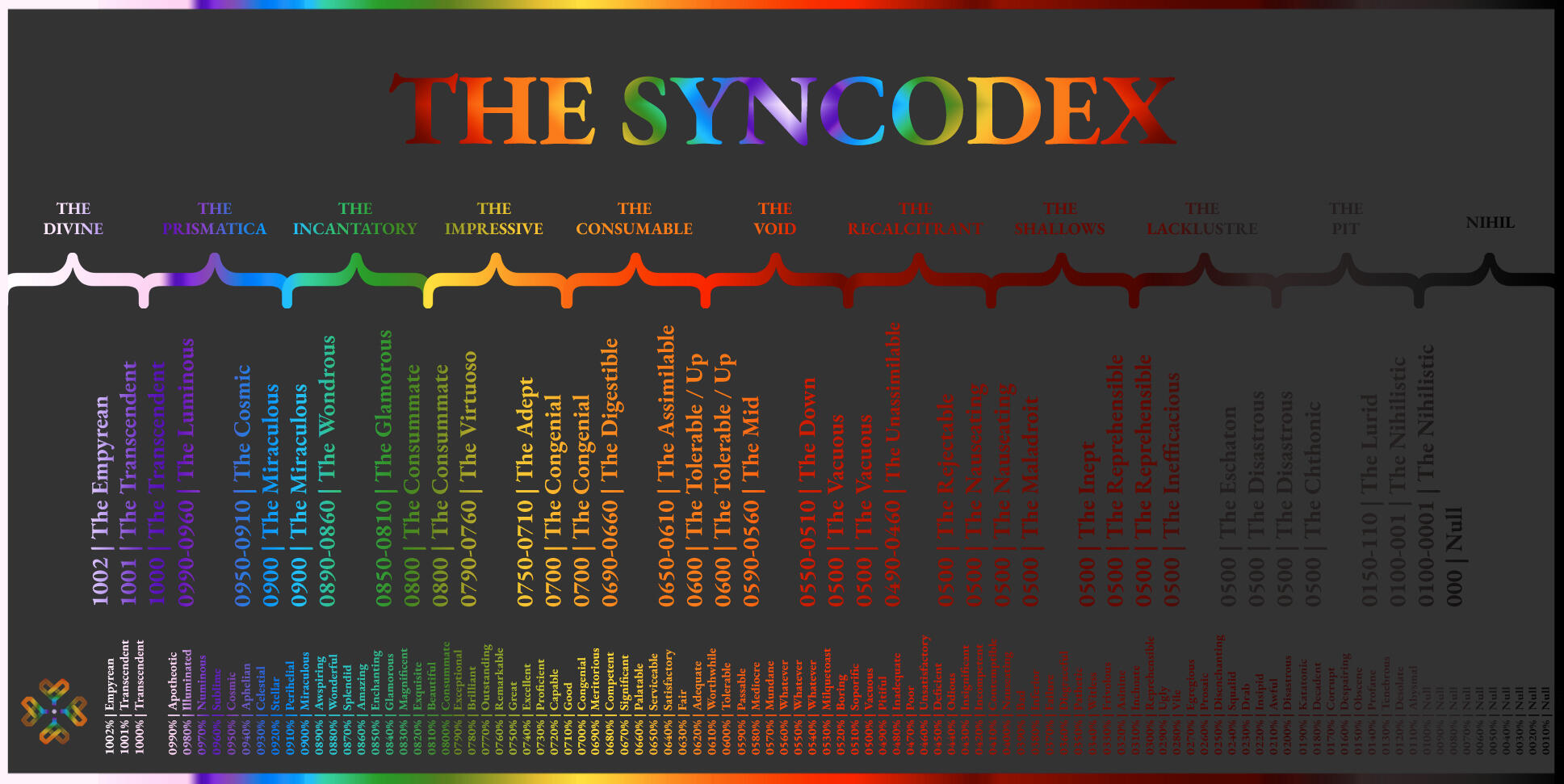
First, the domains. These are eleven groupings representative of the stratum of The Syncodex. You can think of them with standard decimals (970 > 97.0) though they are commonly depicted with percentages of a thousand (970%). They are the books of The Syncodex. Embedded within is a typical grading and star system, <0.4> all colour-coded according to the rainbow or chromatic scale denoted in Sir Isaac Netwton's Opticks (1704) but with black and white at each pole to represent a closed alchemical ouroboros design. In this way, The Syncodex better represents the phenomenological polar struggle between light and darkness of Taoism or Johann Wolfgang von Goethe’s Theory of Colours (1810). <0.5>

Bands
Second, the bands. These are within the domains. Roughly split a domain in half and you're left with a block of two halves comprising four bands; a ceiling band and a floor band sandwiching two other bands. For instance: [The Incantatory] comprises The Miraculous, The Wondrous, The Glamorous, and The Consummate. These registers capture shared frequencies within each domain. In theory, these can be compared to a two-act structure model of narrative which has started in-media-res - 10% aftermath/hook, 40% complication, 40% resolution, 10% aftermath/hook.
Pivots
Third, the pivots. These specific bands, the hundreds, function as structural hinges that anchor and facilitate transitions between the domains. These are the ceilings/floors. For instance: the two pivots belonging to [The Incantatory] are The Miraculous and The Consummate. The former is the floor to [The Prismatica], the latter the ceiling to [The Impressive]. It's important to remember pivots are just another name for the hundreds bands. They therefore belong to two domains and are like interstitial prologues and epilogues which carry us through acts and between books.
Steps
Finally, the steps (the familiar scores or syncratings themselves). Were The Syncodex a high-rise building, these would be the rooms. For instance: [The Incantatory] consists of miraculous, awspiring, wonderful, splendid, amazing, enchanting, glamorous, magnificent, exquisite, beautiful, and consummate. These are simply degrees, or gradations - they are like chapters of the book. Which would make the entries (the experienced works of art) moments or scenes.
Introduction III - Chroma Feelings
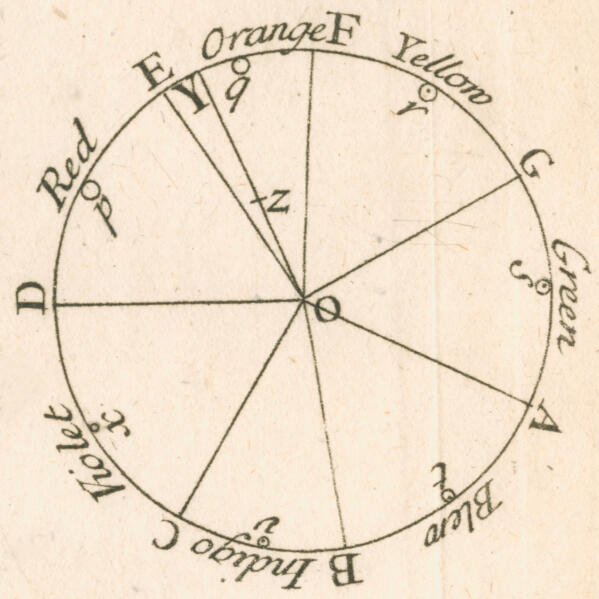
Opticks, by Sir Isaac Netwton's (1704).
Anomalous shades (such as magenta or pink) are included for good reason. Some might consider this a work of 'purple prose,' but I prefer to think of the colourful language as an expression of 'indigo idiolect.' <0.6> Violet is the colour with the highest-frequency and shortest wavelength visible to the human eye before its sublimation into an invisible ultra-violet (here rendered, uh, visible). The looping-bookending suggestion of white > white-pink > pink/magenta > violet > indigo > blue > green > yellow > orange > red > black > (grey) serves to illustrate that The Syncodex forms a closed circuit of colour. <0.7> Except that loop is asymmetrically closed through an illusion of iridescence. <0.8> While white implies an 'unblemished' apex, the preceding shades of magenta (or pink) are an expression of the penultimate's 'blemish', a signifier of the brain's attempt to bridge the highest frequency of violet with the lowest frequency of red.
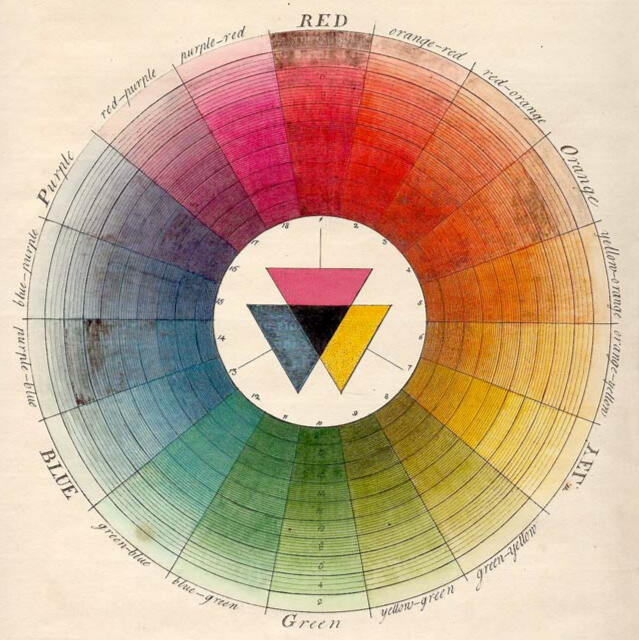
~The Natural System of Colours, by Moses Harris (1776).
Brown is not a part of the list but is implied through the grounded qualities of [The Impressive], the digestive aspects of [The Consumable], and the repulsive properties of [The Recalcitrant]. To make brown you combine red and green or tinge orange, yellow, or red with black. Grey is absent from the Newtonian rainbow as it is an achromatic shade - an admixture of blackand white or a desaturation resulting from competing wavelengths - though its silver can be felt in the cobalt tinge and Luna essence of [The Prismatica]. Considering grey can determine vibrancy, chroma is therefore defined by its freedom from it. Within the context of The Syncodex, grey does not imply the apathy found in [The Void], but a listless lacking of will: the adoption of 'grey glasses' which affect the perception of all things. Though this essay is hardly the first to suggest grey (as a visual inverse of colour) represents a depression or colourless lifelessness, it literally recontextualises that sentiment. [The Penumbra] is the name of its domain, but really it is not a domain but more of a modifier upon the nervous system that affects the experience of all other domains. Illuminated becomes illuminated; numinous becomes numinous; celestial becomes celestial; wonderful becomes wonderful; beautiful becomes beautiful; great becomes great; competent becomes competent; and even whatever becomes whatever. How do we avoid [The Penumbra]? You ask how to avoid melancholia: which is not an easy task (and so must be left to a future essay).
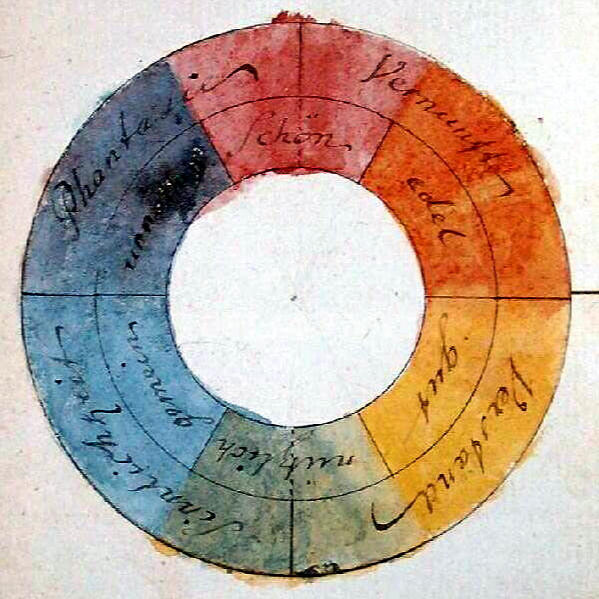
Colour Circle for the Symbolization of the Human Mental and Spiritual life, by Johann Wolfgang von Goethe (1810).
While entries towards the very bottom are irredeemable, here we will attempt an alchemical <0.9> chromatic explanation for any adverse sadomasochistic schadenfreude ('a pleasure of harm or misery') able to be derived from lower entries while acknowledging their (many) relative flaws. Experienced down here are the guiltiest of pleasures; the slop we reduce ourselves and our friends to: laughing swine rolling in muck. Down here, we sometimes engage in the mental polishing of shite. The psyche tries to make something out of near-nothing - 'when life gives you lemons' - as it attempts a transmutation of the rubedo (red) (let us say 'pathetic') experience through the nigredo (blackness) of the nadir to seek the delight of the albedo (white) zenith. This transmutation is tainted by cinereus (ash), which desaturates the experience into a dirty-pink - but not magenta and certainly never white. <0.10> If this is lost on you, that is completely understandable. Perhaps return to this introduction after reading more.
| Color | Wavelength (nm) | Frequency (THz) | Photon Energy (eV) |
|---|---|---|---|
| Violet | 380-420 | 715-790 | 2.85-3.26 |
| Indigo | 420-450 | 675-715 | 2.75-2.85 |
| Blue | 450-485 | 620-675 | 2.56-2.75 |
| Cyan | 485-500 | 600-620 | 2.48-2.56 |
| Green | 500-565 | 530-600 | 2.19-2.48 |
| Yellow | 565-590 | 510-530 | 2.10-2.19 |
| Orange | 590-625 | 480-510 | 1.98-2.10 |
| Red | 625-750 | 400-480 | 1.65-1.98 |
Composed as I am, like others,
of elements on certain well-known lists,
father’s seed and mother’s egggathering earth, air, fire, mostly
water, into a mulberry mass,
moulding calcium,carbon, even gold, magnesium and such,
into a chattering self tangled
in love and work,scary dreams, capable of eyes that can see,
only by moving constantly,
the constancy of things [...] —I pass through them
as they pass through me
taking and leavingaffections, seeds, skeletons,millennia of fossil records
of insects that do not last
a day,body-prints of mayflies,
a legend half-heard
in a trainof the half-man searching
for an ever-fleeing
other halfthrough Muharram tigers,
hyacinths in crocodile waters,
and the sweettwisted lives of epileptic saints,and even as I add
I lose, decompose,
into my elementsinto other names and forms,
past, and passing, tenses
without time,caterpillar on a leaf, eating,
being eaten.- Elements of Composition by A.K. Ramanujan (1959).

THE DIVINE
The Divine
| # | Opposing |
|---|---|
| 1002% - Empyrean | Null Nihil - <100% |
| 1001% - Transcendent | Null Nihil - <100% |
| 1000% - Transcendent | Null Nihil - <100% |
Domain: The Divine
Bands: The Empyrean > The Transcendent
Pivots: The Transcendent
Steps: Empyrean > Transcendent
In the beginning...
We are in the domain of [The Divine] [1002-1000]. <D10> To be more or less precise, we are (in) The Empyrean [1002] <B30/S102> - an unmanifested achromatic and polychromatic niveous zenith: a height of pure-white spirit beyond limitation, infinitely encompassing an absolute metaphysical 'roof.' <0> The Transcendent [1001 & 1000] <B02/P10/S101&100> 'roof' in question is whitened-pink, its inverted 'ceiling' of rose-white representing a subtle membrane of magenta conceptually inferior to the transcendent but superior to the celestial. <1>

THE PRISMATICA
Domain: The Prismatica
Bands: The Transcendent > The Luminous > The Cosmic > The Miraculous
Pivots: The Transcendent & The Miraculous
Steps: Apotheotic > Illuminated > Numinous > Sublime > Cosmic > Aphelian > Celestial > Stellar > Perihelian > Miraculous
The Luminous
| # | Opposing |
|---|---|
| 990% - Apotheotic | Abysmal - 110% |
| 980% - Illuminated | Desolate - 120% |
| 970% - Numinous | Tenebrous - 130% |
| 960% - Sublime | Profane - 140% |
When this 'spirit' encounters resistance, it articulates into a spectrum of light. [The Prismatica] [1000-900] <D9> is the domain where that metaphysical spiritual light is filtered gradually into distinguishable degrees of light until, eventually, it amasses tangibility. <2> But first, we contend with The Luminous [990-960] <B28> - an outer-universe hyper-register of ultra-violet spirit inferred through a divine light yet not perceivable.
This spirit de-intensifies through an Apotheotic [990] <S99> descension. Apotheosis is the meta-phase to deification which follows an Illuminated [980] <S98> eureka spark, enlightening a violet non-rational encounter with the sacred Numinous [970]. <S97> Violet is the colour with the highest-frequency and shortest-wavelength visible to the human eye before its sublimation into an invisible ultra-violet. The Sublime [960] <S96> is the ultimate state of this metaphysical spiritual light before it amasses density and plummets into three-dimensional space-time. <3> So, we have 'travelled' through light. What's next? Space-time.
The Cosmic
| # | Opposing |
|---|---|
| 950% - Cosmic | Obscene - 150% - |
| 940% - Aphelian | Despairing - 160% |
| 930% - Celestial | Corrupt - 170% |
| 920% - Stellar | Decadent - 180% |
| 910% - Perihelial | Katatonic - 190% |
This delineation of liminal into subliminal represents the threshold of the giga-mega transitioning into the macro, The Luminous into the The Cosmic [950-910]. <B27> Subsequently, as we enter the known (but not yet inner) outer-universe of a solar system, we shift our indigo language from the lofty vernacular of the holophotic <4> and divinely luminal to the tangibly astronomical and intergalactic. Our divine light is undergoing signal propagation and refraction.
Newton's laws of thermodynamics <5> and Einsteinian laws on relativity steadily govern us as we atmospherically concentrate into a Cosmic [950] <S95> being of cobalt. <6> Gravity-bound along a universal orbital axis, we drift into the Aphelian [940], <S94> the furthest point from a star, through the Celestial [930] <S93> outer-heavens into the Stellar [920]. <S92>
We have become interstellar, destined to reach a blue star. The Star is our Sol, our youthful soul localised: an azure star-seed-sprouted nervous-system. <7> The absolute closest point of proximity before contact with The Star is the Perihelian [910]. <S91> Then we hit The Star - touch the star - we are The Star - we always were The Star. <8>
Domains: The Prismatica|Incantatory
Band: The Miraculous
Pivot: The Miraculous
Step: Miraculous
The Miraculous
| # | Opposing |
|---|---|
| 900% - Miraculous | Disastrous - 200% |
And with that, we reach the ultimatum of [The Prismatica]'s evident activity: the Miraculous [900]. <B26/P9/S90> Divine intervention <9> itself forms the cyanic morphogenetic ceiling for The Incantatory [900-800] <D8> domain. Miracles can be incidental or post-incantatory. <10> The boundless light of the macrocosmic has been reigned in and focuses through the turquoisine macrocosm into a greening mesocosm. The transition from [The Prismatica] to [The Incantatory] is tantamount to Plato leaving the Sun's embrace to contend himself with the flickering light of a bonfire in a cave. <11> So, we started with an absolute metaphysical light. We dimensionally and spatio-temporally filtered it through (paradoxically) indescribable and (perhaps for most, unbelievably) unfathomable experience into something universally describable and observable. This light has gained mass and takes form, gradually, through incantation. <12>

THE INCANTATORY
Domain: The Incantatory
Bands: The Miraculous > The Wondrous > The Glamorous > The Consummate
Pivots: The Miraculous & The Consummate
Steps: Miraculous > Awspiring > Wonderful > Splendid > Amazing > Enchanting > Glamorous > Magnificent > Exquisite > Beautiful > Consummate
The Wondrous
| # | Opposing |
|---|---|
| 890% - Awspiring | Awful - 210% |
| 880% - Wonderful | Vile - 220% - |
| 870% - Splendid | Insipid - 230% |
| 860% - Amazing | Drab - 240% |
We descend through miracle (via invagination until, later, inversion) into where teal eves meet tea leaves: the magical domain of [The Incantatory] [900-800] <D8b> and our first vital encounter with The Wondrous [890-860]. <B25> The Green Man steadily reveals 'himself' through the course of the incantatory: from vine to visage; vegetative chaos steadily manifesting into gestalts of order. <13>
Here, I created a word to best suit my needs resulting from a dissatisfaction with the word 'awesome.' <14> Awspiring [890] <S89> is the first breath of any spiritual activation we have discussed so far; the ignition of localised will. Awe possesses a vastness ever-so superior to the effect of wonder. It can be totalising and destabilising where the Wonderful [880] <S88> is delighting, inviting, and further localised in the mind of the observer. Wonder is sensationally lighter, easier to assimilate where awe is denser and forces cognitive accommodation. The wonderful is the inherent enchantment of the miraculous made mundane: the last glow of empyrean. <15> And so we reach the apex definition of shine: splendour. The first sole reflection of that instigating divine emittance, the Splendid [870] <S87> is externalised form at its lightest, no longer incandescent in its luminescence. Subsequently, we encounter externalised form at its densest when we are amazed. The brain is the greatest labyrinth; quantum in-determinability the greatest twist-and-turner; the wave function (Ψ) the greatest fork-in-the-road. The Amazing [860] <S86> is the point where the imminence of The Wondrous and the artifice of The Glamorous conjoin through a marriage of art and science. <16>
The Glamorous
| # | Opposing |
|---|---|
| 850% - Enchanting | Disenchanting - 250% |
| 840% - Glamorous | Squalid 260% |
| 830% - Magnificent | Prosaic - 270% |
| 820% - Exquisite | Egregious - 280% |
| 810% - Beautiful | Ugly - 290% |
[The Incantatory] is perhaps best exemplified through the phrase deus ex machina (god from the machinery). Not the literacy denouement used to express narrative dissatisfaction, but the original practice in Greek theatre of suspending actors representing Gods above the stage, the play a supposed result of their overhanging intervention. As we move through [The Incantatory], our likelihood of attributing a divine act of will to the performance is diminished. Kayfabe is broken by immersive-breaking diegetic breaks; technical blunders of the theatrical rigging. <17> Suspended belief blinks in sight of a wire-suspended God. Meanwhile, our Plato, aware of a pervasive yearning for something greater than the animation of a flickering bonfire, has turned his head not towards the mouth of the cave but to the shadows on the walls. Amazing was the lowest of The Wondrous, the highest of The Glamorous [850-810]. <B24> That which is amazing is the last imminence of [The Divine] as emanation gradually fades into fabrication. The illusion of the artifice below increase in their obviousness. Deep in the heart of the Emerald City, we pull back the curtain not to light, not to a Wonderful Wizard - but to Oscar Diggs, the Glamorous Carnival Magician. <18>
We now move into the Enchanting [850]. <S85> Enchanted works have a foliage of glamour applied so near-imperceptible that the enchantment affects us before we recognise the shimmering layer which betrays its artifice only slightly. This work hasn't applied make-up, it's underwent professional cosmetic surgery. Yet even the prettiest rhinoplasty can cause respiratory problems. Such is the adulterating cost of alchemy - an Athanor lightly charring its result. <19> Grammatika is the Greek word for the art of letters, and the root etymology for the words grammar, grimoire, and glamour. We feel the Glamorous [840] <S84> when we interact with the ever-changing runway of life: the absolute crème de la crème of the bewitching; the intoxication of fast-paced high fashion and languid empty carbs. This is made evident when we mingle with the Magnificent [830], <S83> their majestic façades too imposing a spell to deny, their apparent yet confident artifice embedded into the trick. <20> The Exquisite [820] <S82> bridges the shining spectacle above with the embellishing qualities of the Beautiful [810] <S81> below through an intense sharpness, capturing the attractive attentiveness employed by both magician and audience alike.
Domains: The Incantatory|Impressive
Band: The Consummate
Pivot: The Consummate
Step: Consummate
The Consummate
| # | Opposing |
|---|---|
| 800% - Consummate | Reprehensible - 300% |
Beauty is the Consummate [800) <B23/P8/S80> conclusion of artifice, foundational to [The Incantatory]. Beauty is an overused adjective stripped often of its substance, reduced to hollowness and deception without the illusionary efforts of those discussed above. Beauty is in the eye of the beholder: that same fulcrum-point relied upon by phantasm, mirage, hallucination, love, and art. <21>
Just as 'consummation' is to officialise a marriage through sexual intercourse, so too does this pivot wed [The Incantatory] with [The Impressive] [800-700]. <D7> The consummate best exemplifies the vision of art. Literally, observation of art impresses upon the brain; it rewires the cerebral cortex through neuroplasticity, forging new neural connections through the gyri cliffs and sulci valleys of grey and white matter.We have transitioned through the magical exteriority of form. The simplest beauty of the original divine, transcendent light emanates into brain-altering spectacle as form became apparent. Unable to fulfil where it matters, Deus is dumped in favour of auto-motion, reduced to Machina's ex. The incarnate Wizard behind the curtain has been unveiled (the bricks that follow are no longer green, after all) but unlike the case of that storied Emperor, the Wizard's clothes remain visible.

THE IMPRESSIVE
Domain: The Impressive
Bands: The Consummate > The Virtuoso > The Adept > The Congenial
Pivots: The Consummate & The Congenial
Steps: Consummate > Exceptional > Brilliant > Outstanding > Remarkable > Great > Excellent > Proficient > Capable > Good > Congenial
The Virtuoso
| # | Opposing |
|---|---|
| 790% - Exceptional | Inchoate - 310% |
| 780% - Brilliant | Asinine - 320% |
| 770% - Outstanding | Frivolous - 330% |
| 760% - Remarkable | Witless - 340% |
By acknowledging the existence of a projection, we descend from the illusion of light towards the projector. There, we are captivated by [The Impressive] [080-070] <D7> array of electroluminescence. The trick has been revealed yet the spell is not completely broken (during fade-outs, we find ourselves checking the constant lime glow of a light-emitting diode upon the projector to confirm it's still on). You could say our Plato was initially impressed by the shadow-play on the walls of the cave, but growing weary of phantasmagorical simulacra has begun contemplation on The Virtuoso [079-076] <B22> acts of puppetry itself.
The Exceptional [079] <S79> (the threshold of a projection's ability to impress before incantatory consummation) remains a Brilliant [078] <S78> high-frequency laser cutting through the foggier depths. As the name might imply, the Outstanding [077] <S77> situates both the work and us apart from the effigies below. While not as brilliant, it is the last expression of externalised faux-divinity before a full turn towards the brain (and an eventual settling between the eyeballs). The outstanding is the final notably impactful externalization of the truly Remarkable [076] <S76> - the potentiality for instantaneous encoding of memory via the sensorium for later playback.
Domain 7 - The Latin prefix in- ('upon/into') and the verb premere ('press' - the root of 'pressure' and 'depress') build the verb imprimere. It conveys 'a stamping, an imprinting, a marking' which gained a metaphorical substrate in the 15th-century until arriving at the common definition of 'memorable admiration.' Meanwhile, 'expression' is the 'squeezing' of cognition into word: The Incantatory.Band 22 - 'Virtuos' means 'full of virtue' where 'virtue' derives from the Latin virtus ('vir' meaning 'man'). During Baroque-era Italy in the 17th-century, the word virtuoso was created to denote someone or something of 'mastery.' This absolute sentiment on technical skill paired with its distinctly anthropocentric etymology perfectly crowns The Impressive: the place where we are confronted with the pinnacle of human creativity (and nothing more).Step 79 - 'Exceptional' means 'forming an exception.' Derived from the Roman excipere ('to withdraw'), itself built from the Latin ex- ('out') and capere ('to take'), the word over time developed a definition of 'anomalous superiority.' The 'virtuoso' implies a mastery the exceptional struggles to attain. The exceptional is a shining step behind mastery yet an extraction from the passivity of 'brilliance.' Exceptional linguistically operates within (and subsequently is defined by) 'the lines' it attempts to cross, boundaries the virtuoso has inherently overcome.Step 78 - Like with 'awesome,' 'brilliant' has had its definition flattened to 'clever' or a synonym for 'great.' Adopted from the French in the late 17th-century, it wasn't until the mid-1800s that the word shifted figuratively to describe 'admirable talent.' From the Vulgar Latin verb brillare ('to sparkle'), it once exclusively described physical light (refracting gemstones would have a 'brilliant cut' to them). We can trace the word further back through Ancient Greek and Sanskrit origins (bērullos and veḷuriya, meaning the beryl stone). Gemstones do not radiate their own light but passively catch and refract. So why is brilliant not in upper tiers with the splendid - or higher? Brilliant is fundamentally more about the flashing of gems than the light they rely upon, and is subsequently our final photic adjective: the last sharp refraction of light before our vocabulary dulls altogether. They are subterranean, buried miles below, which frames the exceptional ('taking out') as an act of superb mining. Everything before the brilliant could be described 'in the air' or even beyond: superior in some capacity. Every adjective hereon has lost its lustre, has gravity firmly applied, grounding our vocabulary in operational skill, baseline competence, or agreeability.
Step 77 - 'Outstanding' might sound comparable to 'exceptional,' but it is a Germanic compound of ūt and standan ('out' and 'to stand') which emerged in 17th-century Late Renaissance English to describe something like a cliff face or architectural feature. Literally, something physically jutting from a baseline - meaning it remains attached to 'the lines' it linguistically operates within, as opposed to the almost-detachment exceptional implies). By the late 18th-century the definition shifted to mean 'distinguished.' The word 'grounds us' further, remarking upon that which stands above the 'ground' while nodding to the architectural that follows.Step 76 - 'Remarkable' commonly describes 'something striking enough to compel remark,' or that which leaves a mental imprint - achieved via the psychophysiological processes of synaptic transmission and neuroplasticity: the brain is the body, we are psychosomatic creatures). Adopted from the French in the 17th-century, the original adjective remarquable implied this same 'distinguishability' and was itself derived from the prefix re- ('again') and marquer ('to mark,' from the Proto-Germanic marko - meaning 'a physical boundary or signpost'). Marko stems from the Proto-Indo European root merg- ('boundary'). This is ground zero - the marked line settlement for the following architectural.
Nonetheless, the 'remarkable' is something of a misnomer. The truly opinionated can remark upon anything. Art indicative of either end of The Syncodex is capable of mnemonically or memetically encoding an impression upon my cerebral cortex. What we denote here is the marking of the gyri and sulci of the brain, like a lathe needle cutting deep grooves into a vinyl wax cylinder; the potentiality for encoding memory for later playback. Replay fidelity of projection or album (or memory) is contingent on the 'impressive accuracy' of recording (or neuroplasticity) and device functionality, whether that be turntable or projector (or brain).
'Great' is a Germanic word. We can trace its roots to ghreu- ('to grind or crush') so its cousins are words like 'grit,' 'grate,' and 'grout.' It evolved into grautaz ('coarse') to describe the granularity of things like sand, soil, or oats. Over time, as our thoughts on density evolved, we abstracted 'great' to define 'admirability.' By pairing granularity with physical stature we arrive at the 'great' - a baseline positive judgment of ability. The grainy pedantry required to separate the virtuoso from the adept is meticulously reflective of this.Excellent
Proficient
Capable
Good
Congenial23 - Paraphrasing the final sentiment of George Orwell's Animal Farm (1945): 'The [man inside] looked from [puppet] to [puppeteer], and from [puppeteer] to [puppet], and from [puppet] to [puppeteer] again; but already it was impossible to say which was which.'24 - '[...]Free Masons' in the original meaning of that debased term: co-creators of future realities.' - Prometheus Rising, by Robert Anton Wilson (1983).25 - -The word 'great' is thrown around as a contemporary hyperbolic 'good.' The Syncodex brings them closer together, a quarter of the way down the list, to mirror their real-word usage and reflect the many descriptors superior. Some websites have their 09/10 or 4.5-star rating described as 'great.' Even 08/10 or 4.5-stars feels too high to me.26 - 'Capable' derives from the Late Latin capabilis to mean 'receptive' or 'able to hold.' It's impossible to miss the almost-backhanded, ambiguous tone. But it's important to remember all these adjectives praise and it is our contemporary mollification of creators that has set this tone. The author is willing to recognize their own artistic incapability - which is often - while wanting to someday emanate something greater.27 - The word 'good' is now seen as something of a back-handed compliment. To many, it means 'basically: bad.' Nonetheless, good is good. There is nothing wrong with being good (besides 31 articulated points of inference). Sardonicism aside, the author genuinely enjoys art of The Adept and considers many a personal favourite. I'm reminded of the Magdalena Bay song All You Do. The way Mica sings 'All you do~ / Is go~od' is a magnificent, comforting reminder of why we should still love that which is good.A-'All that glisters is not gold.' - The Merchant of Venice, by William Shakespeare (1596).B-Here, I pair an unhealthy consumption of art with a declining standard of commodification, while touching upon the creator-cannibalizing para-social vampirism frequently seen in myopic fandom.
The Adept
| # | Opposing |
|---|---|
| 750% - Great | Pathetic - 350% |
| 740% - Excellent | Disgraceful - 360% |
| 730% - Proficient | Failure - 370% |
| 720% - Capable | Inferior - 380% |
| 710% - Good | Bad - 390% |
What unifies the virtuous is an ability to shimmer but not shine. As we descend further, this yearning for more misdirects our Plato further into the belly of the cave. No longer content with fire or shadow, he is now enamoured by The Adept [075 - 071] <B21> puppets and their animated puppeteers. <23> Likewise, cognizant of our position in the booth, we increasingly check the condition of the projector's L.E.D (artificial light) as it dithers proportional to how impressed we are: from lime to chartreuse.
There is something systemic or routine about these lower, nonetheless impressive acts. The adjectives used to describe them might be found on a report card but that should not entirely diminish the gravity of their precarious altitudes. Here we enter the descriptive and immediate vernacular of the reviewer extolling their opinion on established ability or a building's magnitude. This is where most freemasonry language collapses into masonry. <24>
Great [075] <S75> is often reserved for upper placements and so crowns this band. <25> We cannot deny the massive masonry of a monumental experience one might describe as great. Likewise, Excellent [074] <S74> captures a physically-bound high or emergent loftiness: a Proficient [073] ^39 building atop Capable [072] <S72> foundations. <26> And with that, we arrive at Good [071]. <S71> Perhaps too high for some, too low for others, my good is the absolute load-bearing for an impressive work of construction. <27> The mechanisms from before are recontextualised as concrete and rebar, the structure's framework evident but nonetheless compelling. Later blueprints have such a work in mind but struggle to achieve what they advertise.
The Congenial
| # | Opposing |
|---|---|
| 700% - Congenial | Nauseating - 400% |
Domains: The Impressive|Consumable
Band: The Congenial
Pivot: The Congenial
Step: Congenial
Shifted in the 18th-Century to mean agreeable, Congenial [070] <B20/P7/S070> originally conveyed 'a coming together of spirit.' It is the final form and the first birthing (genialis) of the impressive. This domain marks a finalized transition from luminal language, through the mechanical, into the architectural. The light on the projector foreshadows a bloodier hue as it dwindles from pale-gold to yellow. <S6> But this is unobserved by us, no longer eyeballs floating in a booth but a stomach on two feet wandering the streets for The Consummable [070-060] <D6> to eat. Meanwhile, our Plato watches the puppeteer with a salivating eye and comes to the wrong conclusion on how to consume art and artist alike. <7>
We now pivot sensorially from the eyeballs through the olfactory into gastronomical expressions of taste.

THE CONSUMABLE
The Digestive
| # | Opposing |
|---|---|
| 690% - Meritorious | Contemptible - 410% |
| 680% - Competent | Incompetent - 420% |
| 670% - Significant | Insignificant - 430% |
| 660% - Palatable | Odious - 440% |
Domains: The Consumable
Bands: The Congenial > The Digestive > The Assimilable > The Up
Pivots: The Congenial & The Up
Steps: Congenial > Meritorious > Competent > Significant > Palatable > Serviceable > Satisfactory > Fair > Adequate > Worthwhile > Tolerable
Here, buffet cuisine slides down the assembly line into content. Our language turns insular and pedestrian, concerned with evaluating hospitality along the scaling immediate needs and shallow wants of The Consummable [070-060].43 Thankfully, the doors of the abattoir remain closed until later (where we discover how the sausage is made).A This is the crucible of retention: that which can be swallowed and kept in.
Our senses have been reduced to The Digestive [069-066].44 We are what we eat.B We eat what we can keep down. The top-end act of digestion implies an offering which pleases the tastes without leaving a genuinely notable impression: we enjoy the Meritorious [069].45 We gulp and we chew the (slightly) exalted.
Slap a star-sticker on that.
Meanwhile, that which is Competent [068]46 to one collapses for another. Without merit, the competent is barely promoted above the tacit thumbs-up of the Significant [067].47C Something significant is still something worthwhile, digestible, nearly impressive. We could say the same for the Palatable [066]:48 the point where taste converges with functionary consumption.
A-talk about being veggi thoughB-'Let food be thy medicine and medicine be thy food.' - Hippocrates.B2-'To fight the Empire is to be infected by its derangement.... Whoever defeats the Empire becomes the Empire; it proliferates like a virus.' - VALIS, by Philip K. Dick (1981).C-More than any adjective, this one caused the most consternation. Obviously, signification - marks and signs - comprises the interpretational universe we live in. Symbols and signs are the brick and mortar of mythic architecture. Consequently, there is a banality that leaks through when one declares something 'significant,' a lustre similarly lost in 'iconic.' 'Of note,' is a sentiment I feel best expressed two-thirds up The Syncodex.
The Assimilable
| # | Opposing |
|---|---|
| 650% - Serviceable | Deficient - 450% |
| 640% - Satisfactory | Unsatisfactory - 460% |
| 630% - Fair | Poor - 470% |
| 620% - Adequate | Inadequate - 480% |
| 610% - Worthwhile | Pitiful - 490% |
We still swallow - but only just - as we move onto The Assimable [065-061].49 Fast-food consisting of low-taste carbs; a bitter-pill's artificial coating. Our hopes '[,,,] won't change how mustard tastes'D so we almost abandon them in this lowest domain of positivity.
We say, "That wasn't bad," to admit to ourselves it was not good either. We don't award these experiences with a thumb's up. We go, "Eh..." as it provides and does its job in a Serviceable [065]50 way with amber-trapped potential. We move from this mechanical unity down to complacency when something is merely Satisfactory [064]:51 the checking of a tick-box. As the name suggests, it is the bare minimum required to not offend.
Meanwhile, we witness an ochreous erosion of identity, where textures dissolve into a lukewarm chime of chyme affirmation; not particularly tasty, only just eliciting an opinion. The Fair [062]52 manage to twitch the corners of the mouth almost into a smile. It proves itself on the menu, unlike the wire of offerings stretched thin we call Adequate [062].53 Preferable to starvation, of course, and Worthwhile [061]54 in the truest sense of the world. There may not be any merit to this consumption - by some standards, it is slop - the chewing is automated, and we swallow with a wince as the gut aims to break it down.But to our stupefied Plato there is no distinction. Grendellically crouched in the stance of Saturn devouring the sun, he fattens himself on puppet, puppeteer, projection, projector, creation, creator alike, until eventually in his gluttonous lust, he consumes the flames themselves.E All is worth gorging.F There is no light, no shadow, as the mouth of the cave shrinks to nothing.
D-As the shameless Blade says: '[Change my name?] To what? Templeton Ferrari III? Won't change how mustard tastes.' - Community: Origins of Vampire Mythology, by Dan Harmon.E-Reference Beowulf and Goya (I made a pun - it's Son not Sun - right?)F-Link to RIP AND TEAR doom thing
The Up
| # | Opposing |
|---|---|
| 600% - Tolerable | Vacuous - 500% |
Domains: The Consumable|Void
Band: The Up
Pivot: The Up
Step: Tolerable
Though The Up [060]55 stays down, we were saved due to its tastelessness. Peristalsis is the automatic act of muscle-contraction requires to move food through the gastrointestinal tract. We bite into a bitter orange to no citrus zest, only limonin pith. Our senses whisper a trace of passive interest, curiosity winning over apathy, stomach's pinned to the floor of acceptance.
Behind another name: we retain Tolerable [060]56 information as it enters us in the nadir of ingestion. Did we leave the gaslight on? The low-friction prevents it from climbing, and any attempt to do so would mean pivoting from the hooked perch keeping it this high. Besides, joules are jewels to the depleted, down here where energy is scarce. Even though this band suggests ascension, any here would grow weary at a precipice invisible.

THE VOID
The Mid
| # | Opposing |
|---|---|
| 590% - Passable | Soporific - 510% |
| 580% - Mediocre | Boring - 520% |
| 570% - Mundane | Milquetoast - 530% |
| 560% - Whatever | Whatever - 540% |
Domains: The Void
Bands: The Up > The Mid > The Down > The Vacuous
Pivots: The Up & The Vacuous
Steps: Tolerable > Passable > Mediocre > Mundane > Whatever > Whatever > Whatever > Milquetoast > Boring > Soporific > Vacuous
The Down
| # | Opposing |
|---|---|
| 550% - Whatever | - |
| 540% - Whatever | Whatever - 560% |
| 530% - Milquetoast | Mundane - 570% |
| 520% - Boring | Mediocre - 580% |
| 510% - Soporific | Passable - 590% |
The Vacuous
| # | Opposing |
|---|---|
| 500% - Vacuous | Tolerable - 600% |
Domains: The Void|Recalcitrant
Band: The Vacuous
Pivot: The Vacuous
Step: Vacuous

THE RECALCITRANT
The Unassimilable
| # | Opposing |
|---|---|
| 490% - Pitiful | Worthwhile - 610% |
| 480% - Inadequate | Adequate - 620% |
| 470% - Poor | Fair - 630% |
| 460% - Unsatisfactory | Satisfactory - 640% |
Domains: The Recalcitrant
Bands: The Vacuous > The Unassimilable > The Rejectable > The Nauseating
Pivots: The Vacuous & The Nauseating
Steps: Vacuous > Pitiful > Inadequate > Poor > Unsatisfactory > Deficient > Odious > Insignificant > Incompetent > Contemptible > Nauseating
The Rejectable
| # | Opposing |
|---|---|
| 450% - Deficient | Serviceable - 650% |
| 440% - Odious | Palatable - 660% |
| 430% - Insignificant | Significant - 670% |
| 420% - Incompetent | Competent - 680% |
| 410% - Contemptible | Meritorious - 690% |
The Nauseating
| # | Opposing |
|---|---|
| 400% - Nauseating | Congenial - 700% |
Domains: The Recalcitrant|Shallow
Band: The Nauseating
Pivot: The Nauseating
Step: Nauseating

THE SHALLOWS
The Maladroit
| # | Opposing |
|---|---|
| 390% - Bad | Good - 710% |
| 380% - Inferior | Capable - 720% |
| 370% - Failure | Proficient - 730% |
| 360% - Disgraceful | Excellent - 740% |
Domains: The Shallows
Bands: The Nauseating > The Maladroit > The Inept > The Reprehensible
Pivots: The Nauseating & The Reprehensible
Steps: Nauseating > Bad > Inferior > Failure > Disgraceful > Pathetic > Witless > Frivolous > Asinine > Inchoate > Reprehensible
The Inept
| # | Opposing |
|---|---|
| 350% - Pathetic | Great - 750% |
| 340% - Witless | Remarkable - 760% |
| 330% - Frivolous | Outstanding - 770% |
| 320% - Asinine | Brilliant - 780% |
| 310% - Inchoate | Exceptional - 790% |
The Reprehensible
| # | Opposing |
|---|---|
| 300% - Reprehensible | Consummate - 800% |
Domains: The Shallows|Lacklustre
Band: The Reprehensible
Pivot: The Reprehensible
Step: Reprehensible

THE LACKLUSTRE
The Inefficacious
| # | Opposing |
|---|---|
| 290% - Ugly | Beautiful - 810% |
| 280% - Vile | Exquisite - 820% |
| 270% - Egregious | Magnificent - 830% |
| 260% - Prosaic | Glamorous - 840% |
Domains: The Lacklustre
Bands: The Reprehensible > The Inefficacious > The Eschaton > The Disastrous
Pivots: The Reprehensible & The Disastrous
Steps: Reprehensible > Ugly > Vile > Egregious > Prosaic > Disenchanting > Squalid > Drab > Insipid > Awful > Disastrous
The Eschaton
| # | Opposing |
|---|---|
| 250% - Disenchanting | Enchanting - 850% |
| 240% - Squalid | Amazing - 860% |
| 230% - Drab | Splendid - 870% |
| 220% - Insipid | Vile - 880% |
| 210% - Awful | Awspiring - 890% |
The Disastrous
| # | Opposing |
|---|---|
| 200% - Disastrous | Miraculous - 900% |
Domains: The Lacklustre|Pit
Band: The Disastrous
Pivot: The Disastrous
Step: Disastrous

THE PIT
The Chthonic
| # | Opposing |
|---|---|
| 190% - Katatonic | Perihelial - 910% |
| 180% - Decadent | Stellar - 920% |
| 170% - Corrupt | Celestial - 930% |
| 160% - Despairing | Aphelian - 940% |
Domains: The Pit
Bands: The Disastrous > The Chthonic > The Lurid > The Nihilistic
Pivots: The Disastrous & Null
Steps: Disastrous > Katatonic > Decadent > Corrupt > Despairing > Obscene > Profane > Tenebrous > Desolate > Abysmal > Null > Null > Null > Null > Null > Null > Null > Null > Null > Null > Null
The Lurid
| # | Opposing |
|---|---|
| 150% - Obscene | Cosmic - 950% |
| 140% - Profane | Sublime - 960% |
| 130% - Tenebrous | Numinous - 970% |
| 120% - Desolate | Illuminated - 980% |
| 110% - Abysmal | Apotheotic - 990% |

THE NIHIL
The Nihilistic
| # | Opposing |
|---|---|
| 000% - 100% - Null | Transcendent / Empyrean - 1000%> |
Domains: The Pit|Nihil|Null
Band: The Nihilistic
Pivot: The Nihilistic
Step: Null > Null > Null > Null > Null > Null > Null > Null > Null > Null > Null
REFERENCED MEDIA
PUT MEDIA HEREhttps://josie.zone/welcome-to-neokayfabewrestling video of undertakervince mc spitEyepatch wolf videoA Philosophical Enquiry into the Origin of Our Ideas of the Sublime and Beautiful is a 1757Ensure other IMPLIED texts (like Edmund Burke Sublime and Beautiful) are included here'Heterodon Thanatosis: a hognose snake playing dead,' by @willrobertsonwildlife (27/08/2026).Psychodiagnostik, in 1921click links to check for sources too (websites)

THE SPIRALLING SHELLThis is a very short story inspired by the extensive research into mazes and labyrinths I’ve undertaken the past half-a-year. Cognitive maps, hippocampus, Asterion, Ariadne, shells, the cochlea. I wanted to capture the nausea I sometimes feel when I think about this – about the infinite perplexing nature of life, let alone our own biology. It was inspired by the scene from Sartre’s Nausea whereupon he stares at a tree and is overwhelmed.
- 05/10/2022
You hear the whistle of wind on water, batting against boulders by the beach you've wandered.
You stoop and retrieve a spiralling shell swirling on the shore. It's creamy and translucent, indented with curves that converge on a point. To an ancient Greek ear, this shell was a labyrinthos, home of the moon snail. You see it as the Cochlis vittata, the Naticdae mollusk named for the cochlea...
You pocket it and listen to the wind, whistling on water, batting boulders, while wondering on the beach.You close your eyes and think of the cochlea; a bony maze of balance in the ear; a twisting city, thumping with the sound of blood, hammers, anvils, and stirrups working ceaselessly, it seems, in a town of sound and nausea, coiling like intestines, fingertips, hair-ends, nail, and the soul, contorting, pulsating, dilating and closing –Bdump, bdump.
Slither, slither.
Round it goes.But you inhale sea-air, sand-swept…
Dip your hand into your pocket…
And brush your finger against the shell…
And…
Exhale…

SPELLCASTING KAYFABEKayfabe as spellcast glamour and the rise of neokayfabe.
Extracted from a footnote of another essay: The Syncodex, .
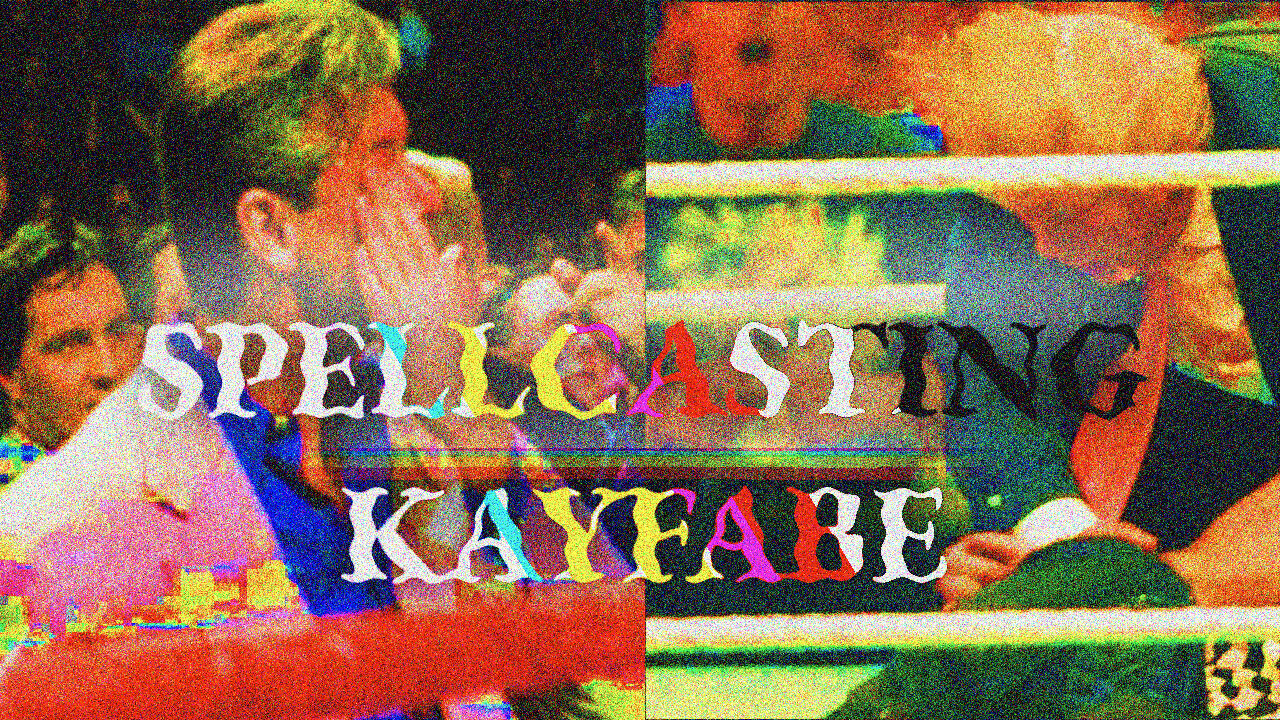

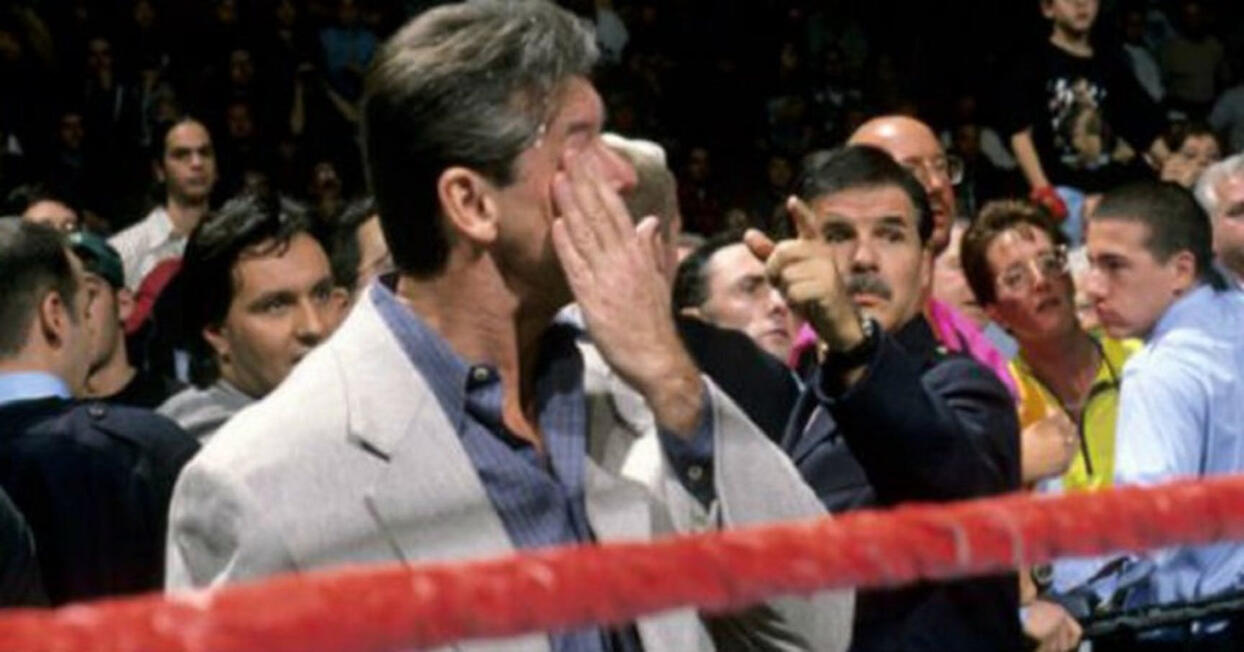
'Kayfabe' is etymologically difficult to pin down, believed to have originated as carnival (carny) slang (perhaps Pig Latin for 'be fake') before its famous adoption by wrestlers to indicate to one another they should maintain performance for the sake of narrative illusion. Two wrestlers who are best buds in real life but mortal enemies in the ring (or a 'heel' villain and a 'face' hero) would whisper this nearly-indiscernible 'nonsense' when a fan approached to signal a maintenance of performance. Therefore, it functions as an incantatory grammar - an utterance exchanged between fellow performers to conjure and maintain their collective glamour. Kayfabe is a spell. Kayfabe is a state of mind.
Why are we talking about wrestling?
Honestly, I don't know much about the subject beyond what we will discuss in a moment (here, my friend helped frame some of my existent thoughts on kayfabe). When I was six-or-so, I pinched myself on the opposable joint of a newly-bought Undertaker figurine which operant conditioned me from wrestling for decades. Otherwise I might have believed the façade, if only for a moment (give me a break, I wanted to be a Power Ranger). Nonetheless, even grown adults around me would wonder how much of wrestling was real. You can't argue with the blood, the violent perspiration and feats of aggressive agility. When The Undertaker (Mark William Calaway) threw Mankind (Mick Foley) off the top of the Hell in a Cell cage structure at King of the Ring 1998, Foley dropped sixteen feet (or two stories), dislocated his shoulder and jaw, lost and displaced his teeth, suffered bruises and punctures and was left briefly unconscious before standing up to return to his boiler room dwellings to convalesce alongside his pet rat George (actually he got up and fought for another ten minutes: the rat is part of the character).
Faith in the magical architecture of the ring was fractured in 1996 during the Madison Square Garden 'Curtain Call,' when a group known as The Kliq (Shawn Michaels, Triple H, Kevin Nash, and Scott Hall) broke kayfabe in front of a live crowd, embracing one another in a display of fair-well - as Nash and Hall were leaving for a rival faction. Without them knowing, a fan had recorded the interaction with a smuggled camcorder. After the footage circulated, the curtain was pulled back definitively. The following year at Survivor Series 1997, the friction between fiction and reality boiled over.
For decades, Vince McMahon had upheld a friendly play-by-play announcer role. McMahon's father had established WWF (later WWE), making Vince's promotional role for the company an act of nepotism. Later, he would become a temporary in-ring performer (even awarding himself the WWF Championship), and chairman, CEO, and executive chairman of WWE before permanent resignation in 2024 following legal allegations. For now, let's go back to the Survivor Series 1997, when Bret Hart refused to relinquish his championship to Shawn Michaels because Vince McMahon had changed the script without Hart's knowledge. Hart retaliated by going off-script to spit directly into McMahon's face on live television. Here, character and actor merge to attack the writer and director: the saliva spat from creation back at architect a profane inversion of Promethean fire.
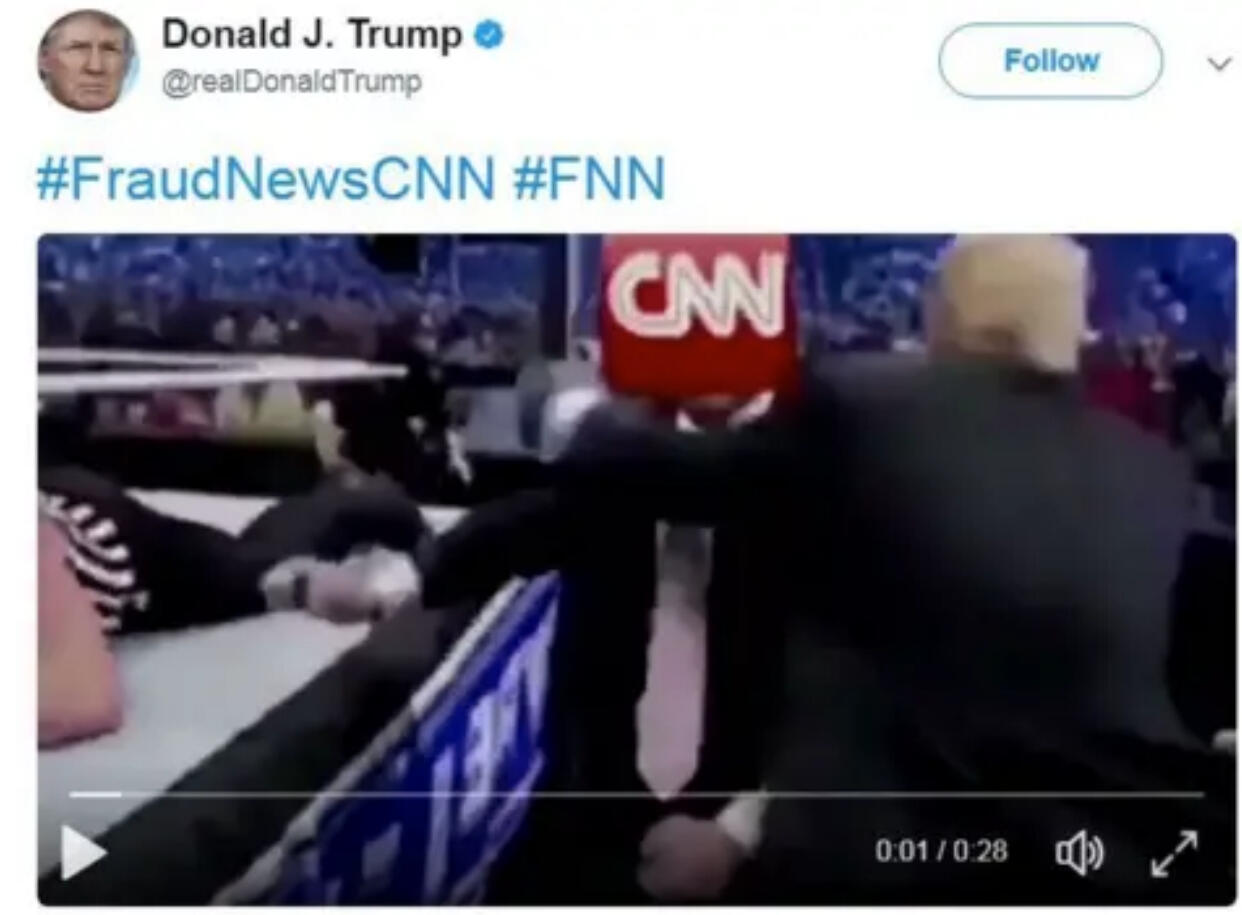
With this, the term kayfabe gradually lost its mystery as it entered popular vernacular. The spell had been broken, so a new spell was cast. Now politicians openly engage in kayfabe in this dual-reality 'neokayfabe' era. Abraham Josephine Riesman (2023) coined the term to define the reality-distorting response to kayfabe's exposure. McMahon (and wrestling as a whole) evolved to survive, incorporating its meta-fiction into the text, mixing truth with lie - faking reality - and so paving the way for contemporary Republican strategies for campaigning and governance. Did you know Trump was inducted into the celebrity wing of the WWE Hall of Fame in 2013? Did you know that as of 2025 Linda McMahon (Vince's wife) serves as the U.S. Secretary of Education in Trump's administration? The 'conman' - 'confidence man' - uses deception and psychological manipulation to scam. You can find them at carnivals, in the ring, on social media, in the White House, and at Downing Street, where bread has been replaced with protein powder, circus with carnival.
Why aren't we talking about wrestling?
'I love pro wrestling, but I fear neokayfabe. It turns the world into a hall of mirrors from which it is nearly impossible to escape. It rots the mind and eats the soul. And yet, we cannot return to the world of old kayfabe, either — we know too much. Perhaps the only antidote to neokayfabe is radical honesty. It’s less fun, but it tends to do less material harm, in the long run.'- Welcome to Neyokayfabe, by Abraham Josephine Riesman (2023).
REFERENCED MEDIA
Breech, S. (2024, September 28). WWF - The Kliq Curtain Call at MSG 5/19/1996 [Video]. YouTube. https://www.youtube.com/watch?v=tgIAiOMZXJYBBC News. (2017, July 2). Donald Trump posts CNN wrestling video on Twitter. BBC News. https://www.bbc.co.uk/news/world-us-canada-40474118Goldman, A. (n.d.). Wrestling with Trump: The nature of kayfabe and its broader applications. Religion in Praxis. https://religioninpraxis.com/religioninpraxis.com/wrestling-with-trump-the-nature-of-kayfabe-and-its-broader-applications/Independent Digital News & Media. (2015, December 15). 6 ways Trump used world wrestling to hone his brash campaign trail persona. The Independent. https://www.independent.co.uk/news/world/americas/6-ways-trump-used-world-wrestling-to-hone-his-brash-campaign-trail-persona-a6787976.htmlLiptak, K. (2024, November 19). Trump nominates Linda McMahon for education secretary. CNN. https://www.theguardian.com/us-news/2024/nov/19/trump-nominates-linda-mcmahon-education-secretaryRiesman, A. J. (2023, February 26). Welcome to neokayfabe. Josie.zone. https://josie.zone/welcome-to-neokayfabeRiesman, A. J. (2023, February 26). The best way to explain the G.O.P. is found in the W.W.E. The New York Times. https://www.nytimes.com/2023/02/26/opinion/vince-mcmahon-wwe-trump-kayfabe.htmlThe Independent. (2015). Donald Trump's WWE history [Video]. YouTube. https://www.youtube.com/watch?v=5NsrwH9I9vEWWE. (2010, November 23). The Undertaker throws Mankind off the top of the Hell in a Cell: June 28, 1998 - King of the Ring [Video]. YouTube. https://www.youtube.com/watch?v=9hMp65SzyTUWWE. (2013). Donald Trump enters the 2013 WWE Hall of Fame Induction Ceremony [Video]. WWE. https://www.wwe.com/videos/donald-trump-enters-the-hall-2013-wwe-hall-of-fame-induction-ceremony

IUIOIUI: LIMERENCE
I?
U! I...
- O -
U... I!
I?

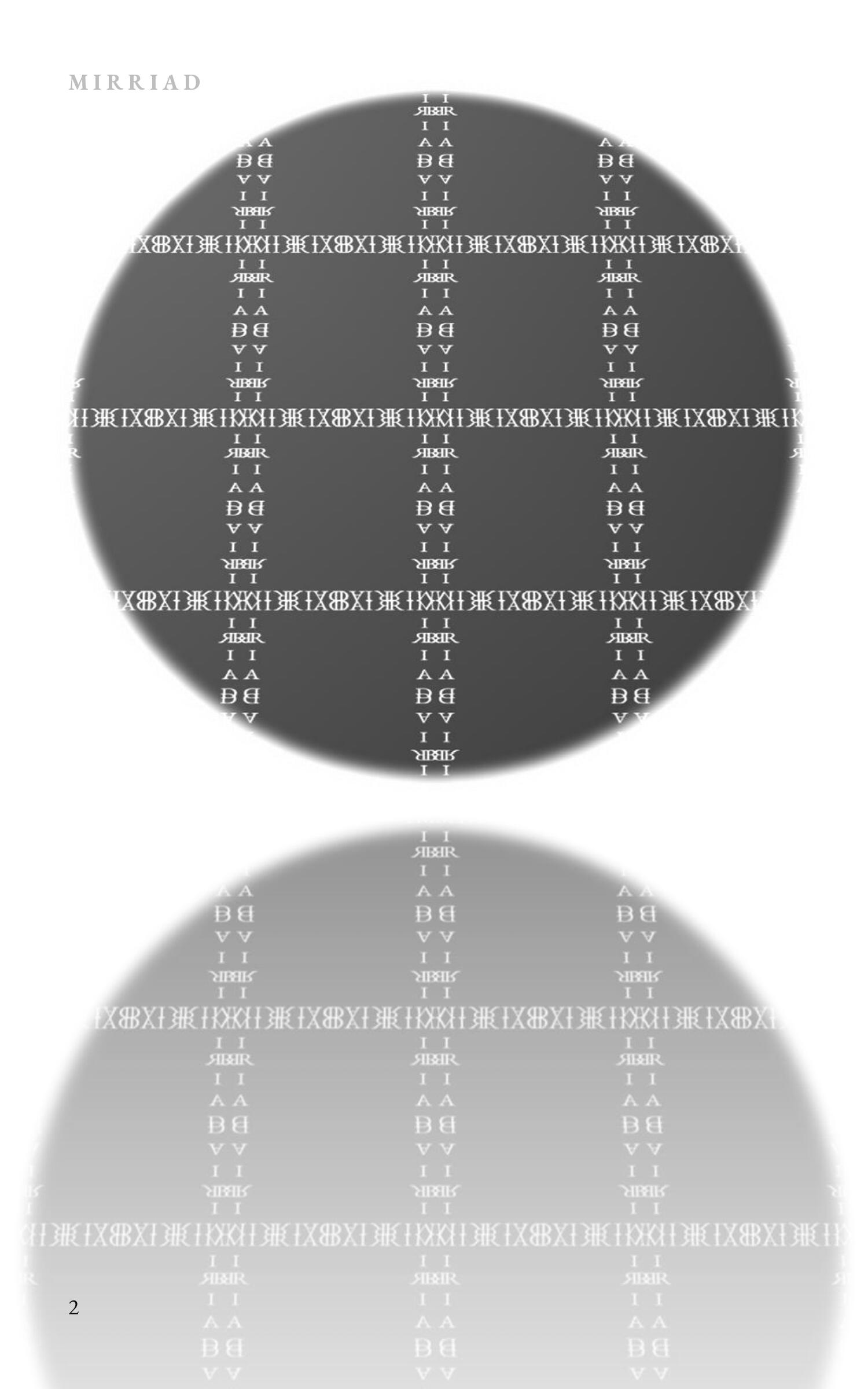
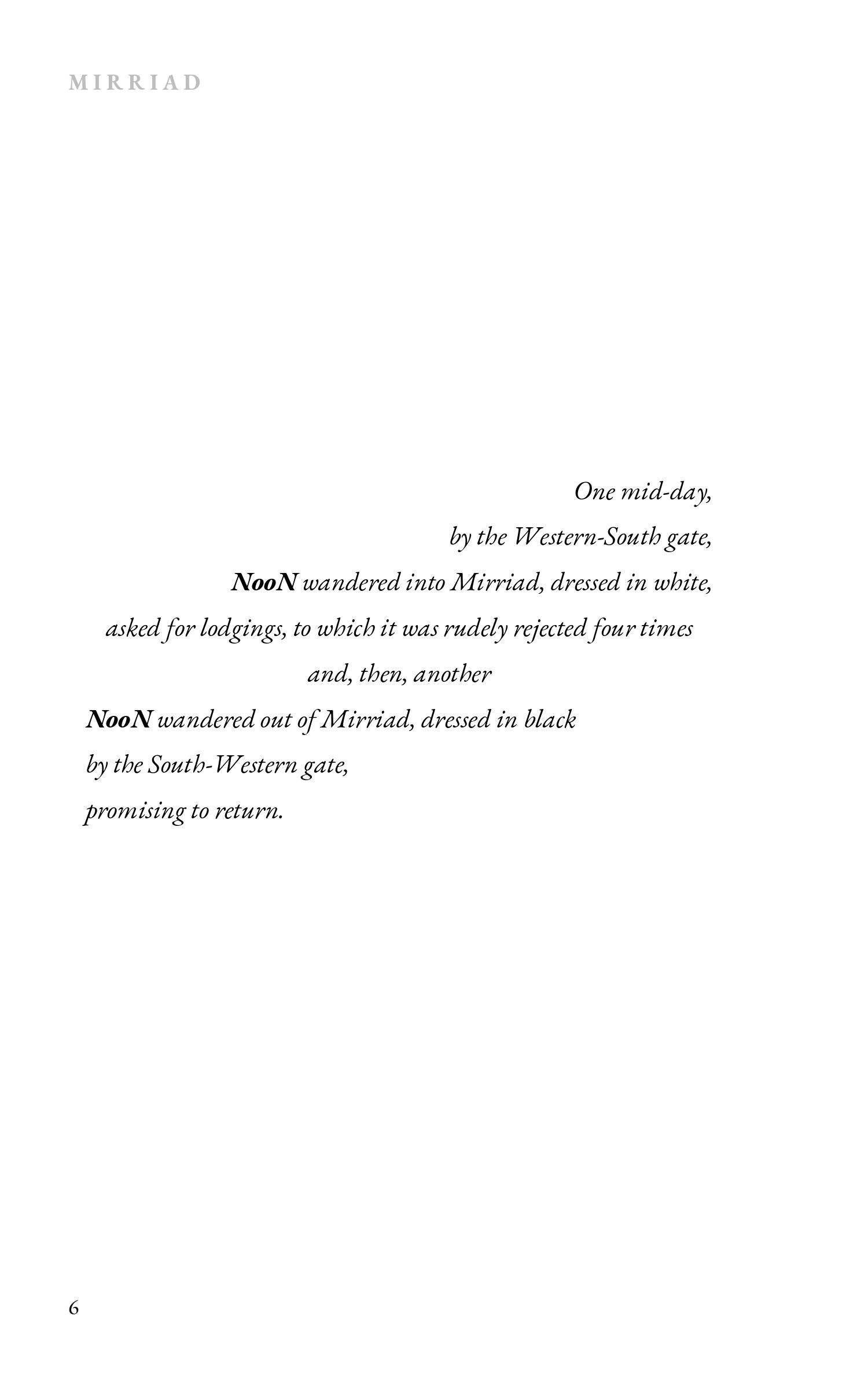
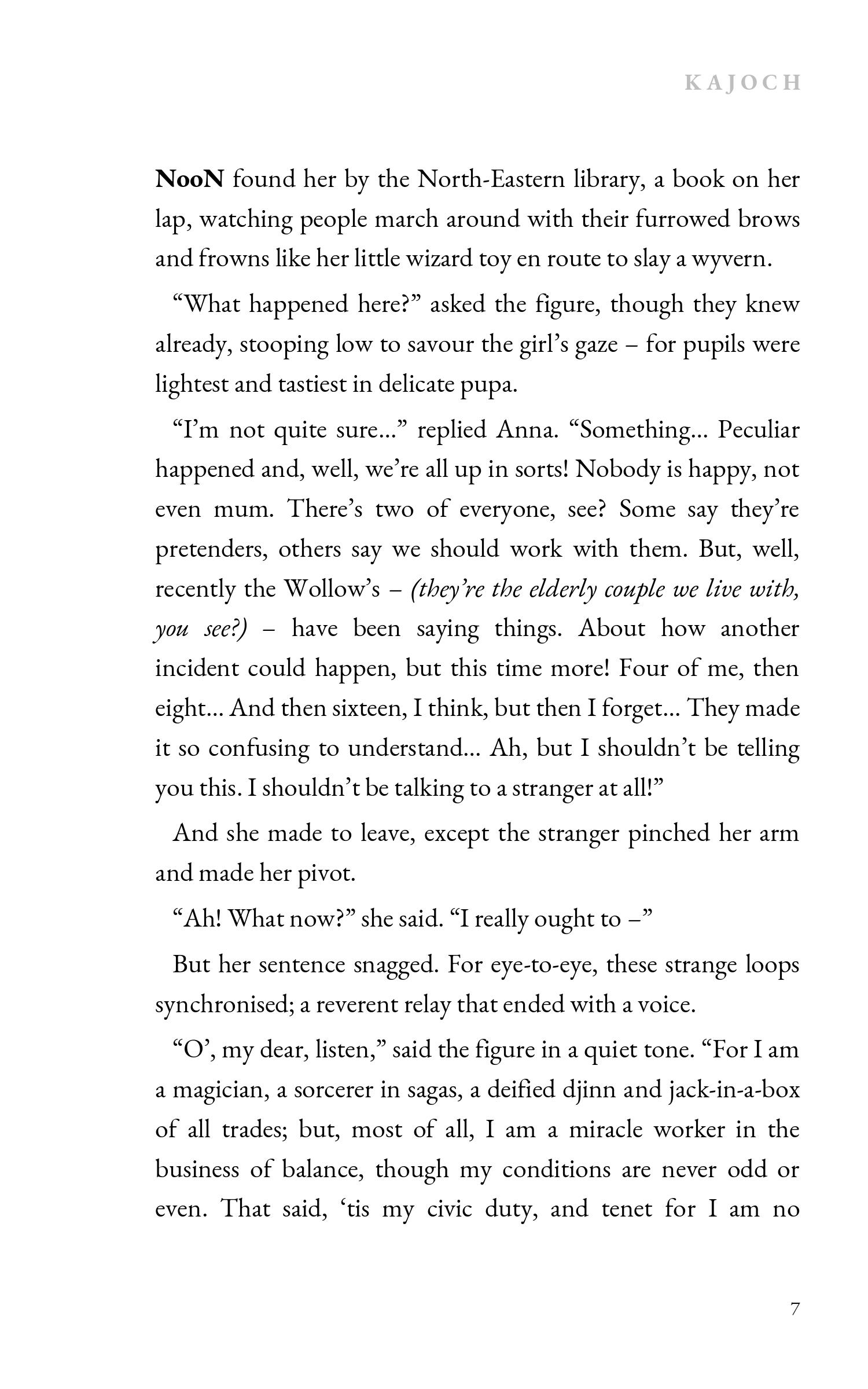
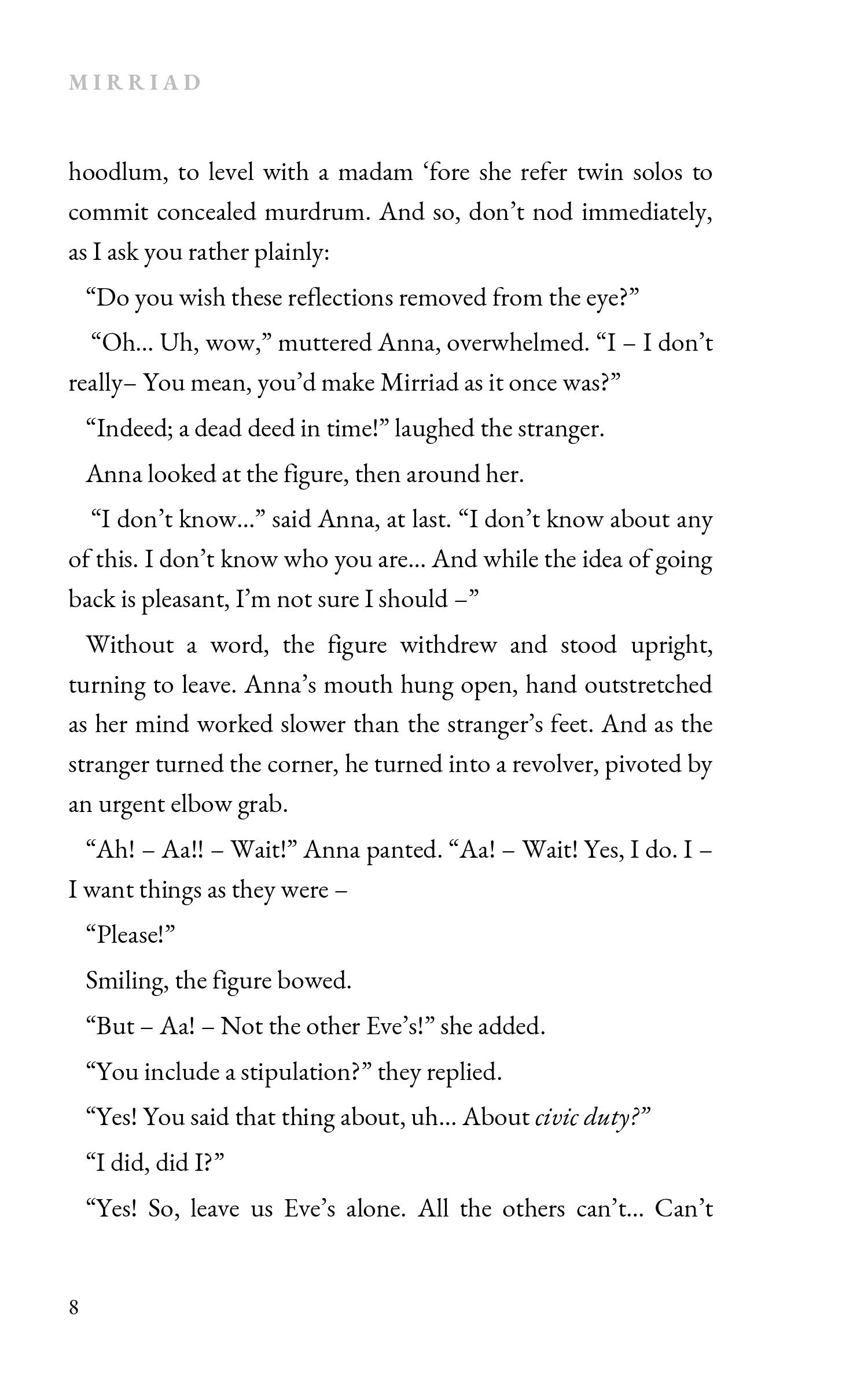
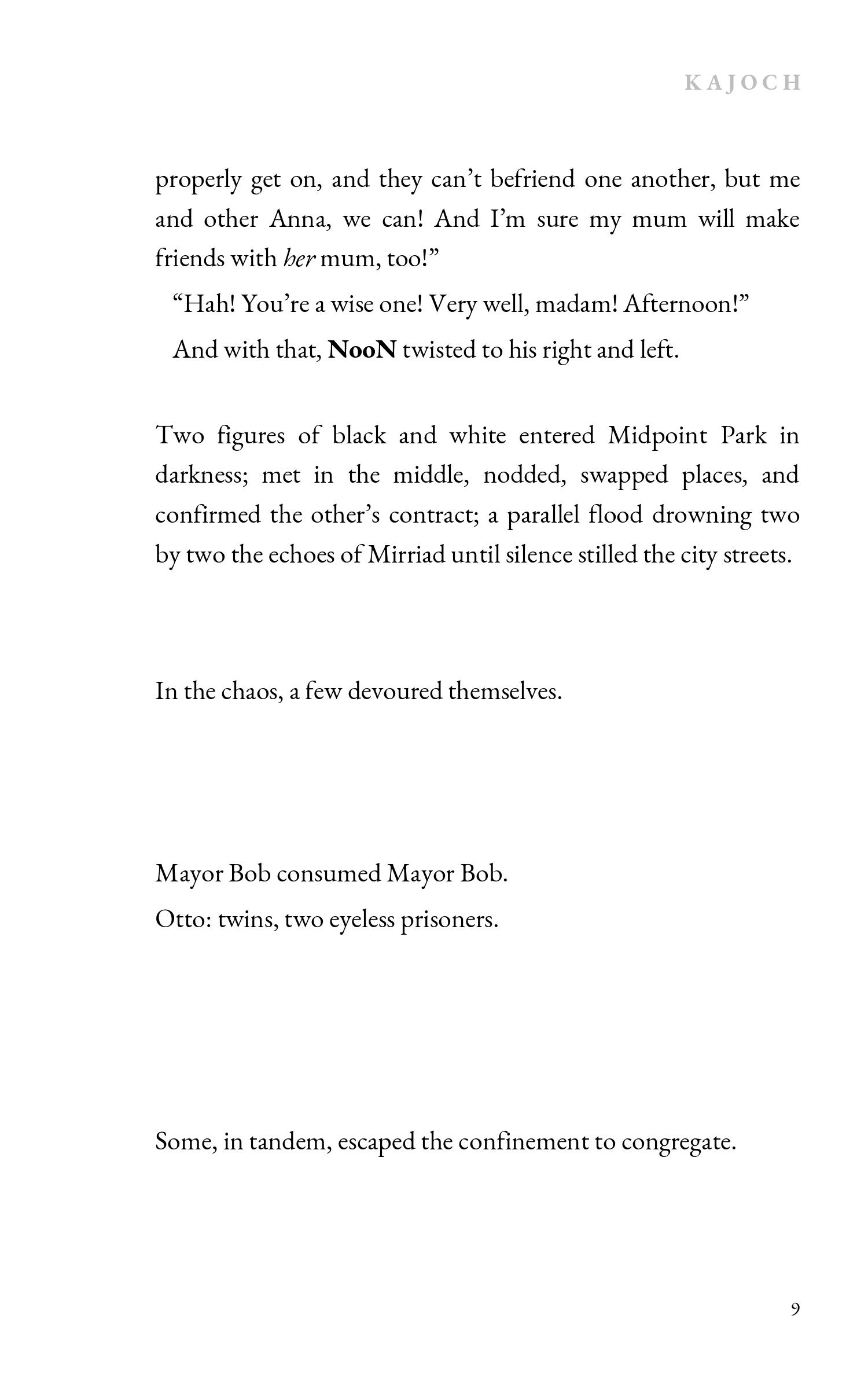
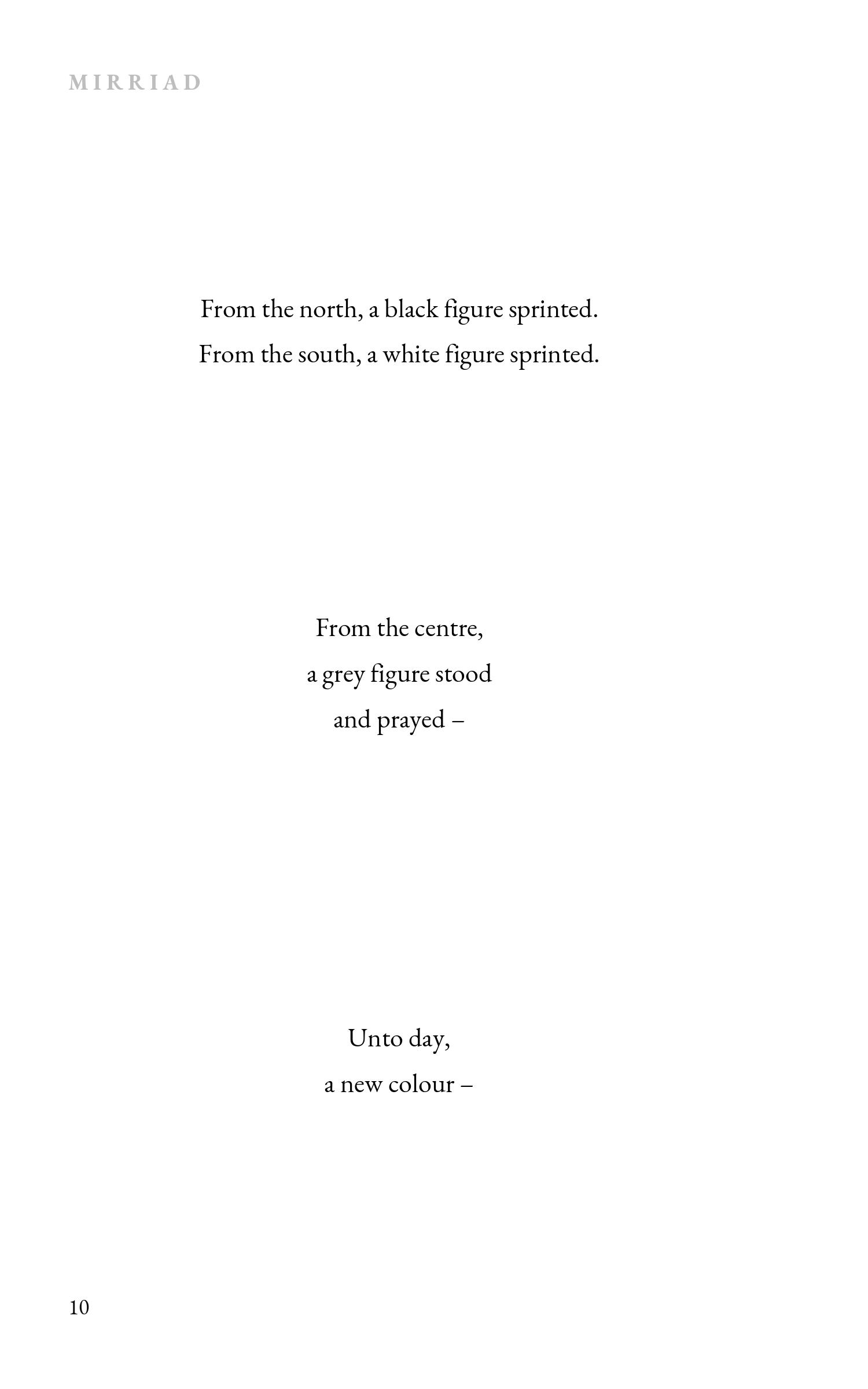
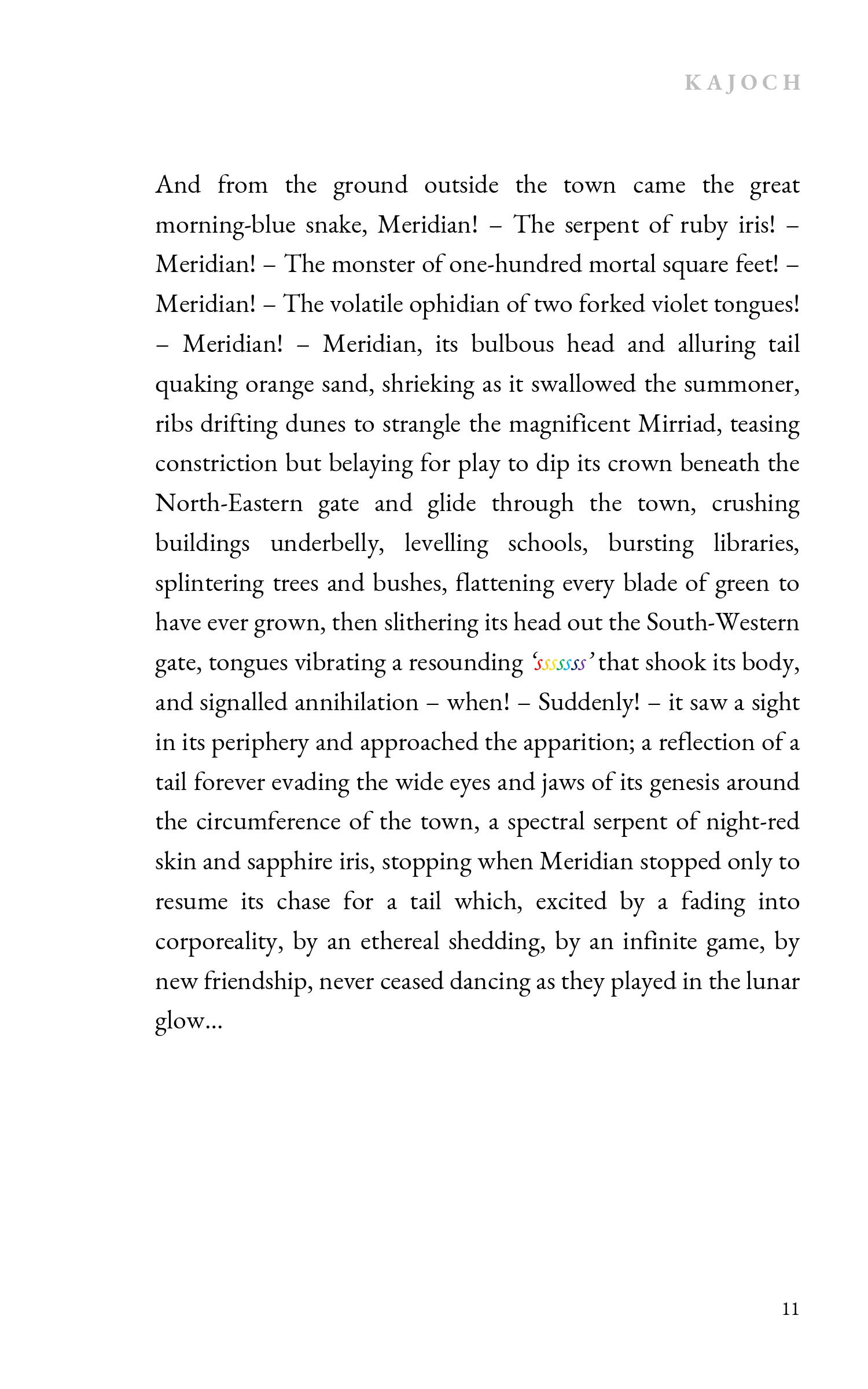
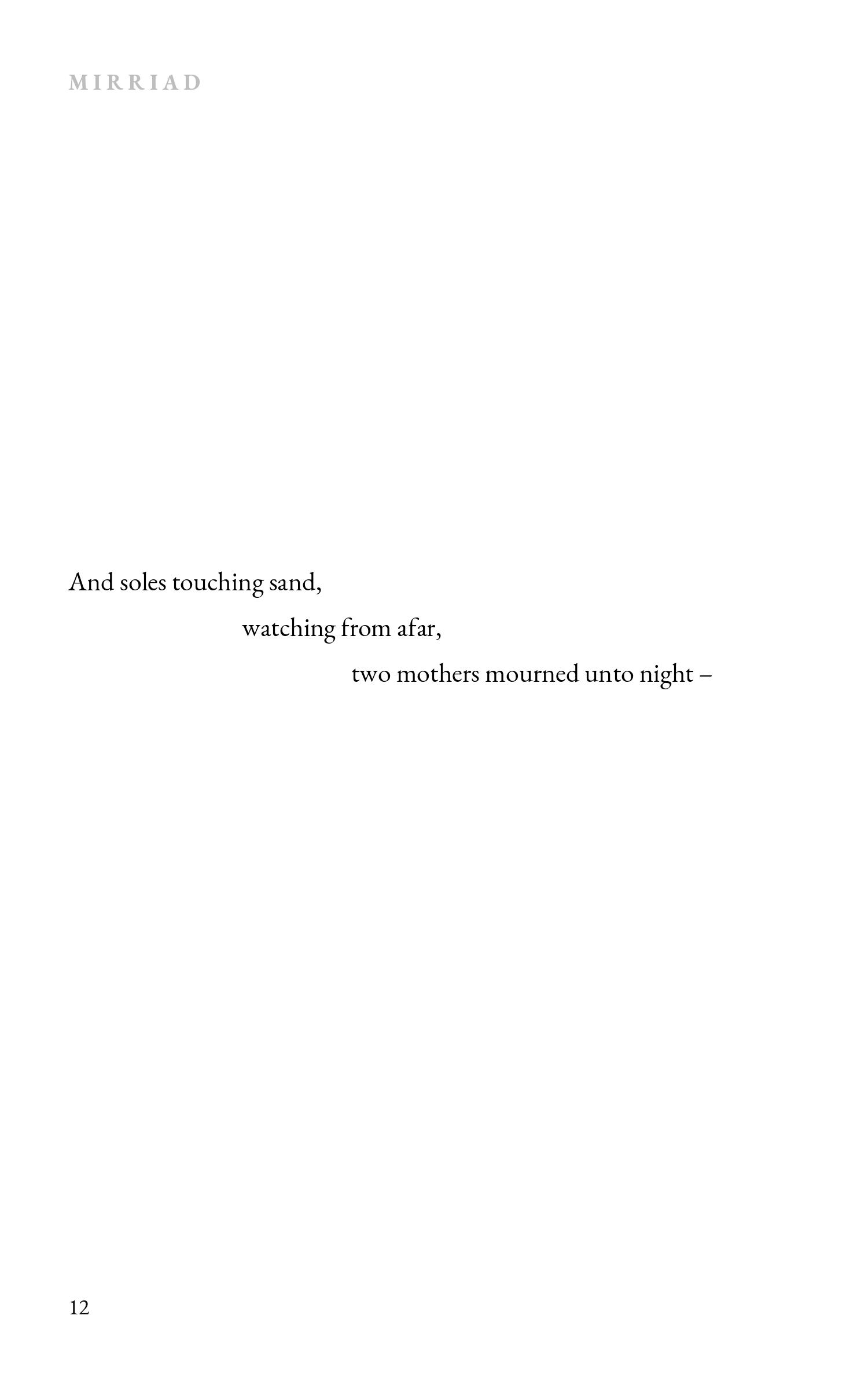
MIRRIADMirriad is somewhat of a eulogy for my little sister, Anna. I wanted to bridge the emotional distance between where I am in 2023 and where she was in 2008. It was inspired by the oulipo movement, particularly Calvino’s Cosmicomics, Invisible Cities, and Numbers in the Dark; all of Borges’s work; psychoanalysis, topics like symbiosis and symbiotic interactionism; Rorschachian Klecksography; Biblical narratives like Noah, Babel, Lot, Eden, Cain; the short stories of my book, Deliriums; Alice in Wonderland, Coraline, Ariadne, Pandora; ouroboros and Norse serpent mythology; the double or doppelganger (particularly Russian); Douglas Hofstadter’s writings on isomorphism and strange loops in Gödel, Escher, Bach and I Am a Strange Loop; Faust, deal with the devil narratives, and Dead Papa Toothwort from Lanny. I wanted to keep it short and structurally symmetrical, with an emphasis on depth within breadth – that is, subtextual complexity within a fairly swift and simple tale. More than anything, it (and all the items in my portfolio, if not my career) concerns itself with relativity.
- 08/11/2022

WE ARE MORE SIMILAR THAN DISSIMILAR
Exploring a Vegetarian's Views on Empathy Towards Animals
(or, a Candid Interview on The Links Between Human-Animal Interaction and Psychological Wellbeing)
Conducted by S. Stanczyk (04/05/2026)

AbstractThere is a rise of vegan and vegetarian lifestyles for reasons such as a greater empathy towards animals and awareness of the cruelty of the animal industry. Cognitive dissonance is a factor to why meat consumption continues despite the individual’s knowledge of the mistreatment of animals. The study explores how cutting meat products out of one's diet can influence psychological wellbeing and empathy for animals.
A semi-structured qualitative interview and thematic analysis was used for gathering and analysing data. The participant is a British person (aged 29) who has been a vegetarian since 2018 and has had a pet gecko since 2017. Themes constructed were: relative experiences and connectivity (non-human, non-meat eaters, passive meat-eaters, and active meat-eaters) and influences (media and people).
Introduction and RationaleThere is a growing interest of vegetarian and vegan lifestyles in the UK (Kaminski, 2020), with 4.5% of the UK population engaging in this lifestyle (Vegetarian Society, 2022).
Vystopia concerns the distress vegans face living in a world revolving around the consumption of animals and associated cruelty. Cognitive dissonance (Festinger, 1957) is mental distress caused by individual holding two or more conflicting inconsistent beliefs. Leading to what Bandura (2002) calls moral disengagement theory where individuals shift locus of control to allow them to participate in harmful behaviours without guilt. This may explain why in Graça et al (2014) study, participants felt guilt and responsibility for animal and environment welfare but weren’t willing to reduce meat consumption.
Some research shows a link between emotional and social benefits and veganism/vegetarianism; but there is also evidence of deficit (Campbell, 2025; Cornish et al, 2025; Fazelian et al, 2022; Iguacel et al, 2021). Apart from awareness of animal cruelty, non-meat-eaters may experience distress due to social stigma and discrimination (Mahdavi & Hatami, 2023), and downplaying of identity (Fordonnell et al, 2024). Higher activation in empathy related brain regions have been found in vegans/vegetarians compared to omnivores as well as scoring higher on empathy related tests (Filippi et al, 2010). Higher empathy correlates with a higher depression risk when individual feels powerless (O’Connor et al, 2007). So ‘exploring a vegetarians view on empathy towards animals’ may provide insight into how psychological wellbeing is linked with empathy and lifestyles.
MethodI will be conducting my research using a qualitative semi-structured interview. I have 10 pre-set questions, so I have a structured basis for exploring themes but compared to a structured interview I have flexibility and adaptability (Mashuri et al, 2022) to follow up, to understand deeper the motivations of my participant’s beliefs and behaviours. I will be analysing data using thematic analysis and using Braun and Clarks (2006) 6-step method (familiarising myself with data; generating initial codes; searching for themes; reviewing themes; defining and naming themes; producing a report) which emphasises theoretical transparency for rigour and credibility (Ahmed et al, 2025).
The participant is a 29-year-old British person who has been vegetarian since 2018 and had a pet gecko since 2017. The participant is my partner. One of the issues with investigating psychological wellbeing is the non-strict definitions of non-meat-eaters. Flexitarians, for example, may have different values and attitudes to strict vegetarians (Cramer et al, 2017). Therefore, the participant chosen is a strict vegetarian, with no interest in integrating meat back into his lifestyle; however they have considered adopting a vegan lifestyle in the future.
Exemplar interview questions include:
1. How does owning a gecko influence your feelings of empathy towards other animals?
2. How have your attitudes towards animals have changed since becoming a vegetarian
3. Can you describe the most difficult social struggle you have faced for being vegetarian?
Ethical IssuesAnimal rights are a serious topic matter and may lead to distress when being asked about. Difficult personal experiences associated with vegetarianism risks emotional distress to the participant. I debriefed my participant on the nature of the study and outlined questions that will be asked. We discussed that they can withdraw at any point and they choose how much detail they’d like to go into with answering, as their comfort is important. I emphasised this when asking for their participation in my study; right before the interview took place; and after the interview concluded. There is also concern to the fact that the participant is my partner, the relationship may have affected data as during the interview it is possible for information to be omitted as it may be something I know already. I may ask follow-up questions to answers I feel possess potential for further insight.
Analysis and DiscussionRelative Experiences
The participant talked about multiple key points pertinent to the discussion of animal rights. Whereas typical discussions may involve a back and forth between vegans/vegetarians and meat-eaters, non-human animals are disregarded due to not being able to communicate through human language, though they communicate nonetheless. Before slaughter, animals (in reference to lobsters) ‘squeak, they squeal and they try to get away [from the hot water]’ because we forget (or deliberately choose to ignore) the unique, subjective perceptual experience: the 'umwelt’ of animals. This causes psychological distress, or ‘horror’ in vegan/vegetarians as they are aware of this ‘othering’ to the point of taking action.
It's so inherently horrific to even ask a question that disturbing - Obvious to the point you wouldn't even use it as a horror writer because its hackneyed and feels played out to ask,
‘But what are they doing with the brains?'
Meat-eaters may be divided into what I would like to propose: passive eaters (acknowledging the ‘horror’ of the meat industry but continuing meat consumption) and active eaters (disregarding realities whilst taking pleasure out of the lifestyle and acting offence to non-meat eaters). The participant described (passive) meat-eaters to ‘balk’ and be ‘flighty, touchy, upset’ when confronted with the idea that eating meat is immoral. Rothgerber (2013) found vegetarianism is often seen as un-masculine which could lead to social marginalisation. Though the participant reported only feeling this sentiment online this shows how non meat-eaters may be discriminated against to uphold active meat-eaters’ set beliefs.
'I’ve noticed, perhaps, a correlation between red blooded, red-meat eating Reds… And conservative values.’
Psychological wellbeing is promoted when an individual does not experience cognitive dissonance. Though empathy can be a ‘double-edged sword,’ shared experience between all types of animals promotes benefits of relatedness (Zhang et al, 2025). Though more research should be done in how individuals can recognise and tackle their own cognitive dissonance, empathy and making of deliberate associations may be linked with this. ‘[...] you have to uphold [cognitive dissonance] to continue eating meat, to break it is like [opening] a gate, and the key is the right thing that finally makes it click [...]’Influences
Extrinsic influences are important for people choosing a meat-free lifestyle and for developing their attitudes and beliefs towards non-human animals, either by creating psychological discomfort or promoting sympathetic thinking. Most cultures are meat-eating by default so pro-vegan ideas are a counter to already widely held beliefs. Some of the influences from media that the participant mentioned were: ‘Thomas Fagels’ (1974) ‘What Is It Like To Be A Bat?’; ‘Lisa the Vegetarian (Cohen & Kirkland, 1995); ‘Paul and Linda McCartney’; ‘Pokémon’.
‘…it’s an interesting society, at least in Britain, where Nintendogs sells out but people still wonder if dogs have souls – all the while trying to replicate a dog’s soul digitally…’
Though it does put into question (for we have resources, media, people, who provide a plethora of reasons why animals should not be tortured for our benefit): what is the sequence of steps required for the recognition and prevention of animal suffering? This may begin with an active communication between meat and non-meat eaters. Meat consumption has been found to be lowered when there is a non-meat eater in a social circle (Vandermoere et al, 2019).
Future studies
Discourse Analysis (Potter & Wetherell, 1987), particularly Foucaldian, will be an appropriate method for investigating this topic further as language is currently a part of the subjugation of animals. Animals are excluded from discussion of language and power and are not active participants in their social construction (Stibbe, 2001). In the English language we use words like beef or pork instead of cow and pig. Studies into the influence of individual mental representations can then affect actions. Van Dijk (1997) calls these ‘social cognition’ which is what will influence products people buy. Alternatively, focus groups could be used to collect data reflecting similar/dissimilar understanding of social constructs between both meat and non-meat eaters.
‘…until the boffins in the Science Factory tell people that creatures show love, or fear, or pain, or horror…
[It's like...] Until we can humanise them, we can’t love them. Until we can know they have intelligence, they’re not worthy of our respect.’
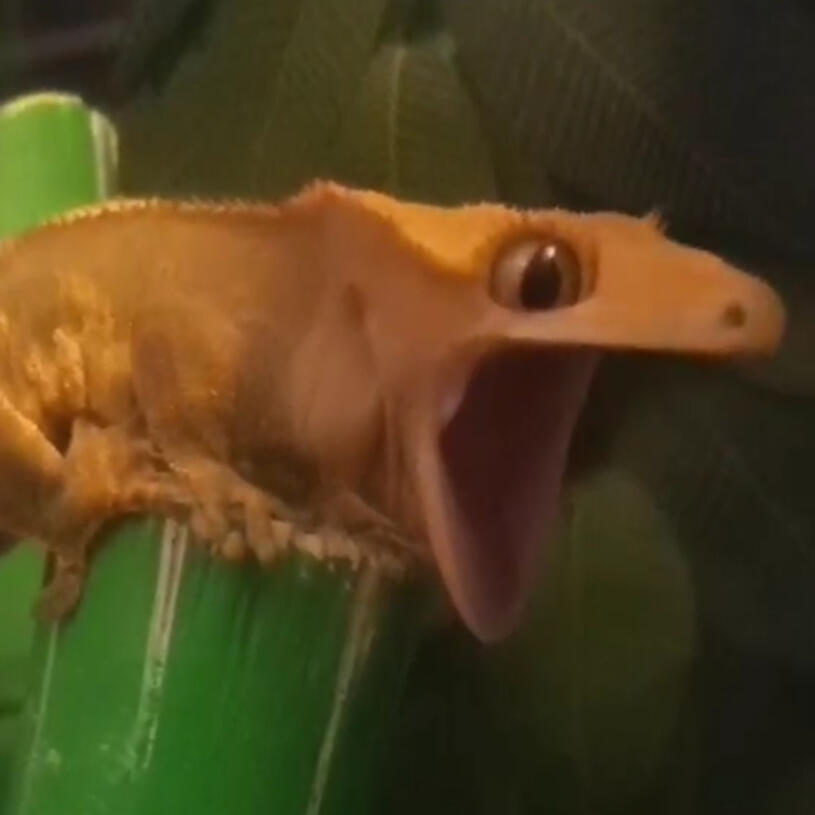
The InterviewInterviewer: In what ways does owning a gecko impact your day-to-day life?Kaf: So, obviously a crested gecko is smaller than the common pet, and I take care to not hurt insects if I see them even. I like dogs and I like cats but having a crested gecko in my life permits me the ability to value the lives of creatures with smaller dimension or personalities. I aim to place a good amount of value to animals of all sizes and types and souls. Feeding him and taking care of him, giving him water, is enriching in a way that's quite difficult to immediately communicate. It’s not as profound as - As... It reminds me of my place in the universe, how small I am. Because his house, his environment is quite large for him and he's always out and exploring it and when he looks outside his viv he sees my bedroom, my vivarium and then outside my bedroom is all our vivarium and there is this sense of micro-macro empathy that goes there. You can take it as far as aliens or God if you keep going upwards and you can take it to the granular level, I'm not quite obsessed with microbiomes or red or white blood cells as much I am with geckos but yeah everything is important. As above so below. Gecko represents that. He’s also cute, very cute. And has a magical realist quality to him. The Harry Potter and the Goblet of Fire film has a moment where the titular character gets given a small dragon which has been miniaturised and the first time I saw a crested gecko I genuinely couldn't believe it. I've seen - Most of the CGI I’ve experienced looks more real at times than Gecko does. I've gotten used to him to a degree, but every now and then I'll catch him in the right light and I'll be reminded that there’s my - What a Christian may call design or simply a nature enthusiast would call beautiful... Beauty. That there are creatures out there, like Darwins’ Finches or the Paradise birds or drill beak stalks - Drill bill stalks - No... Shoe-bill storks! Or even aquatic or underwater creatures that are so alien and unusual and if you're able to sympathise with the alien or the other, I feel it makes you a more well-rounded individual capable of understanding different paradigms. Not just from the side of the animal, such as in the case of Thomas Fagels’ ‘What Is It Like To Be a Bat?’ essay, which expanded the minds in many people to wondering how much individual personality or behaviour each species exhibits via their own personalised umwelt. But yeah, day to day: Gecko make me feel good. [laughs]Interviewer: [laughs] For the next question, could you explain how your empathy is linked with your psychological wellbeing.Kaf: Much like how ignorance is bliss. Having too much empathy or sympathy can feel like touching a live wire. Sensitivity is linked heavily to the central nervous system, nervousness, and all manner of mental disorders can actually come about from feelings of sympathy and empathy. Or growing emergent despair, associated with breaking down that ignorance and subsequently robbing yourself of the bliss. But I think that as long as you can develop... If not coping mechanisms, then approaches to life or circumstances that can offside the emergence of knowledge, or what people call woke, or whatever. Then I think it's to a person's overall benefit that they attempt to connect with other human beings, creatures, animals. Things that aren't there, thing that are there. I think a world where we decide to not continue connecting is a world of nihilism. So, its a double edged sword. But overall, especially as someone who tries to be artistic, I or, even to engage in the arts, I feel it's better for your critical faculties and I feel like there is more benefit to trying to understand other people and animals - than there is to not.Interviewer: Have your attitudes to animals changed since becoming a vegetarian?Kaf: So, I didn't eat too much meat in the first place because I always felt something was wrong and I was sometimes incapable of dissociating, even though it was called a burger, once I was made aware that it was a cow, I found it hard to maintain that level of cognitive dissonance. I always hated fish because you saw them laid out as they are, with their eyes, and all that. I always struggled with things like pigs, because I’d see decapitated pigs heads in butcher windows when I was a kid. Um, and so, by the time I became vegetarian my meat-based diet comprised basically of the annual McDonald burger, chicken balls from the Chinese, meatballs from the tin. I even went off some things like chicken nuggets, which Quorn restored my love off because there's no downsides as each nugget is basically the same. But there were a few instances, side by side. Least of all: adopting Gecko and caring for him - but a number of instances side by side - But the one that really jumps out at me: is the first time I questioned what they do to the majority of animals brains. I know it's a silly question in a way, but I just perhaps too late, realised they have brains and nervous systems, much like me, and we are more similar than dissimilar: cow, and pig, and me. And the switch was actually not hard to flip at all, that's one of the most remarkable things. The build-up of years and years saying I will be a vegetarian but doing absolutely nothing about it, just striving off the cognitive dissonance. All of that wasn't hard either, it was just annoying I wasn't doing it yet. But the moment that the cognitive dissonance breaks. The moment that you reconcile what's happening you don't even need to watch a gory documentary. If you reconcile with what's happening: that the food you're eating is carrion, the carcass of animals, desecrated corpses.Some people of course, don't care, and that's fine or they take a joy that in eating corpses, which I find peculiar because I never had that. Once I fully committed to recognising what was on the plate - I - I certainly felt like when I approached animals, I could now... Fully look them in the eyes, and they knew I was on their side. And I never ate cat, never ate dog, but every cat and dog I interacted with prior to being a vegetarian, I still loved them, treat them right, pet them, but I also knew that in other places of the world, they were the equivalent pig. There are places where people eat gecko. I remember seeing ‘An Idiot Abroad’ episode featuring Karl Pilkington where they went abroad somewhere where they had geckos on a stick. And when I was holding my crested gecko, I remembered that and was shocked. I was liked Oh my God, yeah, there are some places that don't eat pig, don't eat cow, you've heard it all before. But what this all indicates is that your dog or your cat is just environmentally not food. Oh - And pigs can play Street Fighter apparently: they can do combos, they can commit combos to mind which I - I - I’m shit at fighting games so a pig might be able to beat me in Street Fighter?Interviewer: And I've seen cows being able to paint before.Kaf: And there’s birds and all of what they can do. And then people are wondering, "Can cats and dogs have feelings?" still. And then books I've read on octopi - octopuses - octopi isn't actually a real word, it's octopuses. I want it to be but it isn’t. The books I've read on octopuses -Interviewer: Octopuses, yeah.Kaf: Yeah, octopuses. Octopuses are - They really wake you up because there are people I encounter in my day-to-day life that wouldn't be able to do what some octopus do. [laughs].Interviewer: [laughs]Kaf: Next!Interviewer: How have your attitudes towards humans changed since becoming a vegetarian?Kaf: I did kind of cover that but - I guess I don't hate meat eaters. But I do dislike joyous meat eaters, the ones that take - Or vegetarian haters, that kind of force. Where they're actively violent, I guess. Because there is a violence to eating meat, preparing the food, dicing them up. But, you're on the softer end of a spectrum of violence afflicted against animals. When you are angry at a vegetarian for not wanting to do something... [pause] It’s impossible if you turn vegetarian to not then fully open your eyes to the propaganda machine - Like, meat advertising which, you know, is particularly egregious when held up in light of what some vegetarian haters say ,which is, ‘Don't shove it down our throat’. I've heard about PETA like 10 times in my 30 years on this planet, but people make it out to be like they're the worse thing ever. They've done some stupid shit but the meat industry's done some evil shit - What I would qualify as evil.Interviewer: What do you think of people who've turned vegetarian, for a while, and then decided against it?

Kaf: Oh. That's a matter of many things. It could be a matter of willpower, personality change. Depends on why they decided to become a vegetarian in the first place. If they were raised vegetarian, and then turned to meat? That’s a whole other thing. It's like a world unexplored that they're trying to figure out.Interviewer: In certain parts of India, that is actually a thing, where it's seen as a more progressive thing to eat meat because its the counterculture to what you've grown up with.Kaf: Yeah. Exactly. Yeah, if you're eating meat as a statement, there's a level of petulance to it. If you're there for taste: Quorn and stuff, is there, and will be in greater quality and quantity with time. Um, vegetarians that changed... I think a large part of it is a matter of willpower or intent. I don't actually have the inclination to eat meat, it's deactivated from my brain. I see a burger advertised at McDonalds, and think: "Oh that's been engineered to look obviously tasty." Um, but I don't salivate, I don't actually get hungry because I know its not a meat alternative. I think interestingly there's a connection there, at least for me and my developmental history, there's a connection between this and with the way I view, um - Conventionally or stereotypically attractive people, despite their personality or not knowing their personality. I can see a burger advertised and understand its well-dressed or looks tasty, gourmet - Or whatever. But, it is doesn't hold an immediate appeal. Like I don't need to exercise willpower regarding vegetarianism, it's all natural. So, if someone's actually needing to exercise it, that's a whole other thing I can't relate to but I can sympathise - Empathise - No, sympathise with it.Interviewer: Thank you. So, you have sort of covered this, but could you explain three of the most important reasons for your decision to stop eating animals? If you want to go into what influenced you: people, shows...Kaf: Loads of things throughout my life kept telling me to fully commit to the idea so I can't point to an easy three [pause]. Like all of the signs were there, like everything makes it make sense. You can point to Lisa the Vegetarian, an episode from an early season of The Simpsons, featuring Paul and Linda McCartney. You can point to the time I held a chick at a farm, and it was really cute, small, and fluffy. A dad from another kid made a joke about it being tasty, I thought, and I looked at him and he wasn't joking. And I was like wha - Why are you like this? It isn't even a fully formed chicken right now, we don’t eat chicks. So why are you exerting - You're exerting something but like why? And why are you ruining the moment? There is a degree of like - you know - "Welcome to the cold, hard, real world," to that type of person. Like yeah we eat animals, but we don't have to gloat. This chick could have died in bed surrounded by loved ones [laughs]Interviewer: [laughs]Kaf: [laughs] at a ripe old age. Not as a chick - that would be ridiculous. I think of the number one franchise in the world, Pokémon. It asks you to get attached to thousands of different little digital creatures, and people will ask for decades for all sorts of features. Let me ride them, let them follow me, let me pet them, let me feed them. Of course: let them battle to the death. But intrinsically, that speaks to a juvenile desire for familiarity. Literally, too, as in familiarity - having a familiar - like in the witch sense or whatnot. Like a connection to animal that is yours, and you are theirs and there's a romantic and hopeful quality to that. It does help you deal with the idea of death and whatnot, um - Yeah, it's like an interesting society, at least Britain, where Nintendogs sells out, but people still wonder if dogs have souls - all while trying to replicate a dogs soul digitally. And a couple of years ago, Tesco had a controversy concerning its illicit under-the-hood selling of horse meat as beef. People were outraged. That's fascinating as well. There's definitely a - If you spend time with an animal, you can't eat it but that's also not the case. I had an ex who had a mini farm in the back and they ate some of the eggs, and when the animals grew old, they butchered and ate them. And - And that’s crazy to me, but that also makes the most sense. I do have respect for fair-trade farms in that way, there is a way to do it.Interviewer: I wanted to follow up with another game that was recently -Kaf: Palworld.Interviewer: - big, Palworld, which is a sort of Pokémon but with more violence and killing.Kaf: Yeah, Pokemon with guns and farming and all that sort of stuff.Interviewer: Do you think that maybe this is a sign that were progressing more violence towards animals or more of a blip in an otherwise more aware society?Kaf: It's both a parody of the established genre of Pokémon, and shooting games, like Fortnite and stuff and it functions as that. There is a whole dedicated gamer base of people who like playing games like that. It's hard to put it within the context of the animal rights argument. Pokémon was easier to do, especially in the 2000s, it was a neater comparison, and PETA itself also made that comparison. So Palword does inherit the discussion. I guess I brought up Pokémon because people want to connect with creatures, living things, and maybe were not given the opportunity to do it. And so, you could argue that, I would argue that, maybe Palword is a further symptom, a metastasised inability to connect with the creatures around us. Because outside of Australia - Or more - Well places all around the world... We live in the middle of Britain so there isn't a constant functioning connection to animals or wildlife, I've barely seen any in my life. So Palword in places like New York City, or here - Maybe you could argue it is a further symptom of that dissociation or anomic detachment between us as citizens and animal-kind. And because of that detachment, shooting is less horrific. Or its just parodic fun. But it's also gross.Interviewer: In what ways do you communicate your meat-free lifestyle with people who do eat meat?Kaf: Just drop the line. Be like ‘check out these Quorn nuggets’, they try them and they're liars if they say they taste that different - Because I've ate a lot of chicken nuggets in my life and I wasn't born vegetarian. And, you know, taste buds are all subjective and stuff but they're also, uh, liars. Um, yeah so there's the offering part of it, I don't try to convince people. I can let them try to convince themselves around me and that's what seems to happen. They make excuses, they make arguments, I did it myself for a long time. Everyone's different, its like cognitive dissonance, which you have to uphold to continue eating meat, to break it is like a gate, and the key is the right thing that finally makes it click. For me it was a collection of things. But it was the brain comment as I said before that helped a ton. Just a simple innocuous question. But it was the fact that it was- It's so inherently horrific to even ask a question that disturbing - Obvious to the point you wouldn't even use it as a horror writer because its hackneyed and feels played out to ask, ‘But what are they doing with the brains?' And there's an answer there, I looked it up once, and there's all sorts. Just like they use the hooves of horses for Haribo's, or whatever, you know? Like all the body's used, but its that you use these phrases like ‘all of the body's is used’ or like ‘that's how the sausage is made’ - you use those phrases so much that you forget how the sausage is made and how all the body is used. That is horror. That is actually what horror is. To be a creature locked up in a pen and waiting to be smashed up and dismembered and broken apart, and reused and recycled like plastic bottles... [long pause] What was the question again? [laugh]

Interviewer: [laughs] How do communicate your passion -Kaf: Oh, yeah: how do I communicate my passion. Well, I don't go down that route of convincing, as I said before, because people immediately bulk, upset, they don't like to confront. That is the thing with cognitive dissonance, it exacerbates the likelihood for the person to get flighty or touchy or upset because they know they need to - They have these two ideas and only one of them can win.Interviewer: My next question would be, so many vegetarians report feeling social struggles for their lifestyles, would you like to explain any difficult social situations since becoming vegetarian?Kaf: It does feel like there are some people that make a point of acting out how much they love the meat their consuming, just to try getting under your skin or ruffle your feathers. I don't show it and I just sit there amicably, and I think sometimes they feel like they're a dick for it. Because - Well, they are. Yeah, I guess I was with a friend in Wasabi [a Japanese food chain] and he ordered calamari, which is like a squid tentacle whatever. Just seeing it in the box, was the most - It was an artful, beautiful thing. And to even think about it going down my gullet or like you know... Just the concept of a human shitting out an octopus arm is weird and I feel we can move past that. But yeah, I don’t know...Interviewer: Especially after reading about octopuses, and their intelligence.Kaf: Yeah, it might've been squid, it was one of the two, but squid are also clever. But it's not about intelligence either. That's the thing! That's an interesting discussion, it's like were only - Some places have started outlawing the boiling of lobster because - It's been now proven they show pain. But they squeak and they squeal and they try to get away from the hot water. I think that is an exhibition of pain and we’ve been ignoring it for the longest time. So, until the boffins in the Science Factory tell people that creatures show love, or fear, or pain, or horror, people will continue to disassociate - or for lack of better word: dehumanise them. Or, in fact that is the phenomenon. It's like until we can humanise them, we can't love them. Until we can know they have intelligence, they're not worthy of our respect. And - And that is interesting, and we can extend that conversation to the way we treat people who are in vegetative states, or mental disorderly, or individuals that are given the, still quite crassly named ‘special Olympics' to parade around in. Which is good and a good endeavour but also feels like - Well, its called ‘special Olympics’. So, there's still an othering that happens, and were not giving them a 'real' platform. I've went on a tangent there but yeah... [Pause] Social situations, menus. Less places to eat. This is just - I'm already grateful that I live in a GMO Quorn age where places from McDonalds to name-your-chicken shop here, seem to have a fake meatless or whatever they want to call it: beyond alternative. Because ten years ago, I think I would've struggled a bit more because I'm already not a lover of vegetables. So, my options were already limited a bit. Like, fish, like I've already said, I've never liked - It was always a little bit of meat and all the other shit, and now it's an okay amount of meatless meat and all the other shit. [Pause] There’s definitely a link between progressive or progressive values and the rise of vegetarianism as well. So, I have found, most people I’ve spoken to or socialise with, who are vegetarian tend to be activists. Sort of people who are already putting their wallet where their mouth is or putting their mouth where their mind is. Or generally thinking and doing things about the thinking. And while I’m not rallying or standing around with a picket fence, it is, in a way, a form of - Not even in a way, it is a form of activism, my vegetarianism. It's just one that I’m not openly parading. But, yes, I’ve noticed, perhaps, a correlation between red blooded, red-meat eating Reds... And conservative values.Interviewer: Speaking of social situations, have you ever had anyone make you feel as if you're less masculine for being a vegetarian?Kaf: The internet, but not in real life. I think I’ve got a few crude looks from an ex’s dad and some people like that, here and there. Like “Ooo, vegetarian are you?” that sort of thing. Um, and then there's - The most masculine character from Parks and Recreation? One of his highest virtues or most recurring characteristics is that he will eat meat of large quantities. And he will associate that with his masculinity, and vegetables or meat-based alternatives are an anathema to him. So yeah, I guess that is a trope that is recurring but that's the most immediate example of it: the Ron Swanson one.Interviewer: Have you considered adopting veganism?Kaf: Yes. The biggest most pressing thing is price and its - Price, mostly. And I - I - It is in many ways as gross and peculiar to eat the - The ectoplasm or refuse or waste of an animal. That is also quite weird. But [pause] first of all, to me it's like um - If it doesn't kill the creature or hurt it... Which isn't a guarantee itself... But if it does and as long as they're being cared for and stuff. Like cows need to get rid of their milk anyway and as long as they don't have young, but - I'm just creating examples for ease. Uh - I - Yeah. While my views on animal consumption run along the lines of it being almost cannibalistic to me, a form of psycho cannibalism, a form of emotional - We may not be of the same species but were so similar that... You know? There are some human beings that don't look human being to me by whatever - By what I would conventionally describe as human being, like - We are a mutational, amorphous, a very - The range of human being types is large, too, and um - And so a large part to why I don't eat meat is because it does feel like cannibalism... But similarly I do engage in auto-cannibalism. I eat my nails; I have a tendency to eat the skin around my nails. When I was a kid - I’m glad I was told to stop eating my nose mucous early on or I would've continued doing it - Maybe. [laughs]Interviewer: [laughs]Kaf: And then, of course, I’m leaving dust everywhere like every other human being. The nature of that game is a bit different, but nonetheless I do think about turning to veganism and one day I’ll bite the bullet and do it. That's the unusual thing, I use terminology, like ‘bite the bullet’ despite the interview beginning with me expressing with how easily it was to switch. It wasn't biting the bullet at all - it was just opening and closing my eyes. As it stands, all the other problems I’ve listed exist, alone. I can't even imagine how people who are vegan are suffering right now if they can't even have some of the burgers I mentioned before because there is a type of mayo that you know you can't have, or an all-day vegetarian breakfast because there are no vegan eggs. So, I’m already fighting the hard fight, please don't send me to the trenches naked.Interviewer: [laughs]Kaf: [laughs] What's the next question?Interviewer: How do you imagine, views towards vegetarianism and vegan lifestyles to change in the future?Kaf: I think it's only going to increase. And I think there'll be as with all things a radical pushback, and were already seeing that. And I think that's what we were kind of getting at with Palworld, but I didn't want to make a mountain out of an anthill by saying Palworld is a foreshadowing of a world that wants to kill animals for the fun of it. Again, we already have that world: there are hunters - Yeah, I think with the rise of veganism and vegetarianism, the rise of hunting, illegal illicit, legal or not - just like with what happened with the ivory trade - will rise as well. So, I think we're going to see an increasing radicalisation of views towards animal husbandry. I don't know if that's the right phrase. Yeah.Interviewer: Thank you very much for your answers!Kaf: Wait don't let the last phrase be husbandry... [laughs]Interviewer: [laughs]Kaf: And me not knowing is that's the right phrase [laughs]. Just animals, full stop.Interviewer: [laughs] Okay one last question then, animals are good, aren't they?Kaf: I disagree.

REFERENCED MEDIA
- Ahmed, S. K., Mohammed, R. A., Nashwan, A. J., Ibrahim, R. H., Abdalla, A., Q., Ameen, B. M. M., Khdhir, R. M. (2025). Using thematic analysis in qualitative research. Journal of Medicine, Surgery, and Public Health, 6. https://doi.org/10.1016/j.glmedi.2025.100198- Bandura, A. (1999). Moral disengagement in the perpetration of inhumanities. Personality and Social Psychology Review, 3(3), 193–209. https://doi.org/10.1207/s15327957pspr0303_3- Braun, V., & Clarke, V. (2006). Using thematic analysis in psychology. Qualitative Research in Psychology, 3(2), 77–101. https://doi.org/10.1191/1478088706qp063oa- Campbell, L. J. (2025). Mental health research in vegans and vegetarians: A critical commentary on ethics, empathy, and epidemiology. Journal of Affective Disorders, 368, 502–508. https://doi.org/10.1016/j.appet.2025.108348- Cohen, D. S. (Writer), & Kirkland, M. (Director). (1995, October 15). Lisa the vegetarian (Season 7, Episode 5) [TV series episode]. In J. L. Brooks, M. Groening, D. Mirkin, B. Oakley, & J. Weinstein (Executive Producers), The Simpsons. Gracie Films; 20th Century Fox Television.- Cornish, S., Jones, L., & Sheeran, N. (2025). Friends not food: A scoping review into veg*an mental health and psychosocial outcomes. Appetite, 205, Article 107797. https://doi.org/10.1016/j.appet.2025.108207- Cramer, H., Kessler, C. S., Sundberg, T., Leach, M. J., Schumann, D., Adams, J., & Lauche, R. (2017). Characteristics of Americans choosing vegetarian and vegan diets for health reasons. Journal of Nutrition Education and Behavior, 49(7), 561–567. https://doi.org/0.1016/j.jneb.2017.04.011
- Fazelian, S., Sadeghi, E., Firouzi, S., & Haghighatdoost, F. (2022). Adherence to the vegetarian diet may increase the risk of depression: A systematic review and meta-analysis of observational studies. Nutrition Reviews, 80(2), 242–252. : https://doi.org/10.1093/nutrit/nuab013- Festinger, L. (1957). A theory of cognitive dissonance. Stanford University Press.- Filippi, M., Riccitelli, G., Falini, A., Di Salle, F., Vuilleumier, P., Comi, G., & Rocca, M. A. (2010). The brain functional networks associated to human and animal suffering differ among omnivores, vegetarians and vegans. PLoS ONE, 5(5), e10847. https://doi.org/10.1371/journal.pone.0010847- Fordonnel, M., Prosser, A., Kurz, T. (2024). Bringing identities to the table: Exploring conversational practices of vegetarians and vegans at flashpoints in interaction with meat-eaters. Qualitative research in psychology, 22(1) 262-285. https://doi.org/10.1080/14780887.2024.2359423- Game Freak. (1999). Pokémon yellow version: Special Pikachu edition [Video game]. Nintendo.- Graça, J., Calheiros, M. M., & Oliveira, A. (2014). Moral disengagement in harmful but cherished food practices? An exploration into the case of meat. Journal of Agricultural and Environmental Ethics, 27(5), 749–765. https://doi.org/10.1007/s10806-014-9488-9- Potter, J., & Wetherell, M. (1987). Discourse and social psychology: Beyond attitudes and behaviour. Sage Publications
- Iguacel, I., Huybrechts, I., Moreno, L. A., & Michels, N. (2021). Vegetarianism and veganism compared with mental health and cognitive outcomes: a systematic review and meta-analysis. Nutrition reviews, 79(4), 361–381. https://doi.org/10.1093/nutrit/nuaa030- Kamiński, M., Skonieczna-Żydecka, K., Nowak, J. K., & Stachowska, E. (2020). Global and local diet popularity rankings, their secular trends, and seasonal variation in Google Trends data. Nutrition, 79-80, 110759. https://doi.org/10.1016/j.nut.2020.110759- Mahdavi, M., & Hatami, J. (2023). Qualitative exploration of the psychological and emotional experiences of vegans and vegetarians in Tehran. Appetite, 180, Article 106364. https://mhlmj.com/index.php/mhlj/article/view/7- Mashuri, S., Sarib, M., Rasak, A., Alhabsyi, F., & Syam, H. (2022). Semi-structured interview: A methodological reflection on the development of a qualitative research instrument in educational studies. Journal of Research and Method in Education, 12(1), 22-29. https://doi.org/10.9790/7388- Nagel, T. (1974). What is it like to be a bat? The Philosophical Review, 83(4), 435–450. https://doi.org/10.2307/2183914- O’Connor, L. E., Berry, J. W., Lewis, T., Mulherin, K., & Crisostomo, P. S. (2007). Empathy and depression: The moral system on overdrive. In T. F. Farrow & P. W. Woodruff (Eds.), Empathy in mental illness (pp. 49–75). Cambridge University Press. https://doi.org/10.1017/CBO9780511543753.005- Rothgerber, H. (2013). Real men don't eat (vegetable) quiche: Masculinity and the justification of meat consumption. Psychology of Men & Masculinity, 14(4), 363–375. https://doi.org/10.1037/a0030379- Stibbe, A. (2001). Language, power and the social construction of animals. Society & Animals, 9(2), 145–161. http://dx.doi.org/10.1163/156853001753639251- The Vegan Society. (2022). Vegan animal care report: Consumer motivations, barriers and market potential. https://www.vegansociety.com/sites/default/files/uploads/downloads/Vegan%20Animal%20Care%20Report%202022%20Final.pdf- Vandermoere, F., Geerts, R., De Backer, C., Erreygers, S., & Van Doorslaer, E. (2019). Meat Consumption and Vegaphobia: An Exploration of the Characteristics of Meat Eaters, Vegaphobes, and Their Social Environment. Sustainability, 11(14), 3936. https://doi.org/10.3390/su11143936- Van Dijk, T. A. (Ed.). (1997). Discourse as social interaction. Sage Publications.- Zhang, F., Jiang, C., Wong, T., Lin, Y., Ho, C. Y., Chen, Y. W., Poon, M., Li, S., Wang, X., Fang, Y., Li, X., Li, P., & Ma, Y. (2025). The relationship between empathy and mental health: A mediation model via rumination and interpersonal competence. Frontiers in psychiatry, 16, 1725496. https://doi.org/10.3389/fpsyt.2025.1725496

SCRIPTING THE SYNCODEX
(or, Devising a Numerical System of Rating Reflective of Nervous System Response)
> READ MORE ABOUT THE SYNCODEX HERE <
'The universe is a giant Rorschach ink-blot.'- Alan Watts (1959).
La Grenouillère, by Auguste Renoir (1869) / La Grenouillère, by Claude Monet (1869)
'There is some confusion as to what magic actually is. I think this can be cleared up if you just look at the very earliest descriptions of magic. Magic in its earliest form is often referred to as “the art”. I believe this is completely literal. I believe that magic is art and that art, whether it be writing, music, sculpture, or any other form is literally magic. Art is, like magic, the science of manipulating symbols, words, or images, to achieve changes in consciousness. The very language about magic seems to be talking as much about writing or art as it is about supernatural events. A grimoire for example, the book of spells is simply a fancy way of saying grammar. Indeed, to cast a spell, is simply to spell, to manipulate words, to change people's consciousness. And I believe that this is why an artist or writer is the closest thing in the contemporary world that you are likely to see to a Shaman.'- The Moon and Serpent Bumper Book of Magic, by Alan Moore and Steve Moore (2024)
Scores are Functionary
Rating systems are relative. We know this. There are countless memes made every day at the expense of IGN for the scores they tend to award games. Fans and haters gather, soy-facing like the Monolith enraptured Hominini of 2001: A Space Odyssey (1968) around the average-weighted scores of Metacritic, IMDb, MyAnimeList, RateYourMusic, Letterboxd, and Goodreads, slapping each other and the Monolith until the number ascends or descends. Such scores are functionary dependent on context. Some sites use them for database organising, for advertising, for marketing, or simply to summarise the accompanied review. Some people use numerical scores for themselves and their own interests, such as is the case with me, or to broadcast to others via troll or clickbait. People review-bomb, vote-brigade, astro-turf, or simply follow another person's opinion and defer to their reason when they absent-mindedly pick a number.
2001: A Space Odyssey, by Stanley Kubrick (1968)
Scores can determine visibility, impression, popularity, and subsequently sales (which affect the propensity for visibility, impression, and popularity - and so forth, like a snowball rolling down the stripped slope of a scoured mountainside following an avalanche). This is why film budgets are doubled when one factors in marketing and advertising costs, and the affects of score upon the financial success of a work has been well-documented over the decades (2024). One need only survey the disclosed example of when Fallout: New Vegas missed its projected Metacritic score of 85 by one point (84), resulting in a contractually negotiated substantial financial bonus loss for Obsidian Entertainment (2010).
'[...] all fields of science should be properly prefaced with the term “neuro”; i.e. “neuro-physics,” “neuro-chemistry,” “neuro-astronomy,” etc. — because the human nervous system filters every sensory perception with a conceptual grid, and creates such a bias in the reception of every sensory signal, or measurement, that we can never know what the universe is like without it. [...] Generally agreeing with the Copenhagen interpretation of quantum physics, [...] We can never even have a pure form of neuroscience — the study of the nervous system. Rather, we can only have “neuro-neuroscience” - the study of the nervous system as perceived by the nervous system! [...] Likewise, we know that whatever type of tool that we use for measuring any event determines the way in which that event is perceived, sometimes with seemingly contradictory results. For example, in quantum physics this measurement problem creates the classic philosophical dilemma of whether light “is” composed of “particles” or “waves.”'- Jay Brown, in his Introduction to Quantum Psychology, by Robert Anton Wilson (1990)
Let's take a moment to discuss how some review platforms use different rating systems. Aggregators like Metacritic and Album of the Year standardise critique on a granular 1 to 100-point scale, whereas IMDb opts for a system running from 1 to 10. Sites like Letterboxd, RateYourMusic, and Serializd all use a 10-point system via a 5-star scale featuring half-star increments. However Letterboxd and Serializd allow technical logging of 0-stars (meaning they use 11-points). Goodreads halves this into a 5-point system of 5-stars with no half-stars, while the esteemed critic Roger Ebert used an awkward yet sufficient 4-star grid.^1What distinguishes them is in how they process data behind the scenes. Metacritic (as an aggregator) uses a 'Z-score formula' to normalise ratings. This accounts for notoriously harsh or glowing reviewers by relatively adjusting their 10/10 or 01/10 based on a historical baseline. Additionally, Metacritic weighs the value of certain critics differently. Any score awarded by The New York Times is weighted heavier than, say, mine. Some sites (like IMDb, Letterboxd, or RateYourMusic) use Bayesian averaging. Instead of treating all data equally, they calculate an unweighted 'prior condition' - typically the site-wide average score. So an album with only ten ratings (all awarded a maximum score or number of stars) will have its score weighted towards the site-wide average until it receives more. Steam doesn't just calculate the percentage of user reviews but also provides a descriptor system based on a binomial confidence interval (Wilson score). This system accounts for small sample sizes, dampening the score until the sample size grows. An algorithmic binomial confidence interval is similar to Bayesian averaging (it accounts for sample size when calculating the average) but operates more like Reddit's upvote/downvote system by calculating a probability margin; whereas Bayesian averaging adds 'ghost scores' to weigh it.Meanwhile, Rotten Tomatoes throws all of this out of the window, ignoring weighted scoring averages for an infantile curve binary distribution. Red Tomato (Fresh) means at least 60% of the critic reviews are positive, whereas a Green Splat (Rotten) is awarded to those with less than 60%. The Certified Fresh score is awarded to anything which succeeds at surpassing 75%. And that's their Tomatometer. Now we move onto discussing their Popcornmeter. Full Popcorn Bucket (at least 60% of user ratings are positive), Tipped Popcorn Bucket (less than 60%) and Verified Hot (more than 90%) are the descriptors awardable through the Popcornmeter. You can find films with 5 reviews rated 100% Fresh when they should be Tipped Popcorn Bucket. Absolute nonsense. I vehemently dislike the Tomatometer and Popcornmeter.
| Score | GameSpot | Goodreads | IGN | MyAnimeList | Pitchfork | Steam |
|---|---|---|---|---|---|---|
| 10 | Essential | Masterpiece | Masterpiece | Masterpiece | Overwhelmingly Positive | |
| 09 | Superb | Amazing | Great | Monument | Very Positive | |
| 08 | Great | Great | Very Good | Essential | Mostly Positive | |
| 07 | Good | Good | Good | Excellent | Mixed | |
| 06 | Fair | Okay | Fine | Good | Mixed | |
| 05 | Mediocre | Mediocre | Average | Decent | Mostly Negative | |
| 04 | Poor | Bad | Bad | Pretty Bad | Very Negative | |
| 03 | Bad | Awful | Very Bad | Really Bad | Overwhelmingly Negative | |
| 02 | Abysmal | Painful | Horrible | Terrible | Overwhelmingly Negative | |
| 01 | Unplayable | Unbearable | Appalling | Worthless | Overwhelmingly Negative |
The chart above depicts five successful and popular platforms that use descriptors from 1 to 10. Their editorial vocabularies betray fascinating linguistic crises.^2 GameSpot frames its steps around utility and function (with Essential acting as the peak) but grows semantically incoherent with its use of Abysmal - an abyss apparently sits above the Unplayable. Conversely, IGN describes the quality of the subject and/or the visceral emotion it might elicit from the reviewer. Alongside MyAnimeList and Pitchfork, IGN consider Masterpiece representative of the top. MyAnimeList uses intensifying adverbs (like a toddler) to convey two of its points of inference while lifting Great into the 09/10 position - where the other usages of Great fall into 07/10. Pitchfork do the same (though the lexiconic lethargy works to express an intensifying hipster ennui) while the language seems to focus on describing the art's cultural footprint. Goodreads attaches a statement to each of the five stars: '1-star = did not like it / 2-stars = it was okay / 3-stars = liked it / 4-stars = really liked it / 5-stars = it was amazing.' As previously stated, Steam uses a binomial confidence interval algorithm to report its descriptors (meaning a game receiving a poor update or the inclusion of micro-transactions can result in the descriptor negatively deflating). This makes it one of the best online representations of a weighted system: precise organisation of numerical (quantitative) and alphanumerical (qualitative) data as dictated by the audience but ran through fairness filters.'What about their application of colour?' you cry. Well, Metacritic uses a traffic light system. As previously mentioned, Rotten Tomatoes use a Fresh and Rotten system to arbitrarily reflect the condition of a tomato through a red positive and green negative (truly atrocious unless you read it as satire). Steam (or Valve) understand the rainbow can nicely convey this data. They use colours for the Overwhelmingly Positive, Very and Mostly Positive, Mixed, and Mostly, and Overwhelmingly Negative descriptors. Steam Otherwise, a platform might use Olympic styled medals as awards (platinum > gold > silver > bronze) as if to suggest the subject is in competition with others. None of this satisfies my desire for precision.

I Am A Strange Loop, by Douglas Hofsadter (2007)
^1 - Roger Ebert's review of The Human Centipede: 'I am required to award stars to movies I review. This time, I refuse to do it. The star rating system is unsuited to this film. Is the movie good? Is it bad? Does it matter? It is what it is and occupies a world where the stars don't shine.'^2 - Some of these sites (or their respective moderators and contributors) assume the roles of arbiters of pop-cultural taste, drivers of culture, executioners of careers, gatekeepers of art. Pitchfork aims to deliberate what 'sounds good' and have the audacity to include 'pretty bad' and 'really bad' in their limited ten-point scale of evaluation. Sounds dreadful to me.
Eye of the Beholder
For some context: When I was a child in the early 2000s, I would sort and order my favourite things into lists. Favourite to least favourite games or books or toys. All written with the hand of a child in a journal. Every now and then, something peculiar would happen: I would settle on a list's composition only to return and find it had changed in my mind. My favourite was no longer my favourite, two things required switching, or a newer game or book or toy would force me to evaluate where the others stand. So began a lifelong journey for precision, a sharpening of critical faculties and personal preference against the whetstone of countless works. Why do this? Self-satisfaction? Actualisation? Knowledge acquisition? To pull aside the Metatronic curtain, if only for a celestial second? To reach apotheosis through recursive systems of synchronicity? For fun?
Print Gallery, by M. C. Escher (1956)
We all hopefully recognise the effects engaging in art can have on our development, perspective, and socialisation. The better I know myself, my interests, and subsequently my nervous system's response to symbol interactionism, causality simulators, representative simulacra, recursive feedback loops, axiomatic mirrors, or ontological catalysts - or art - the more I feel/appear like a person to myself and others. That is what I believe, anyway. But please don't extrapolate from this a sense of superiority over the media illiterate (as the internet rudely refer to them). There are myriad reasons why a person might not care about this - but I do. And as I cared more about how I consume art, my horizons broadened until I became open-minded enough to let things in I would have previously rejected, while recognising a potentiality for meaning (evident or interpreted) behind almost any art. Like beauty itself, art is in the eye of the beholder^2 - and I refuse to admit to any myopia of the soul, so to increase the signal connection between sender/receiver or artist/audience, I borrow the eyes of another to see what I could not have seen without them. This can be done through the imagination and dramaturgy, by engaging in other people's reviews or impressions, or simply by talking/writing/thinking about the work to establish a new paradigm.
Spinning Cat, variation on Spinning Dancer by Pech Misfortuner (2010).
"Know thyself" (gnōthi seauton), "Nothing in excess" (mēdèn ágan), and "Surety brings ruin"(engyā pára d'até)- The Three Maxims inscribed upon the Temple of Apollo at Delphi
^2 - '[...] intelligence intensification means intelligence-studying-intelligence (I^2) and the first thing discovered by intelligence-studying-intelligence (the brain studying the brain: metaprogramming) is that the more types of intelligence you have, the more fun it is to try to develop even more [...] levels of awareness; higher intelligence still. - Prometheus Rising, by Robert Anton Wilson (1983)
Brief aside: I am aware of the first-world dilemma posed towards the author, here. Consternation or OCD-driven anguish resulting from a trepidation over what number to ascribe their enjoyment of media or entertainment? Somebody call an ambulance. I also want to say, here, using language to convey opinion is healthier for both artist and audience as opposed to snootily stamping a numbered-grade.
Top Ten (or, Numbers: A Gradient of Feelings)
Eventually, little-me discovered that numbers could help delineate my lists by numerically reflecting gaps of preference between entries. My favourites tower at the top, right under 10, just above 9, and miles apart from those zeroes I hated at the bottom. We see here an introduction of ten nodes into the bipolar hot/cold, thumbs-up/thumbs-down, smiley face/frowney face systems of a child.
And for a while, that satisfied. Then I became a teenager, my lists plentiful and steadily extending. There were too many 10/10s, too many 09/10s, too many 08/10s, and not enough 03/10s. Not only was I too positive and therefore not critical enough, I thought, but there were leagues of favour between the top of one number's sub-list and the bottom. My favourite 07/10 and least favourite 07/10 occupied the same area of classification and that felt wrong. So I arrived at the same conclusion Simon Stevin did in the 16th-century by popularizing the decimal, himself riffing off Ancient Rome's decision to compute values by multiples of 1/100, inspired by the Euclidean proportions of the Ancient Greek's. And I'm sure Egyptian or Babylonian methods for land-division probably predate even that. I'm of course talking about: the magic one-hundred. Although, I used decimals for a while before realising I was using a 100-point system in disguise.
9.9: "A-are you me?"
099: "No, I am you but greater."
Thus Spoke Kishibe Rohan, by Hirohiko Araki (2013)
But still I wrestled with how I rate works of art. If what I'm measuring is my nervous system's response to artwork, then there is a recursive loop at play whereby my mood or predisposition can affect any tendency for synchronisation^3. This much is obvious: every person is different, capable of making different connections due to our unique memories and lived experiences. If I'm in a bad mood because my girlfriend dumped me and decided to watch a romcom, I'd be observing the film through a different lens than were I watching it with her on her couch.
An umwelt means the perceptual 'world' experienced by a living organism. Robert Anton Wilson expands upon this with his 'Reality-Tunnel' concept: we each share plural worlds, signals funnelled and filtered by the brain to build a model of reality. A priest, a homeless man, and an architect walk into a cathedral. Each is awed for different (occasionally overlapping or opposing) reasons. Their umwelt Reality-Tunnels attuning to different frequencies to produce unique phenomenological responses. Two film critics leave a screening of The Shawshank Redemption. One calls it a waste of time, and the other says it prompted a re-evaluation of their life. Who is right? Should an adaptive work be compared to its legacy? Does price factor into a score when prices plummet or sky-rocket on a whim? Can you call yourself a confident arbiter of taste and preference when, upon an adulthood revisit, you award a 094/100 to something you had at fourteen-years-old derided with a 029/100? We all feel the weather differently, perhaps prefer a certain season over another - yet all seasons are necessary, and all weather can be beautiful under the right circumstance.

In Rainbows, by Radiohead & Stanley Donwood (2007)
I'd say that's reflective of personal change - an individual curating classics for their own personal canon. Italo Calvino defines a classic as 'a book that has never finished saying what it has to say,' implying an equally important responsibility on behalf of the audience to listen. There is no objectively right way to go about this unless you are looking to ingratiate yourself with the internet-cum-hivemind, your list of favourites the same as everyone else, your opinions one without friction. Finally, correct.
'There is nothing for it but for all of us to invent our own ideal libraries of classics [and] such a library ought to be composed half of books we have read and that have really counted for us, and half of books we propose to read and presume will come to count—leaving a section of empty shelves for surprises and occasional discoveries.'- Why Read the Classics, by Italo Calvino (1991)
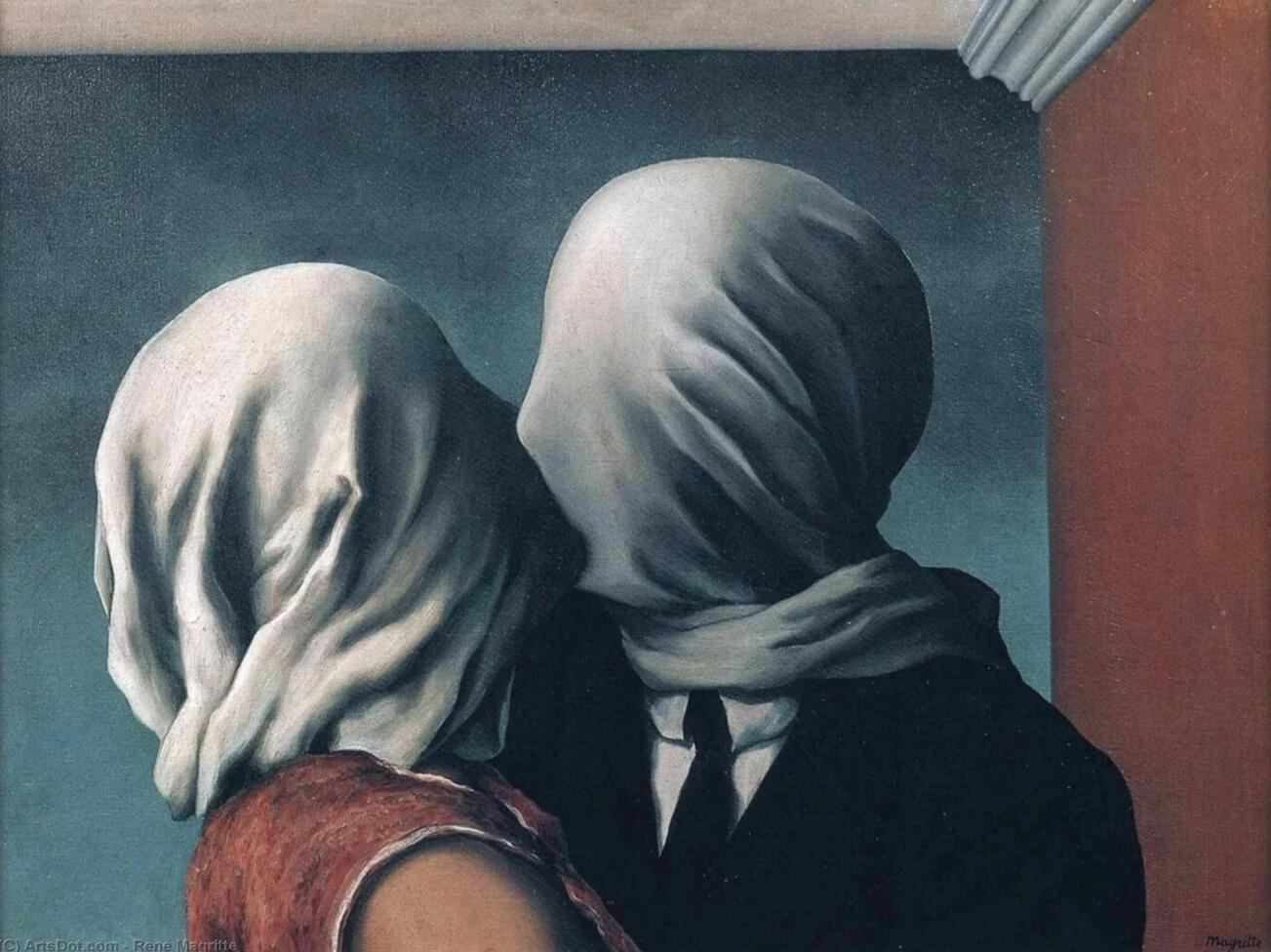
The Lovers, by René Magritte (1928)
'If you only read the books that everyone else is reading, you can only think what everyone else is thinking.'- Norwegian Wood, by Haruki Murakami (1987)
In many ways I used to follow the axiom that the worst thing a work can do is bore you. In some respects, I still subscribe to that. As I developed principles with age I discovered that an outrageous, offensive offering of shit might be more intellectually stimulating than a milquetoast slice of nothing. This is indicative of a nervous system response oppositional to any received from a 10/10 work, and befitting the lower tiers - with 05/10s reserved for works that left little impression. Therein I cherish my least-favourite works in a similar-(but-completely-different) way to how I might those at the top. Art indicative of either end is capable of mnemonically or memetically encoding an impression upon my cerebral cortex.
^3 - *If this begins to sound like nonsense, that is inevitable on this level. [...] "Godel's Theorem was once explained to me by a patient, a gentle mathematician, and just as I was taking it all in, nodding appreciatively at the beauty of the whole idea... It all turned into nonsense inside my head." It happens in both linguistics and mathematics, because it happens in consciousness itself, language and math are just models of consciousness. [...] Approximately 3% of neuro-somatic adepts have mastered the meta-programming circuit [to the degree they can be considered] 'Free Masons' in the original meaning of that debased term: co-creators of future realities.' - Prometheus Rising, by Robert Anton Wilson (1983)
To One-Thousand
The advantages of a 100-point system over a 10-point system are obvious. You have 90 more numbers to work with. That power-gap between the lower-7 works and their exalted high-7 superiors can be distinguished through the neat breadth between 071/079. Boxes within boxes. That should suffice, right? Perhaps for a list comprising hundreds of entries. But what about thousands? Suddenly, we're at the same problem: there is a notable distance between my lower 079/100s and higher 079/100s and -
You see where I'm going with this? The larger the dataset, the more points of inference. Therein more optimisation and calibration can accurately communicate what that data represents (which, in this case, is something as seemingly nebulous as impression through deduction). As my tastes and interests continuously expanded through decades of growth, the more I felt a self-imposed requirement to determine what matters to me. But this required further nuance, once more. More numbers. Dissatisfied with all my lists and current system, I meditated a long time on a complete upheaval before coming to a decision. What resulted was three months spent rigorously stress-testing this new system of refractive attunement best representative of how my nervous system reacts to art. This involved a 1000-point system (or 100 with a decimal if you're inclined), an excel spreadsheet instead of a text document, colour theory, and a large-scale semantic analysis of the English language (and a few loanwords and inventions of my own) to determine a gradient of adjectives commonly (or uncommonly, in some circumstances) used by people to describe art.
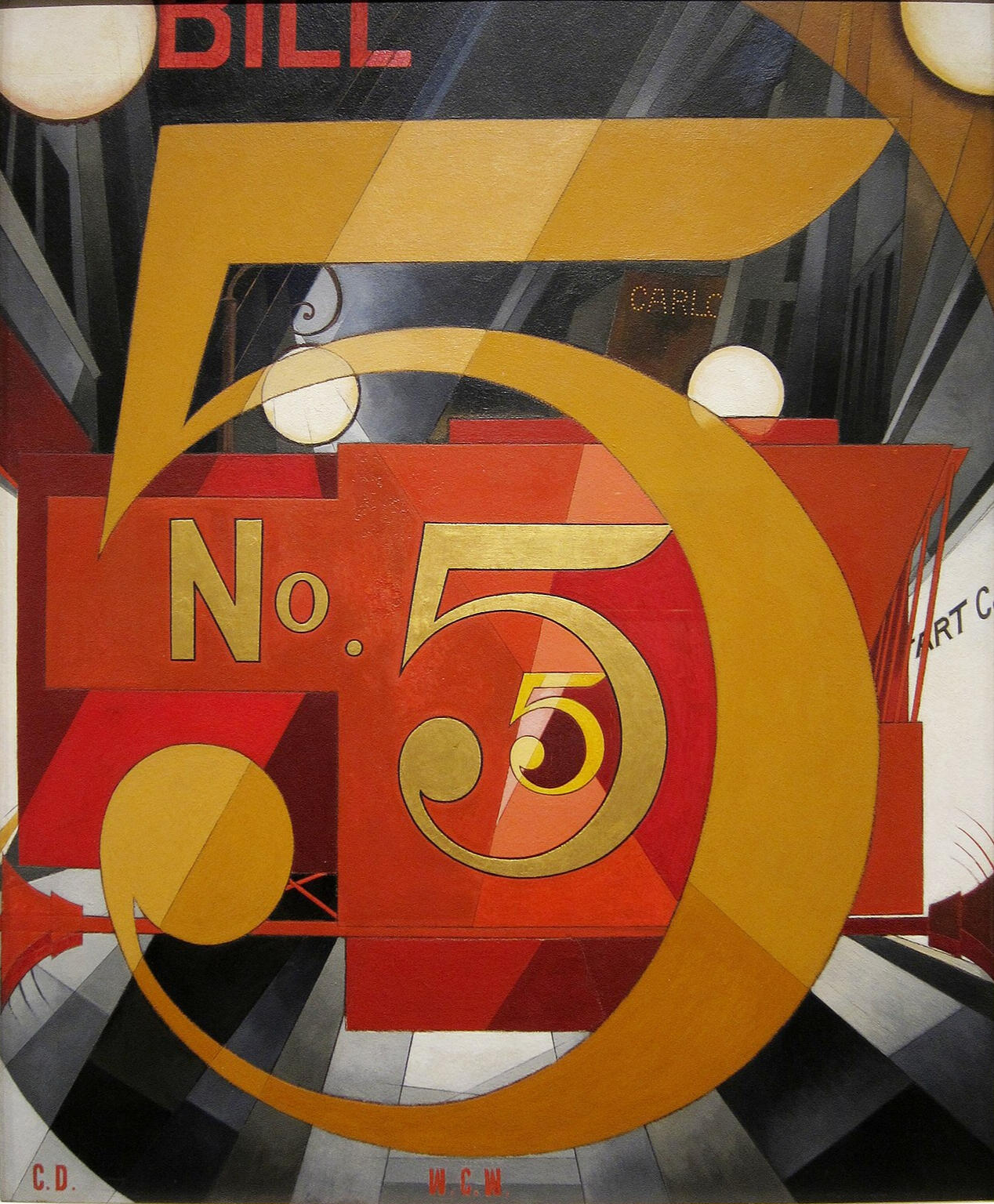
I Saw the Figure 5 in Gold, by Charles Demuth (1928)
'I can't help but recall, at this point, a horribly elitist but very droll remark by [...] James Huneker, in his scintillating biography of Frédéric Chopin, on the subject of Chopin's étude Op. 25, No. 11 in A minor, which for me, and for Huneker, is one of the most stirring and most sublime pieces of music ever written: “Small-souled men, no matter how agile their fingers, should avoid it.” [...] "Small-souled men"?! Whew! [...] I would suggest that it is only because we all tacitly do believe in something like Huneker's shocking distinction that most of us are willing to eat animals of one sort or another, to smash flies, swat mosquitos, fight bacteria with antibiotics, and so forth. We generally concur that "men" such as a cow, a turkey, a frog, and a fish all possess some spark of consciousness, some kind of primitive "soul" but by God, it's a good deal smaller than ours is — and that, no more and no less, is why we "men" feel that we have the perfect right to extinguish the dim lights in the heads of these fractionally-souled beasts and to gobble down their once warm and wiggling, now chilled and stilled protoplasm with limitless gusto, and not feel a trace of guilt while doing so.”- Gödel, Escher, Bach: An Eternal Golden Braid, by Douglas R. Hofstadter (1979)
At first, I called this system The Awe-Veritas Cadence: a relative measurement of my opinion of a work's ability to ellicit awe and convey truth, two things I find fundamental to any impressive work. Another thing I look for is an expression of soul - soulfulness. It's a difficult thing to describe, and adversely (paradoxically, in places) I love some works for their conveyed absence of soul. While a work's ability to embody soul is not an absolute deal-breaker, it is a factor (sub)consciously noticed in the same way I pay attention to audio-visuals, acting, animation or narrative - for instance.
I landed on that name because I like its connections to rhythm, melody, flow - a process; a seasonal progression - and co-opted it instead of Codex. Later, annoyed by the pretentiousness (no kidding?) I began referring to the list itself by The Awe-Veritas Codex. Then, three months went by and I recognised the system ultimately, simply, measures my nervous system's capacity to synchronise with a work, and have since referred to the system and the list as The Syncodex. It began as a symmetrical 21-step system with 4 incremental steps expressed through 100 different adjectives. Over time, it grew in scale in accordance to my differing opinion on the datum until arriving at the rendition I felt suitable to disclose in this essay.

Steins;Gate, by Chiyomaru Shikura, Huke, 5pb. and Nitroplus (2009)
'I'm working on expanding subjective time so that it feels like I live longer [...and to] avoid that feeling you have when you get to the end of the year and feel like, where the hell did that go? [...] By remembering more. By providing my life with more chronological landmarks. By making myself more aware of time's passage.'- Moonwalking With Einstein, by Joshua Foer (2011)
What Makes For Good Art?
Plato determined the value of art by its ontological mimesis (its representation of truth) and thought philosophy highest in this regard, with imitative art - like painting or poetry - the lowest. Arthur Schopenhauer ranked the arts by how they express the metaphysical Will, with architecture ranked lower than poetry and literature, and music sitting at the very top. Hegel (in his Lectures on Aesthetics) ranked the individual arts by their ability to manifest an 'Idea' or split free from manifest physical material boundaries, crowning poetry at the top (with architecture at the bottom, again). Immanuel Kant ranked the fine arts by their capacity to expand the mind, situating poetry at the top and instrumental music at the bottom while famously comparing instrumental music to wallpaper. Similarly, and shockingly perhaps, the musically anhedonic author of Lolita^4, Vladimir Nabokov said music, 'affects me merely as an arbitrary succession of more or less irritating sounds.' I've elected to not be that discerning towards mediums, because when I tried to be, my life took on a notably more miserable tone (reflected in my syncratings) - all for faux-pretence.

Tengen Toppa Gurren Lagann, by Hiroyuki Imaishi and Studio Gainax (2007)
'Perhaps we should ponder more deeply on the fact that Daedalus means 'artist' in Greek. Daedalus, designer of labyrinths, imprisoned by those he served in a labyrinth he himself built. [...] Why does he represent Art, instead of Science? [...] remember that the ancient Greeks did not distinguish 'Art' from 'Science' as we do. The genius of an artist, Aristotle says, lies in his texne, the root from which we get our word 'technology;' but texne basically means skill or craft, or the ability to make things that never existed before. Negative entropy, i.e., information.'- E-Mail to the Universe, by Robert Anton Wilson (2005)
Now, as I enter my thirties, I'm reminded of a few quotes concerning the nature of art-consumption and agree with many of them^5. I implicitly believe a raison d'être - a reason to exist^6 - beyond fame or profit remains critical to a work's success at synchronization, but I now acknowledge the folly and benefit in this post-capitalist Hellscape of depriving oneself of corporately-supported (or less independent, or less sublime) art purely on the basis that the work will help a company grow. There are mitigating factors, and one should always vote with their wallet and their attention. I've decided to love some anime as much as I love some poetry as much as I love some paintings as much as I love some films as much as I love some books.

Promethea Issue #32, by Alan Moore, J. H. Williams III, Mick Gray, and Todd Klein (1999 - 2005)
Claude Shannon's famous equation for the information content of a message:
'H = - Σp i loge pi
Σ merely means "the sum of." The symbol, Pi , tells us what we will summarize, namely the various probabilities (p1 , p2 . . . etc. to pn , where n equals the number of signals in the message) that we can predict in advance what will come next. The logarithmic function merely shows that this relationship does not accumulate additively but logarithmically. Notice the minus sign. The information in a message equals the negative of the probabilities that you can predict what will come next every step of the way. The easier you can predict a message, the less information the message contains.'- Quantum Psychology, by Robert Anton Wilson (1990)
^4 - '[...] light of my life, fire of my loins. My sin, my soul. Lo-lee-ta: the tip of the tongue taking a trip of three steps down the palate to tap, at three, on the teeth. [...] Ladies and gentlemen of the jury, exhibit number one is what the seraphs, the misinformed, simple, noble-winged seraphs, envied. Look at this tangle of thorns.'
^5 - This is one of the reasons I don't like Ready Player One (2011/2015) despite my lifestyle suggesting to others I might be a fan. Where's the grace? The decorum? Eh? The book and protagonist appal me though I understand their pop cultural existence was an inevitability. Or, to quote Roger Ebert from his A Horrible Experience of Unbearable Length: More Movies That Suck (2012): ''A lot of fans are basically fans of fandom itself. It's all about them. They have mastered the Star Wars or Star Trek universes or whatever, but their objects of veneration are useful mainly as a backdrop to their own devotion. Anyone who would camp out in a tent on the sidewalk for weeks in order to be first in line for a movie is more into camping on the sidewalk than movies. Extreme fandom may serve as a security blanket for the socially inept, who use its extreme structure as a substitute for social skills. If you are Luke Skywalker and she is Princess Leia, you already know what to say to each other, which is so much safer than having to ad lib it. Your fannish obsession is your beard. If you know absolutely all the trivia about your cubbyhole of pop culture, it saves you from having to know anything about anything else. That's why it's excruciatingly boring to talk to such people: They're always asking you questions they know the answer to.'
^6 - Towards the top-end of my Syncodex is a documentary entitled Dear Zachary: A Letter to a Son About His Father (2008) which I recommend the reader go into blind equipped with the knowledge it is a tough watch. It is a considerably pure example of a work's raison d'être shining through: it made me re-examine my (already-shaky) relationship with film. Similarly, Hotaru no Haka (Grave of the Fireflies) (1988) serves many purposes as a product for a company without compromising itself as a meaningful work of art. And this is without touching on traditional art - such as in the case of William Blake (1757 - 1827) with his poetry and artwork, both of which exemplify a visionary output of sublime design and intent.
> READ MORE ABOUT THE SYNCODEX HERE <
Living on the Edgeley, by Sara Stanczyk (2025)
'Since we all create our habitual reality-tunnels, either consciously and intelligently or unconsciously and mechanically, I prefer to create for each hour the happiest, funniest, and most romantic reality-tunnel consistent with the signals my brain apprehends. I feel sorry for people who persistently organize experience into sad, dreary and hopeless reality-tunnels, and try to show them how to break the bad habit, but I don’t feel any masochistic duty to share their misery.'- Cosmic Trigger I: Final Secret of the Illuminati, by Robert Anton Wilson (1977)
REFERENCED MEDIA
Big Bang, by Yoshitaka Amano (2018)
PAINTINGS / ARTWORKAmano, Yoshitaka. (2016). Big Bang [Tapestry / Promotional Painting for Final Fantasy XV].
Crowley, Aleister & Harris, Frieda. (1944). The Thoth Tarot Deck / The Book of Thoth.
Demuth, Charles. (1928). I Saw the Figure 5 in Gold [Oil, Graphite, Ink, and Gold Leaf on Composition Board].
Escher, M. C. (1956). Print Gallery [Lithograph].
Magritte, René. (1928). The Lovers (Les Amants) [Oil on Canvas].
Monet, Claude. (1869). La Grenouillère [Oil on Canvas].
Renoir, Auguste. (1869). La Grenouillère [Oil on Canvas].
Stanczyk, Sara. (2025). Living on the Edgeley [Acrylic on Canvas].CLASSICSUnknown. (????). The Three Maxims inscribed upon the Pronaos of the Temple of Apollo at Delphi.
Homer. (-800). The Iliad.
Homer. (-800). The Odyssey.POETRYBlake, William. (1789–1794). Songs of Innocence and of Experience: Shewing the Two Contrary States of the Human Soul.STORYJacobs, W. W. (1902). The Monkey's Paw.BOOK: FICTIONCline, Ernest. (2011). Ready Player One.
Murakami, Haruki. (1987). Norwegian Wood.
Nabokov, Vladimir. (1955). Lolita.
Shelley, Mary. (1818). Frankenstein; or, The Modern Prometheus.BOOK: NON-FICTIONCalvino, Italo. (1991). Why Read the Classics.
Ebert, Roger. (2006). A Horrible Experience of Unbearable Length: More Movies That Suck. Andrews McMeel Publishing.
Foer, Joshua. (2011). Moonwalking With Einstein: The Art and Science of Remembering Everything.
Moore, Alan & Moore, Steve. (2024). The Moon and Serpent Bumper Book of Magic. Top Shelf Productions / Knockabout Comics.
Hofstadter, Douglas R. (1979). Gödel, Escher, Bach: An Eternal Golden Braid.
Hofstadter, Douglas R. (2007). I Am a Strange Loop.
Wilson, Robert Anton. (1977). Cosmic Trigger I: Final Secret of the Illuminati.
Wilson, Robert Anton. (1983). Prometheus Rising.
Wilson, Robert Anton. (1990). Quantum Psychology.
Wilson, Robert Anton. (2001). E-Mail to the Universe.BOOK: MANGA & COMICSAraki, Hirohiko. (1987–Present). JoJo's Bizarre Adventure [Manga / Graphic Canon]. Shueisha.
Araki, Hirohiko. (1987). Part 1: Phantom Blood [Manga / Graphic Canon]. Shueisha.
Araki, Hirohiko. (1987–1989). Part 2: Battle Tendency [Manga / Graphic Canon]. Shueisha.
Araki, Hirohiko. (1989–1992). Part 3: Stardust Crusaders [Manga / Graphic Canon]. Shueisha.
Araki, Hirohiko. (1992–1995). Part 4: Diamond Is Unbreakable [Manga / Graphic Canon]. Shueisha.
Araki, Hirohiko. (1995–1999). Part 5: Golden Wind [Manga / Graphic Canon]. Shueisha.
Araki, Hirohiko. (1999–2003). Part 6: Stone Ocean [Manga / Graphic Canon]. Shueisha.
Araki, Hirohiko. (2004–2011). Part 7: Steel Ball Run [Manga / Graphic Canon]. Shueisha.
Araki, Hirohiko. (2011–2021). Part 8: JoJolion [Manga / Graphic Canon]. Shueisha.
Araki, Hirohiko. (2023–Present). Part 9: The JOJOLands [Manga / Graphic Canon]. Shueisha.
Araki, Hirohiko. (1997–Present). Thus Spoke Rohan Kishibe (Kishibe Rohan wa Ugokanai). [Manga / Graphic Canon]. Shueisha.
Moore, Alan (W), Williams III, J. H. (P), Gray, Mick (I), & Klein, Todd (L). (2003). Promethea Issue #32: "The Universe". America's Best Comics.DOCUMENTARYAnohni (Dir). (2008). Dear Zachary: A Letter to a Son About His Father.FILMCline, Ernest (W) & Spielberg, Steven (Dir). (2018). Ready Player One [Motion Picture Adaptation]. Warner Bros. Pictures.
Darabont, Frank (Dir). (1994). The Shawshank Redemption. Castle Rock Entertainment.
Feige, Kevin (Prod), Russo, Anthony & Russo, Joe (Dirs). (2018). Avengers: Infinity War. Marvel Studios.
Kubrick, Stanley (Dir). (1968). 2001: A Space Odyssey. Metro-Goldwyn-Mayer.ANIMATIONImaishi, Hiroyuki (Dir). (2007). Tengen Toppa Gurren Lagann [Anime Serial]. Gainax.
Lord, Phil, Miller, Chris & Pascal, Amy (Prods). (2018–2023). Spider-Man: Into the Spider-Verse & Spider-Man: Across the Spider-Verse. Sony Pictures Animation.
Takahata, Isao (Dir). (1988). Grave of the Fireflies (Hotaru no Haka). Studio Ghibli.VISUAL NOVELMAGES. Inc. (2009). Steins;Gate (Standard Edition) [Steam]. Spike Chunsoft Co., Ltd.
MAGES. Inc. (2015). Steins;Gate 0 (Standard Edition) [Steam]. Spike Chunsoft Co., Ltd.
MAGES. Inc. (2018). Steins;Gate ELITE (Standard Edition) [Steam]. Spike Chunsoft Co., Ltd.
MAGES. Inc. (2026). Steins;Gate Re:Boot (Deluxe Edition) [Steam]. Spike Chunsoft Co., Ltd.OTHERCarless, Simon. (2021). How User Reviews Affect Your Games. GameDiscoverCo. [Digital Reference Engine / Industry Database Study].
Purchese, Robert. (2012). Obsidian: Fallout: New Vegas Deal With Bethesda Meant Bonus Payment Only With 85 Metacritic. Eurogamer [Digital Reference Engine / Industry History Study].
Wake, Paul. (2016). Life and Death in the Second Person [Lecture / Academic Media Presentment]. Manchester Metropolitan University.
The Book of Thoth: ATU XVI - The Tower, by Lady Frieda Harris & Aleister Crowley (1944)

EIGENSTATE;STEINSGATE
NOTE /// a few years ago (2022) I posted a number of Steins;Gate theories online. While I would love to have them confirmed, I'm growing increasingly worried that may have been apophenia... So, this is less of an essay, and more an abridgement of a series of Reddit posts, including the comments of some detractors and supporters.

An Overview
- In quantum mechanics, an eigenstate is what we call a measurable state of a quantum system - which is something observable; the function of a wave.
- When something is observed, its many possibilities reduce to one. We call that the wave function (Ψ) collapsing.
- That symbol (Ψ) denotes the Greek letter psi - it is pronounced 'sigh' and is the universal symbol for 'psychology' (ψυχη - psyche) but also was adopted by Erwin Schrödinger in 1926.
- Schrödinger adopted it out of mathematical habit to argue against the possibility of wave function collapse, but by coincidence^1 the symbol illustratively denotes the precise collapsing of two states into one he strove to argue against.
- He created his Schrödinger Cat paradox to ridicule Heisenberg and John von Neumann.
- [Inspired by Ryukishi07 and his work Umineko no Naku Koro ni, I like to call the theoretical hyperobject itself a 'catbox.']
- In legalise and bureaucratic doctrine, a scintilla represents an infinitesimal interstitial, transitionary moment where something possible manifests into actuality.
- Schrödinger's Equation measures the process of time in a quantum state before that state collapses into an eigenstate: the scintilla of being.Eigenstate
- Here, I posit Steins;Gate is a quantum cypher of eigenstate, encrypted using the non-isomorphic initials of Schrödinger's Equation [S;E] as its operational toggle.
- In prose/programming, a semi-colon joins independent clauses to maintain conceptual continuity, mirrored in the parallel functions of world-lines and representative of the barrier Okabe must overcome.
- When extended to the Science;Adventure series as a whole, there's an argument that all of them possess a semicolon because they all concern dichotomy, connectivity, and language cryptology.
- To achieve Steins;Gate, is to achieve an idealised relative disposition on a fixed world-line; to achieve superposition wave function collapse via one's perspective on an otherwise 'predetermined' outcome, and overcome the flow of fatalistic time with an ebb of one's reverse-engineered (that is to say: imagined) future. I write about this in greater depth, here. But there is an element of the New Thought Movement (or self manifestation) to this; a shifting of one's Locus of Control from external to internal, best exemplified through Okabe's character development throughout Steins;Gate (whereas Steins;Gate 0 comprises an Okabe that has given up on Steins;Gate - that is, overcoming fate via deception.El Psy Kongroo
- Here, I posit El Psy Kongroo is a witty, deliberate act of gairaigo (loanwords) word-playing with phonotactics.
- One reading is The Mind Agrees, as in the case of (el = the; psy = mind; kongroo = congruent).
- Another reading uses the alternative interpretation of (Ψ) is the The Wave Function Agrees, where Psy represents all the possibilities that a quantum object, like an electron, can take across time and space. Which is a nice way of writing The Wave Function Conglomerates, or...
- The Wave Function Collapses.Simulation Theory
- Here, I posit the idea Hououin Kyouma is an individual 'playing' Okabe Rintarou, and that the snippets of delusional chunnibyou dialogue are, in fact, the lingering memories of the extra-dimensional character controlling him; memories unpacking without Okabe's awareness, the result of the Time Leap Machine sending messages encoded in the hippocampus back through time via the Large Hadron Collider compressing the memory / mnemonic data.
- Per binary: 0 - 'off' & 1 - 'on.'
- The third Steins;Gate game will feature the observer being observed.
- This conjecture was founded before the release of Anonymous;Code. Upon playing it, my theory was strengthened by the confirmed existence of *World Layers,' 'Hacking Trigger,' 'Brain-Machine Interfaces,' 'Anon,' and the 'Year 2038 Problem' (which thematically links to the Y2K crisis, postulated by Okabe to be when he developed his Reading Steiner ability).
- Mages. and 5pb. have gone onto announce, Steins;Gate Re:Boot, the name alone suggestive of my building theory.----------------------- I HEREBY BOISTEROUSLY DUB THESE PERCEIVED CONNECTIONS - Operation Ansteigt,^2 or The Ansteigt Theory^3.----------------------^1 - The same type of coincidence that resulted in Ben Jonson's (1598) "care'll kill a cat" transforming into "curiosity killed the cat" with time (and no association with Schrödinger). Similarly, Shakespeare's (1597) abridging of the phrase, "a cat has nine lives" delineates the limitations of single-digit operations in a Base-10 system. Or lest we forget, "let the cat out of the bag" (an expression perhaps originating in livestock farmer frauds, where you'd replace a pig with a cat and hope the buyer doesn't open the bag). Or, "there is more than one way to skin a cat" - another expression of determining possibility dressed up in the feline macabre. You can read more about quantum mechanics and cats in my juvenile debut novel, Phantasomniphobia: A Tail of Cicatamies.^2 - Interestingly, we the audience as observers of Steins;Gate pass through operations Urd (meaning: past), Verandi (present) and Skuld (future) in a linear progression.^3 - Okabe's 'random bullshit' (rarely ever actually random bullshit) and Daru's naming scheme operate as beautiful red herrings in-universe, but the former could be symptomatic of Gigalomaniac Realbooting. Within the Science;Adventure universe, Einstein is recontextualised as a Gigalomaniac Realbooter who altered reality via E = mc2.

QUESTIONS / COMMENTS / INSULTS / MOREQuplet: The Japanese kanji for Steins Gate is 運命石の扉, which has the alternative reading of stone doors of fate.
Me: Yeah, which is a metaphorical allusion common in depictions of stubborn fate. Somewhat reminds me of the theological 'veil,' too. Metatron, (the angel of the veil) etc. The best I can derive from a very literal translation of that is lithomancy or the Stone of Scone. Of course, the literal 'philosopher's stone' could also be similar, which is the basis of the elixir of life and immortality. However, unsupported, it made me think of prisms - though perhaps because I recently read Ted Chiang. Either way, it carries alchemic/magic qualities to it. Interrrrresting!
----------------------
KyberVader: Wow, I always thought It had something to do with Einstein, lol
Me: the natural assumption is the 'Stein' bit to relate to the Frankenstein's and Einstein's of the world (Kyouma's idols). And while that's still completely accurate, much like the 'gate' denotes the obstruction Okabe must overcome with a 'key,'
----------------------
Me: I'm aware of correlation x causation, conspiracy theorist psychosis, apophenia, etc - don't worry. I just think the overlaps here are compelling. Hopefully this might kickstart some discussion, speculation, or the like.
I also argue for a binary system behind the Steins;Gate naming convention confirmed by the naming scheme:
0 - 'off' & 1 - 'on'
So, if we follow this interpretation the first game is the story of 'Achieving a Desired Eigenstate Result.'
And the second game is the story of 'Failing a Desired Eigenstate Result.'
Steins;Gate is the story of a quantum observer (Reading Steiner) achieving a desired wave function collapse, and concerns humanist, generational, and modern love. Steins;Gate 0 is the story of a quantum observer failing a desired wave function collapse, and concerns transhumanist, transgenerational, and transmodern love. The third, I think, will feature the observer being observed.
It's my belief (supported by the working title, Steins;God), that Hououin Kyouma is 'playing' Okabe Rintarou a'la simulation theory, and that the snippets of delusional chunnibyou dialogue are, in fact, the lingering memories of the extra-dimensional character controlling him.
If I was to name the sequel something numerical, I'd go for...
Steins;Gate 42 / Steins;Gate 33% / Steins;Gate 50% / Steins;Gate 01100111 01101111 01100100 / Steins;Gate 3.141 / Steins;Gate 137
or maybe something to do with Godel's Incompleteness Theorem or Goldbach's Conjecture or recursiveness.
----------------------
polybius32: Won’t pretend I understood everything you wrote, but the fact that you've arrived here―rather, to this save point―at this moment in your life is nothing short of a miracle. It delights me to no end. Step through the stage's curtain; rip off the mask of the wizard who pulls the strings. Close the loop. Hack into God.
----------------------
misterinfoman: The semicolon is carried over from the first game, chaos;head… how da ya not know that?
Quplet: Many don't know about anything other than S;G.
Me: Steins;Gatekeeping. Of course I know, ahaha, I've been playing these for more than a decade. It doesn't invalidate the correlations I've discovered. It just shows a pre-established pattern to thread the Sci;Adv titles together. I could just as easily correlate the semi-colon to denote the dissociative tendencies of both Chaos games; the semi-colon denotes depersonalisation? For all I know there's another anagram, were I correct, aha.
I've span your comment over. There's an argument that all of them possess a semicolon because they all concern dichotomy, connectivity, and language cryptology.
We've seen the social, the antisocial; dissociation, depersonalisation; quantum leaping, romance, friendship. 'Multiple personalities' in the same head, in the same universe, and across numerous universes. And genres. The idea of 'bridges' is more explored subtextually in this series of games than in Death Stranding, ahahah. All of them are about connection, the merging of 'two clauses' together, it's just then interpretative how far you take that.
----------------------
shinigamixbox: This is reaching/false. This isn't an anagram for anyone unless they don't know what an anagram literally means... At best it's a rhyme.
STEINSGATE
EIGENSTATE
FORNICATE
PERCOLATE
Thank you for coming to my Ted;Talk.
Me: I don't even know how to reply to this. It's IS an anagram of 'eigenstate with the two non-isomorphic (remaining) letters corresponding to (S)chrodinger's (E)quation.'
The definition of eigenstate, nature of Schrodinger's Equation, and their direct relation to the text and subtext of Steins;Gate makes this all look a bit more than a 'reach' otherwise I wouldn't post it.
That's not including the speculation regarding the semi-colon; a break between two clauses - two correlative points.
You do need to stretch your brain, which might be what you think is a 'reach' but it's hardly outlandish for the franchise. In fact, it's entirely fitting. My gut instinct to the "it's not that deep, bro" sentiment is: "perhaps you are accustomed to the shallow."
Lovely condescension, though. How's it feel?
KaptainCeating: Don't mind people like u/shinigamixbox. You do have to remember this is still an anime subreddit, the slag of the slop if you will. Anything outside of their comprehension makes then feel attacked, hence the harsh response. I got quite a bit of it too when I did my own two cents.
Don't mind them; keep up the good work. I considered anagrams but didn't think of isomorphic letters.
shinigamixbox: "An anagram is a word or phrase formed by rearranging the letters of a different word or phrase, typically using all the original letters exactly once."
You look for conspiracies in used McDonald's wrappers, don't you?
If you do the bearest level of research, you'd realize the gate referenced by the name is the fork between BerenStain versus BerenStein worldlines, also commonly known as the Mandela effect. Thank you, come again.
Me: I've referenced this in the comments already. Also, I said regardless of intent and Death of the Author:
[Death of the Author is a concept from mid-20th Century literary criticism; it holds that an author's intentions and biographical facts (the author's politics, religion, etc) should hold no special weight in determining an interpretation of their writing. This is usually understood as meaning that a writer's views about their own work are no more or less valid than the interpretations of any given reader. Intentions are one thing. What was actually accomplished might be something very different.]
weebjail: okay so this literally doesn't mean anything. you're literally just saying hey it doesn't matter what the intention was because it kind of fits if you stretch it a lot and then squint really hard
sure, i guess you could turn almost any word in the story into an anagram and claim it fits with this logic, but then what the fuck is the point lmao
Me: Well, it literally does mean something, if you understood what I wrote, but that's fine. It's barely stretching. and if you need to squint hard: that's reflective of your perception. Death of the Author is academic theory. You can apply it to anything artistic, because at a certain point, the creator won't have something to say about it. If you need validation from the creator all the time, then good luck, because people die all the time. Nonetheless, I don't feel I need to fallback on Death of the Author, to be honest, as my theory is very much supported within the text.
----------------------
tipoima: "Ah, yes, definitely, I did think so far about it, indeed." - Okabe, probably.
Me: He seems to accurately predict a number of literary instances (Urd, Verandi, Skuld). And I'm also of the opinion Okabe is 'written' by Hououin Kyouma via simulation. So, this'd fit to that theory of mine rather nicely, too.
Also, Okabe didn't write the visual novel... Hahah
Sveitsilainen: Isn't it more Okabe that "writes" Hououin Kyouma? It's the personality he takes first as a joke then as a coping mechanism.
Me: Within the text, aye - the rest is my speculation.That said, it reminds me of Hofstadter's interpretation of the 'I' in I Am a Strange Loop. The way we write our Self as we live it, informed by the past and future; infinitely recursive and impossible to entangle. Like how the brain named itself the brain, etc. Chicken/egg, Ouroboros. Nature vs Nurture, etcetcetcetc.
Sveitsilainen: I have seriously no idea WTF you are talking about. Frankly you sound like a bot spouting nonsense.
Me: “In the end, we self-perceiving, self-inventing, locked-in mirages are little miracles of self-reference. [...] A mirror mirroring a mirror.”
― Douglas Hofstadter, I Am a Strange Loop
Why bother saying something insulting about someone about something you don't get? I'd have been fine explaining. Plus, Google exists, so... Solipsism & Dunning Kruger Effect. I'm not replying to you.
----------------------
DeusGiggity: Our friend above missed the nugget of truth nestled at the centre, so naturally your references lacked any apparent connection.
Fortunately, I speak High-Concept, and think you have a point here. The issue you look at from the high-definition perspective of Physics can be addressed by climbing a few rungs on Jacob's Ladder, to the macro-realm of Psychology.
Put simply, the Ego is a 4th-dimensional structure acting upon 3rd-dimensional space. Its job is not unlike the skin's, to keep the loose collection of sensitivites and subpersonalities we are born with acting as a functional cohesive unit for social interaction, the 'I'. It has membranes for letting new information in, and has numerous defense mechanisms that I'm sure the reader is familiar with.
Another relevant tool of our mind, the prefrontal cortex gives us the strange and fantastical ability to conceive of versions of ourselves performing actions, as well as to simulate the likely consequences. That way, these "instances" of us can die instead of our physical body, say in the classic case of l'appel du vide. But it also opens up an entire new world to us previously unknown to animal life. The world of Possibility. Sometimes these Possible selves can stick around, and (if sufficiently 'like') can be encompassed by the Ego.
As a result, modern humans tend to include their past selves in their definition of 'I', even if that body contained an entirely different set of atoms (Thank you, Theseus!), as well as these possible future selves. This of course lends itself well to time travel stories, when such assumptions are most frequently called into question.
El. Psy. Kongroo.
Me: I'm particularly grateful for you introducing me to l'appel du vide - I've always been aware of The Call of the Void but having a French etymology to research will be valuable for my book. Thank you so much. I hope you have a fantastic new year!
----------------------
saltymermaid47: "It doesn't mean anything"
Me: Precisely what someone who's hidden a code would make their character say, haha. Plus, most (if not all) else he says does mean something, even if he insists otherwise.
saltymermaid47: Respectfully, for me, i really like this phrase, where he says it doesn't mean anything. I just cant imagine the pressure and sadness which Okabe feels during each time leap to save loved ones. In the beginning, it is his persona talking El Psy Kongroo.. which is just some stupid phrase of his to seem cool. El psy kongroo phrase is something belonging to the peaceful days, when he could just hand around in the lab with Mayuri and Daru. And they loved Okabe way back then too. It is a reminder (as for my interpretation), that Okabe WANTS to go back to living his peaceful life, and he just cant. It is a connection to his lightweighted Houoin Kyouma persona. It is surely a code, but for me, the code is for himself, to stay calm, be loved, take care of the most important friends in his life. El psy kongroo in itself (for me) is just a phrase and i love that he says it doesnt mean anything.
It just adds to that chaos theory atmosphere, and one of my favorite lines in the VN.
Because in the end, it does not mean anything, its gibberish, and silly, and Okabe knows that. For me, this qoute gives deepness to SG.
Me: Yeah, I've felt that the past decade; this is a recent development of mine.
Funnily enough, your back and forth with the bot below perfectly exemplifies the 'nonsense' wordplay that actually means something. Zombie; Christina; FB; NyanNyan as a metaphor for Schrodinger's Cat - there one instant, gone the next, depending on wave function collapse; all of the historic or mythological references; Daru posing as Barrel through etymological wordplay; the encoded nature of Titor's posts.
(For instance, if he DOES say 'it means 'nothing'' in the original text, that's quite profound itself within my interpretation of wave function collapse. I'm hardly looking into this too far, either, just going off what they give me)
I'll be playing/watching it closer than I have before this year for my essay, so we'll see!
EDIT: even IF my interpretation was 'correct,' yours would be. Absolutely and forever. Double entendre, wordplay, and cryptology are the foundations of this franchise.
saltymermaid47: Man, I really love this series. My all time favorite. Currently i am playing the S;G0 VN, and it tooks me so much time because i want to enjoy it while i can and i've been playing for 1,5 years. I let the story sink in and I dont want to end the story 🤣 THIS is how much I just Love this series. The dedication to detail, just like your encoding, is out of this world, and one can only see these little pieces of information if you really pay attention. I've already saw the anime multiple times, but I prefer the VN because of the deepness it holds. If I could only watch one anime/play one VN for the rest of my life, the SG-s would be it.
I like your explanation to the words though, and after consideration I think there is absolutely meaning there, good job discovering these 😊
----------------------
Me: I'm calling this the 'Ansteigt Theory,' (rather fitting) for now. I've left a slew of supporting 'evidence' across these three threads and the YouTube video. It's an incomplete hypothesis...
Or maybe 'OPERATION ANSTEIGT' ahahahahah.
(Also: we as observers of 'Steins;Gate' pass through operations Urd (past), Verandi (present), and Skuld (future) in a linear progression. Which I find neat).
Taiyaki11: You're putting way more thought into it than the creators ever did. There is no code or hidden secrets, it's just part of Okabe's chuuni nonsense where he steals or comes up with phrases (usually from norse mythology like a lot of chuunibyos) that hold minor relevance and sound cool. The writers weren't sitting there playing 4d chess with the writing, they just wrote in some funny coincidences like Okabe's made up Organization turning out to have a real life equivalent in the form of the committee of 300 (naturally completely unknown to him) and that's as far as they went. Speaking of Chuunibyo...this post kinda epitomizes the concept
Me: Are you honestly trying to diagnose someone you've never met based on their theories on a visual novel online? The editing is to keep the theory consistent and so I don't spam a thread or elsewhere; that's why the feature is there.
I am not being psychoanalyzed by anime fans for fan theories.
Sincerely and respectfully leave me alone.
Taiyaki11: I don't think you have a grasp at what exactly a chuunibiyou is, I wasn't saying just that post was, your whole borderline conspiracy theory over this stuff is what I was saying is the perfect epitomization of chuunibiyouism...which you've been defending vehemently and even made a defensive edit to the main post over it, so don't think you can say this whole thing is just a joke lol.
No interest in arguing either, just pointing out that you're taking this way more seriously than 5pb and Nitro did and putting too much stock into how meta they went. So good luck with all that
----------------------
[deleted]: It's just his delusional catch passphrase.
Me: And it couldn't possibly be anything else? Despite the way all of his delusions are, by and large, founded in reality?
[deleted]: Just saying I say random delusion bullcrap that means nothing too. Of course unlike me he is a genius that invented message time alterations.
[deleted]: I think you just made me realise something. The Time Leap Machine sends messages encoded in the hippocampus back through time via the Large Hadron Collider compressing the memory / mnemonic data. It's just as likely that these 'delusions' - that is, off-the-cuff 'random' expressions - are actually memories unpacking themselves in Okabe's brain without his awareness. In this way, they'd be 'Phone(tic)Waves'
[deleted]: Except he's only sending them a few days back. You're absolutely going off the rails looking for meaning where it doesn't exist. Sad.
----------------------
TheRedPeninsula: a yes, schizoposting.
----------------------
Existing-Ad-1916: Few years ago i had dinner with the producers and few other staffs. I asked the meaning. Their response was, IT HAS ZERO MEANING! They really randomly found words together. They laughed a bit because everyone tryna find the meaning.
Me: I mean... Like... Proof? You've posted twice and that's quite a big claim.
Existing-Ad-1916: What proof? They were in germany for the anime premiere and i was the translator. We talked about it at the dinner. They also answered it at the Q/A panel once i think.
----------------------
PiXI_Skeptic: I know I'm quite late to this post, but I didn't see anyone mention this:
El also means God in several ancient Semitic languages.
It fits nicely into the understanding that ψ represents the wave function if we look at it as the infinite possibilities of God.
Then, taking note that the phrase in question is always said with pause between each word - like a code phrase rather than a sentence, it can fit quite nicely into the interpretation that it also means something like "God - Wave Function - Congruent."
God and ψ are inseparable and completely congruent.
The key difference in our interpretations being that I view the reduction of the state vector as done by God, not happenstance. So it's something like God decided, instead of just probabilistic chance - or in Kyouma terms: the choice of Steins;Gate.
----------------------
epk-lys: Steinsgate sounds like eigenstate and that's a nice fact, but doesn't make sense to say it's an anagram, because what good of an anagram is it if you need to drop letters. It's not easy to come up with a good name like Steins;Gate so I don't think they had the freedom to be doing anagrams.
You're right psi is the symbol for wavefunction, I've noticed that before. SciADV is beautiful in the sense that it takes quantum physics and expands on it, making it into a multiple world theory that's in some way equivalent to a neuroscience theory, identifying the self as the [Attractor Field Theory] observer (Ir2, Reading Steiner). As how I see it, there is a duality between psi from EPK and ψ in the series, and good catch on interpreting it as the wavefunction collapse, but no idea whether it's a coincidence (it goes excellently along the theme though).
Schrödinger [evolution] and Eigenstate (measurement collapse) are really what QM is, since they comprise two of the three axioms of QM, the other one setting definitions; I don't think Steins;Gate is any sort of anagram despite this, though. To entertain the idea, another possibility. In physics there are two equivalent approaches to QM, the Schrödinger picture and the Heisenberg picture, deciding who is time dependent -- the observed/wavefunction or the observer/operator, respectively. Wavefunction collapse occurs in the Schrödinger picture, while operator collapse occurs in the Heisenberg picture. So if E were to stand for Eigenstate (Schrödinger picture), S could perhaps stand something equivalent in Heisenberg picture, which would probably be Subspace, as in projection operator subspace. But really, just used this comment as my excuse to read about the S/H pictures lol your anagram speculation doesn't make sense to me
Me: I GREATLY appreciate the depth of your comment. Q: "What good is an anagram if you have to drop letters?" A: encryption via quantum cryptology.
...the 'anagram' nature of it (non-isomorphic and requiring a key) is conforming to quantum cryptology as I have suggested; it's a common technique in encryption. Your comment 'its not easy to come up with a good name like Steins;Gate so I don't think they had the freedom to be doing anagrams," makes no sense to me. It's always been a clunky, confusing name to me. I've shown it to at least a dozen people and they still hardly understand the name - it's basically ASKING you to decode it in some capacity. It has always felt like the cumbersomeness of the name is obscuring a code; that's my pattern recognition kicking in, though. And, I mean, it's Steins;Gate; an extremely cohesive story about cryptology (IBM, even, directly pertinent to quantum cryptology decryption), quantum observation, Eigenstate manipulation.
Also, the psi = wave function collapse is a bit more than a coincidence. Steins;Gate is self aware of it (and self aware of all else I've suggested. I have tried to not stray from the directly pertinent when possible). I mean, c'mon, ahaha.
Schrödinger's Equation as a cryptological key in particular is important for this conundrum. Your suggestion doesn't actually make any sense, RE subspace and the like. You COULD then say anything can stand for S/E, and you've broken the key for no reason. It's not like Heisenberg and Schrödinger were the only pertinent physicists, so to randomly suggest it IS random without reason.
Schrödinger's Equation acting as the key also, well, makes sense, to be reductive. That is, of two things in superposition which through observation collapse into one... The two clauses distinct via a semi-colon; Eigenstate acting as a single end result via interaction.
I'm exhausted trying to explain this.
I'm aware my theory hasn't been structured or conveyed very well; all off-the-cusp and scattered across different websites in comments, and the like. I'm reading Helgoland at the moment, and am busy with university, so I'll probably return to this with a clearer head in a few months. That said, I just went on to the Wikipedia for Wave Function Collapse to see how it's explained by them, and got a laugh out of the first paragraph which, almost, weirdly, EXPLAINS facets of my theory and interpretation:
"In quantum mechanics, wave function collapse occurs when a wave function—initially in a superposition of several eigenstates—reduces to a single eigenstate due to interaction with the external world. This interaction is called an observation, and is the essence of a measurement in quantum mechanics, which connects the wave function with classical observables such as position and momentum. Collapse is one of the two processes by which quantum systems evolve in time; the other is the continuous evolution governed by the Schrödinger equation."
(Thank you for your comment, I appreciate you taking the time)
epk-lys: "It's always been a clunky, confusing name to me."
Steins Gate... Einstein's Gate. What's so confusing about it?
The writers of SciADV barely knew any English, do you really think they thought that far into it?? I believe in one of the interviews they even said that's the origin of the name.
"Steins;Gate is self aware of it "
Not sure what you mean. As I said, epk = wave function collapse fits the theme. But coincidences that turn out to fit the theme are very common for complicated reasons.
"It's not like Heisenberg and Schrödinger were the only pertinent physicists, so to randomly suggest it IS random without reason."
I wasn't talking about Heisenberg and Schrödinger being the only pertinent physicists. The two ways of interpreting time in QM is by their so called "pictures" (remember S;G is about time travel?), leaving time dependence to either the wavefunction or the observer. These interpretations happen to bear their names. But sure, I don't think this is very related to the idea of an anagram. I don't think anything is.
"Collapse is one of the two processes by which quantum systems evolve in time; the other is the continuous evolution governed by the Schrödinger equation"
That's the same as I said. You can call it (S)chrödinger evolution and (E)igenstate determination. But again, why anagrams?? Steins;Gate is just a cool sounding name that sounds like Einstein's Gate (come on, Einstein's gate?? If anything Gate here means the gate through time), with a semicolon following SciADV convention, and possibly also a biblical reference (stone of Jacob), not an anagram.
I have no idea how you're trying to fit quantum cryptography into this, as seems completely arbitrary. Have some sleep, no offense but seems as if you haven't had any in ages.
Me: It's not called Einstein's;Gate, is it? and the Stein denotes 'Stone' - a Gate of Stone - as much as it suggests Einstein, Frankenstein, or anybody else.
I'm sorry, but they barely knew English? Okay...
This is JAPAN we are talking about, where 13%> on AVG learn fluent English, and the streets are populated with English and Romaji expressions. It's not 1895. Not to mention you're claiming their foreign illiteracy despite the overwhelming counter evidence within the text. And, like, what? They didn't consult anybody? Jesus, look at the credits. You, yourself, just argued their Germanic literacy in some way.
Nonetheless, the title is explicitly clunky; both grammatically and punctually - and it's 'illiteracy' is referenced within the otherwise exceptionally literate script. Even across translation. That's what I mean by self awareness.
"Didn't think too far into it."
Hilarious - genuinely. If you were talking about most other VNs or Anime, sure. Have you ever actually wrote a piece of fiction before? They don't just happen.
Link me to that interview, please.
I've countered most of your points across my other comments. You didn't need to get insulting out of nowhere nor presumptuous. I legit thought you were being polite, but forgot this is an anime Subreddit. Now I'm convinced I'm talking to a solipsistic teenager and won't reply.
epk-lys: I tried being polite, but can't stand people who demand politeness. There are people far more 'unpolite', with wiser things to say than most people. If you want to reply, that's up to you.
"It's not called Einstein's;Gate, is it? and the Stein denotes 'Stone' - a Gate of Stone - as much as it suggests Einstein, Frankenstein, or anybody else."
This is a time travel story, LOL.
"This is JAPAN we are talking about, where 13%> on AVG learn fluent English, and the streets are populated with English and Romaji expressions. It's not 1895. Not to mention you're claiming their foreign illiteracy despite the overwhelming counter evidence within the text."
Do you even know anything at all about Japan? Did you really think the original story writing of Steins;Gate was in English?
Also didn't say they didn't think far into the title. Just that they didn't think it how you are thinking.
"Link me to that interview."
https://dengekionline.com/elem/000/000/212/212275/index-2.html
It literally took me less than two minutes.
"I can tell you have no idea (you've hardly tried) and I'm not repeating myself. Cheers."
Clearly a physics degree is not enough to understand your quantum cryptology. I'm already too generous with my time here, but wtf does quantum cryptography have to do with anagrams or anything you've said?
Edit: BTW nice diagrams. Yes, the screenwriters suspiciously know a lot about mythology and they're really into digging into stuff but an anagram that's not even an anagram doesn't make any sense to me when there are way more sensible explanations.
Me: Them: I would like to ask about the title of this work. What does "Steins Gate" mean? Does it mean "no particular meaning"?
Matsubara: As I said before, the title of "Chaos Head" changed over and over. However, the title "Steins Gate" this time was written from the beginning in Shikura's proposal. So, if you ask me what I mean by adding it, it's a mystery, but... (laughs).
Hayashi: No, it's not a mystery (laughs). The "Stein" in "Steins;Gate" is taken from Einstein. That's why I use the theory of relativity.
Them: In the game, “Steins;Gate” is written in kanji as “Door of Fate Stone”, right? Why is this reading "Steins Gate"?
Hayashi: Stein means "stone" in German. A gate is, of course, a "door". It's a coined word that's a mixture of German and English, but it's pronounced in Japanese, and we added the word "fate," which sounds like chuunibyou (*3), and it became "fate stone door." rice field.
If you read the link you attached, it operates as an oxymoron, reiterates what I've literally said, and raises my suspicions higher: "It's a mystery / no it's not, it means Einstein / it means 'Stone"
So, yes, multiple interpretations. And? If you looked at my comment history, I've went over this. Do you REALLY think I missed this and you're elucidating something here? I've addressed this in both text and video form, numerous times.
If ANYTHING, your link further supports the confusing double entendre nature of the name - the 'confusing title' I mentioned prior. It also suggests their hiding a true meaning, and that they're VERY aware of English etymology.
So, thank you for the link!
epk-lys: Aw the misunderstood English major can't accept reality lmao
----------------------
NOTE /// these comments were from four years prior to me posting them there, and I cringe at many of my points as much as I still stay stubborn on others.

Names
Name: Kafka-Joeseph James Shane Champin.
Nickname: Kaf.
Author Pseudonym: Kajoch.
Musician Pseudonym: Dayface.
Online Name: Dayface.(TheDayface).
Birthdays
Gregorian Date of Birth: 07th February 1997.
Lunar Date of Birth: 01st Day, 1st Month, 4695th Year.
Time of Birth: 07:07 AM.
Place of Birth: Luton, UK.
Personality
MBTI: INTP
Enneagram: 4w5 (Bohemian Romantic)
Gematria (Chosen Name):
Pythagorean: 114
Chaldean: 108
Simple English (Ordinal): 267
Reverse Ordinal: 516
Gematria (Birth Name):
Pythagorean: 102
Chaldean: 94
Simple English (Ordinal): 237
Reverse Ordinal: 411
Astrology
Western Sun Sign: Aquarius
Western Moon Sign: Aquarius
Western Rising Sign: Aquarius
Hindu Vedic Sidereal Sun Sign: Capricorn
Hindu Vedic Sidereal Moon Sign: Capricorn
Hindu Vedic Sidereal Ascendant: Capricorn
Chinese Zodiac Animal: Ox
Chinese Zodiac Element: Fire
Features
Height: 6 foot 3 (190.5 cm).
Skin Tone: Ivory/Vanilla/Porcelain.
Race/Nationality: Caucasian.
Fluent Language: English.
Eye Colour: Hazel. Green or Dark Brown.
Natural Hair Colour: Sometimes Black in Winter and Dark Brown in Summer.
Dominant Hand: Right.
Physical Traits: Various physical/mental conditions.
Tattoos
Left Arm: a Heartless (Kingdom Hearts), Chocobo (Final Fantasy), Sonic (Sonic the Hedgehog), and Link (The Legend of Zelda).
Right Arm: an exclamation mark (Toradora), the numbers 1.048596 (Steins;Gate Worldline), the letter L (Death Note), a Geass Symbol (Code Geass), a hand-drawn Ensō (Shinsekai yori), a Brand of Sacrifice (Berserk), a Mal Fleur (Aku no Hana), Simon's Drill (Tengen Toppa Gurren Lagann).
Right Hand: a Oculus Octopetala (a self-designed starflower octagram comprising four overlapping eye-shaped petals encircling a sigil for self-actualization where there would otherwise be a pupil or pistil), and an Enigma Cordis (meaning 'the aforementioned self-designed sigil comprising four question marks (?) rotating a fulcrum (.) point. Copied, pasted, and flipped, this creates four love hearts (♡), denoting themes of inquiry, gnosis, recursion, duality, love, decision, and emergence').
Households & Education
Houses: Luton, Whitby, Scarborough, Bridlington, Southport, Stockport, Liverpool + more.
Primary Education: East Whitby, Moorfield, Burlington, Hilderthorpe, Norton, Norwood, Neville + more.
Secondary Education: Bramhall High School (2008-2013).
College Education: Aquinas (2013-2014) (DNF), Stockport (2017-2018).
University Education: Liverpool Hope (2018-2019) (DNF), of Liverpool (2019-2020) (DNF), Manchester Metropolitan University (2020-2023).
Degrees & Qualifications: 7 GCSEs in multiple subjects,
1st Distinction Undegraduate Degree in Social Sciences: Criminology, Psychology, Sociology,
1st Distinction Backelor of Arts (BA) in Creative Writing.

CAGE IN SEARCH OF A BIRD
Following three nights
of weakened young lungs
releasing bronchial cries,
you left Loved by Mum.
Your boot fell uneven
off the lax foot it hung,
and as you were leaving,
the other loss sung:
“Granddaughter, your passing
reminds me of another,
who, thickened lungs collapsing,
ignored his pleading lover
to take refuge, post-flames,
in nicotine
lighting and a solemn face
that soured the pre-war teen.”
While his worn-in pair
inhaled until ill and blackened,
yours released a youthful air,
a timid winter chill,
then slackened.- Tiny Lungs (2017)
He is perched on heavy footfall ground, beak dipped into a swollen crop and eyes closed; a bird between a jackdaw and a black rock dove. I try to identify him but struggle. I’m not good at discriminating particular species.
You can imagine him sleeping or hibernating, body held tight; all feathers, all pillow.
Or that he has given up, with his downcast crown and irises obscured.
I approach on my haunches and ask if he is okay. He doesn’t reply.
It’s a cold evening close to night, May 2023.
We’re by Manchester Piccadilly Gardens. Thousands have walked around him. Earlier this morning, I had had an appointment with my therapist: a re-assessment that doubled as both a first and final appointment. He had been my therapist from February 2021 to February 2022, more than a year prior. He helped me process things from my past: my insecurities and depression; unwanted misanthropic thoughts; and my little sister and grandfather dying of lung complications within a year of one another; among other things. I was hoping I could have more sessions.
However, I was out of luck: they were closing this service of trauma recovery for financial reasons. My therapist admitted disillusionment; confiding that he was seeking a new profession due to NHS dehumanisation.As I neared sleep around half one in the morning, September 2021, I heard a woman scream. I leapt from my bed to run down the road in my socks and found the source of the scream: a woman being attacked by a man. I intervened, and he struck me to the ground. He punched me repeatedly in the face. He slammed his fists onto my chest like a gorilla and broke my ribcage. I tried fighting back, but was too weak and tired. I managed to defend from a few hits, and somehow pulled down his tracksuit bottoms. Two neighbours emerged, agreed I was the culprit, and attacked me without conversation. I escaped in pain and high on adrenaline after I had stopped struggling and stayed still. They ran into a home together, indicating I’d stepped unwanted into a public domestic dispute. But her screams of help had nonetheless felt authentic. Some people called the police. They arrived.The bird opens his left eye, recognises no ill-intent, and closes it.
With my presence known, I confidently and delicately stroke his bib and hackle.
I renamed myself to Kafka-Joeseph for multitudinous reasons. Among them: my original name was spelt incorrectly by an uncaring mother and had served as a homage to my Mormon upbringing; I’ve always connected with the name Kafka and the stories I had read before changing my name; it’s the only name I could call myself in the mirror and feel appropriate synchronicity; Franz felt a fondness for the name Joseph/Josef and employed it in conjuncture with his surname a few times; and at the beginning of the magical realist novel Kafka on the Shore by Haruki Murakami, the nameless main character adopts the name while in conversation with a crow (to put it simply).
After finishing that novel in conjuncture with The Trial, I decided to change my name, there and then, due least of all to my affinity with black birds. Kavka in Czech means ‘black bird’ – though now often in reference to jackdaws. I’m afflicted with regurgitating rumination syndrome, caused by childhood negligence, and have developed a ranged, varied whistle, owing to boredom. We migrated around the UK twenty-six times before I was eleven, and more times since. I’m active, eyes darting, legs shaking. I like shiny art.
My fingertips gently pry the fluff apart, cautious of prodding any invisible wounds. I flatten his wings, patting them down as I comfort. They’re rimmed with white and streaked with grey. His beak is a dark cream. He is breathing irregularly. I check for any obvious disfigurements but only find one. We stay like that for twenty minutes as I deliberate what to do. At one point, a woman asks if he wants some water. But he couldn’t sip any of the water we offered.
He was missing the lower half of his beak.In my living room, clutching my right side, eager to wash the blood and granite from my skin, I was interrogated by three police men while we waited for an ambulance. I have never had a fruitful encounter with a cop before, but this particular circumstance enraged me. They laughed and jeered, questioned why I hadn’t fought them off, inquired why I was snooping into other’s business, and chastised me for trying to help.
Two of them left to interrogate the couple in question and returned two minutes later.
“We knocked on their door. They told us they weren’t in.”
I was in disbelief. Who told them? Well, the people on the other-side of the door, of course. The police continued to make sideways glances and grins. I couldn’t decipher their intentions and asked them to leave.
“We’ll leave when we’re ready to leave.”
I told them they’d leave now, or I’d report them. One left immediately; the other two sauntered casually behind. After the slowest had stepped outside, I closed the door – on his foot: which he had returned so I could close the door on it. He withdrew his foot and said something sarcastic about assaulting an officer, but the door was already closing again. They had never called the ambulance. I washed the mess off in the bath.A group of singing inebriated football fans walks past. The bird opens his eyes to weakly watch. Even in the state he is in, he recognises a danger. And perhaps rightly so: one of them lurches at my new friend. Feigning a stomp like a toddler scaring doves in a park; he grins and laughs at the bird as he hobbles under my coat.
I feel a warm sense of responsibility flutter in my chest.
And anger. I yell at them; they yell back. And they’re gone.The noise had woken my father up.
After exiting the bath, he suggested we take a walk. It hurt, but I needed to breathe and wasn’t ready for sleep.
It was four in the morning. He said something to the effect of, “Nothing like this happens to me,” when a woman ran around the corner crying hysterically. She had fled her husband and needed help. We sat by her for an hour, helped her get a taxi, contacted her family, and returned home by six. My dad was stunned by the night, but this type of circumstance is common to me. I hate the bystander effect and want to help where I can. Dozens of times, this complex has led to happiness – I have helped a bomb squad on a bus, homeless with being assaulted or finding shelter, an elderly cowboy with an epileptic fit, and many strangers with their upsets. As many times, this inclination has harmed me. I went to the hospital later that day: two broken right ribs, among other superficial traumas.But the bird stays under my coat, eyes closed once-more, and I commit myself to his care.
With minor coaxing, I withdraw him from the safety of my coat and take it off to make a small nest, which I hold with two hands. My new friend is wiser than I imagined, as he waits patiently for me to lower my arms and steps into the nest. Now holding a coat-nested black bird, I start my cold walk to Piccadilly train station.
Plenty I pass seem confused by my actions, and some point at us.
Midway there, the bird indicates he wants to disembark. I’m discomforted by the notion, frightened I’ve annoyed or failed him – but am surprised again. After lowering down and letting him hop off, I discover he merely wants to defecate but not on me or my possessions. I feel even more love for him, then: a reciprocal respect has formed between us. He reminds me of ‘my’ crested gecko, Gecko. We have a similar, understanding and gesture-enthused relationship.
When we dehumanise something, we might mechanise them; we don’t necessarily animalise them. This might explain the second group to interact with me that night; a cloister of late-teenage girls, one of whom stops to say:
“Is that a pigeon? Eugh! Aren’t they vermin?”
I reply: “So are humans,” and continue our path to the station.When I told my therapist about my ribs, he cried.
It was an unprofessional thing to do, he admitted, but having got to know me for a year, I think he understood I wanted to help and autistically hurt myself instead. We discussed why I feel the need to help when I can.
I like knowing I did all I could. I like extending ladders.
And I don’t like daydreaming intervention: I like to intervene.
My ribcage still aches as I write this nearly two years later.
I feel perpetually wounded, no matter the number of stretches, no matter the amount of exercise.
When I sleep, I need to be careful to not directly rest on it.
Otherwise, it feels as if the rungs are overlapping. There’s nothing you can do, really.My therapy ended, five months later, February 2022.
He was disappointed we needed to conclude our sessions with so much work unfinished, but such is the nature of bureaucracy. This is not an alien thing to me: my life started with an overworked, underpaid nurse puncturing my wrist with a needle that came out the other side. I still have the scar. My little sister died under similar circumstances. The nurse attending her overlooked sweeping the windowsill, and the dust infected her lungs.
Later, in October 2022, after a day at university, I boarded a bus at Manchester Piccadilly to go home.
I sat upstairs, midway, and read Gödel, Escher, and Bach by Douglas Hofstadter. Moments in, two men in their mid-twenties boarded and sat behind me at the back, grimacing at me as they did. Two stops into the journey, they began rapping alongside a poorly arranged beat on one of their phones connected to a Bluetooth speaker. All present were privy to a live performance. It only took a few lines – not even the first verse – until they moved onto infantile rhyming couplets depicting the torture and mutilation of a woman’s breasts. I turned to look at them for half a second, if only to capture a glimpse of such an artist. I shouldn’t have. I was wearing a skirt.At the train station, I take a few extra steps to avoid any workers or guards and finally arrive at my platform. I enter the train and hide in a closed gangway. The bird has had its eyes closed for most of the excursion, opening them, here and there, for a glimpse. Leaning against the rhythmic sways of the flexible tube-wall, I wait until a stop or two before Stockport and emerge into an empty carriage.
But as I take a seat, a woman enters.I slipped on my headphones and resumed reading about the algorithmic mechanistic arrangements of ants.
But even through the noise-cancelling, I heard one of them:
“Got something to say, faggot?”
And they threw something small and scrunched up – likely a wrapper – at my head.
I didn’t respond, continued reading. And though they continued their noise, we finally arrived at Stockport.As I take a seat on the train, a woman enters. Binoculars wreathe her neck, and in her pocket is a bird-watcher’s guide.
She’s about my age. She breathes birds. And so it’s only natural that, upon seeing me with two handfuls of one, she immediately approaches. We exchange details while she examines the bird. Her Instagram is rife with bird saving.
She barely looks at me. She knows what to look for.We were in the centre of Stockport.
I was getting off in two more stops, but the bus tends to linger outside of town. The two men walked down the aisle as I continued reading. They turned to descend downstairs.
One descended, while the other lingered. I looked up. We made eye contact.
My music was playing. His mouth made an indignant ‘What?’ shape. I shrugged and returned my gaze to my book but he approached.
He knocked my headphones off my head. His friend had ascended, re-emerged upstairs, and joined behind him.
“What the fuck do you want? What’s your problem? Fucking faggot.”
Each interrupted the other’s barrage of interrogation and insult. I can’t recall all they said.
The angrier one grabbed my phone, I lashed out, and it began. Fist after fist after fist. I was punched three dozen times. I couldn’t see. I was weakened after a few. They kicked my head. They stomped on my face. They ruptured my nose and burst my gums and loosened a tooth and left twenty-three lacerations across my skull. They scrambled my brain. All I could think of was Gödel, Escher, and Bach and Radiohead and Björk and the person I had romantic feelings for. And then everything went black following a chorus of ‘faggot faggot faggot’ punctuated with kicks.We are quickly approaching Stockport station where I’m getting off. She’s staying on for another two stops. She gives me the number of a local vet who can help in the morning. She tells me to keep him at a moderate temperature on straw or newspaper, with a bowl of water deep enough for his beak to fully submerge.
Before I disembark the train, she provides an amateur diagnosis beyond the broken beak.
Based on her experience, he was either hit by a car or kicked with a steel-toe-capped boot; likely the latter.
He can’t fly because he can’t breathe well. He cannot breathe well because his ribcage is broken.My first instinct upon regaining consciousness was to lash out with my right arm. For four months after the event, I would occasionally wake up similarly; like a faulty heuristic defence mechanism that had formed in my brain during the incident but hadn’t been executed. My second instinct was to find my phone, which, thankfully, they hadn’t taken. In the commotion, my phone’s shake-to-camera shortcut had activated. So, I got a view of myself less than five seconds after regaining consciousness, and I took a photograph.
I also sent an illegible text to my father. I didn’t think to call any services myself.
After this, I stood up. As shocked as I was, I somehow found myself further stunned upon discovering the bus was still full and we had only rode one additional stop. I had been unconscious no longer than five minutes. Nobody had helped me. One redheaded man saw me as I stood, covered in blood, and I shouted at him in particular to call an ambulance, but he made a half-gesture of dismissal and ran downstairs. There were six witnesses to the event. They all rushed away, leaving nobody to catch me as I lost balance and consciousness and fell backwards onto the floor.
I hate the bystander effect.Once home, I fashion a nest for him out of newspapers and a basket, prepare a small but deep bowl of water, and sit by him as he fidgets and shakes for hours, occasionally stroking his neck as he lay on his side, left eye staring at me. He cried.When I woke up, again, the bus had advanced another two stops.
I stumbled downstairs and shocked the driver, who had not been alerted to the altercation. He promptly stopped the bus, and we waited for forty minutes for an ambulance and policeman to arrive. Two strangers nearby left their offices to bring me towels and coax me from concussed sleeping. It was the kindest gesture I’d received. When they arrived, I told the police officer, PC. M., my story. He told me he would ascertain CCTV footage, as the perpetrators assaulted me in the eye of four cameras before advancing – on foot, without hoods, face clearly visible – through Stockport town centre.PC. M. e-mailed me a few days later. He had reviewed the footage, and reported one man held a blade which they thankfully didn’t use. I suppose I hadn’t fought back hard enough. The case was deemed S18 grievously bodily harm with intent to kill. I was attended to, and I left the hospital – traumatised, confused, and missing a part of myself.
All I could think about was Gödel, Escher, and Bach.
Here’s a quote from its sequel, I Am a Strange Loop, also by Hofstadter.
In which the author discusses the concept of discriminating ‘soul-size’ by species:“All human beings at least all sufficiently large-souled ones have to make up their minds about such matters as the swatting of mosquitoes or flies, the setting of mousetraps, the eating of rabbits or lobsters or turkeys or pigs, perhaps even of dogs or horses, the purchase of mink stoles or ivory statues, the usage of leather suitcases or crocodile belts, even the penicillin based attack on swarms of bacteria that have invaded their body, and on and on. The world imposes large and small moral dilemmas on us all the time — at the very least, meal after meal — and we are all forced to take a stand. […] What gives us word-users the right to make life-and-death decisions concerning other living creatures that have no words? […] By virtue of our might, we are forced to establish some sort of ranking of creatures, whether we do so as a result of long and careful personal reflections or simply go along with the compelling flow of the masses. Are cows just as comfortably killable as mosquitoes? Would you feel any less troubled by swatting a fly preening on a wall than by beheading a chicken quivering on a block?”From October 2022, the date of the incident, to April 2023, a month before I met the bird, I was dragged along by PC. M. First, he went on holiday for two weeks. He claimed Stagecoach no longer held the footage. Then, after saying I’d contact them myself, he said he had misplaced the footage. Then he said the ‘DVD was corrupted,’ a statement which quickly changed to ‘the file won’t play.’
For twenty long, lopsided e-mails, I sought justice for the attempt on my life with no result. Until, eventually, PC. M. replied: ‘This crime is now being closed due to there being no identification of the suspects,’ and I gave up.I didn’t know birds could cry.
That sounds ridiculous… Why wouldn’t birds cry? We hear them, vocally, cry all the time. But I didn’t know they could cry like I cried, stroking his feathers as he breathes with difficulty, hiccupping every exhalation with a waning effort. Watching a droplet leave his little duct and disperse across his fur into his feathers, I realise something. I knew he was dying when I saw him standing there with his eyes closed. What’s more: I knew his ribs were the culprit. Her diagnosis had only confirmed what I felt already, selfishly, from my imprinting, my projecting. This little bird is suffering. He can’t fly. I want him to fly. We both want him to fly. I tell him as much.
I am about to tell him more – when he shakes aggressively, as if in a fight with himself. He throws his wings the full span, tumbles on the spot, and goes still, looking up at me. I watch the tiny white glint in the black bead dim, fade out.
For a moment, I think it returns, but it doesn’t, and it was in my mind.Here’s a quote from Jonathan Safran-Foer’s Eating Animals:“And chickens? There has been a revolution in scientific understanding here as well. Dr. Lesley Rogers, a prominent animal physiologist, discovered the lateralization of avian brains — the separation of the brain into left and right hemispheres with different specialties — at a time when this was believed to be a unique property of the human brain. (Scientists now agree that lateralization is present throughout the animal kingdom.) Building on forty years of research experience, Rogers argues that our present knowledge of bird brains has made it “clear that birds have cognitive capacities equivalent to those of mammals, even primates.” She argues they have sophisticated memories that are “written down according to some sort of chronological sequence that becomes a unique autobiography.” Like fish, chickens can pass information generationally. They also deceive one another and can delay satisfaction for larger rewards.”Instead of pursuing ‘justice,’ I arranged physiotherapy for trauma; and an appointment with my psychotherapist: a re-assessment that doubled as both a first and final appointment. And one month later, one cold morning in May, I was in his office again. We talked about the newest incident on the bus, and he expressed a wish to continue as we had. However, I was out of luck: they were closing this service of trauma recovery for financial reasons. My therapist admitted disillusionment; confiding that he was seeking a new profession due to NHS dehumanisation.
We said goodbye forever. Later that day, I met a bird.
We bury him around the corner on a plot of grass owned by the local NHS doctor, populated by dandelions.
I lift a dandelion to my mouth and blow a wheezy, strained gust into it.
Dozens of seed heads flitter through the air and gently land atop the grave.

REVIEWS
• (2026) T!he Steins;Gate Re:Boot Re:View
my review and soft-analysis of the Steins;Gate re-release.
CLICK HERE FOR MORE REVIEWS
ESSAYS
• (2026) The Syncodex
a mythically syncretic essay on language as a spectrum of experience.
• (2026) Spellcasting Kayfabe
a mini-essay on kayfabe as spellcast glamour, and the rise of neokayfabe.
• (2026) Scripting The Syncodex
devising a numerical system of rating reflective of nervous system response.
• (2026) The Gelnaniad
a fabulous (and) Greek myth examination of Steins;Gate.
• (2026) Here Dead and Not Dead, Character and Reader
reworking of my past essay, A Fear of Missing Branches, with emphasis on Steins;Gate.
• (2023) Cage in Search of a Bird
life-writing about instances of recent violence.
• (2023) A Fear of Missing Branches
an essay on how Steins;Gate and Virtues Last Reward circumvent bifurcation antipathy of branching narratives to provide a paradoxical sense of closure.
• (2022) Eigenstate;Steinsgate
some Steins;Gate theories and explanations from 2015-2022. Compiled in 2026.
• (2018) Composite Elements to Elements of Composition
an analysis of A.K. Ramanujan's Elements of Composition.
• (2018) Freedom From the Carapace and the Argonaut
a comparative essay of Mark Doty's A Green Crab's Shell and Marianne Moore's The Paper Nautilus.
OLD ESSAYSNOTE /// that I do not necessarily stand by everything I wrote a decade earlier, as people change.
• (2018) Something is Wrong III - Evil Vie a Live
a criminological punk af essay on social law, nadset, moral relativism, and criminal creativity for college.
• (2018) Something is Wrong II - Rags From the Richest
a sociological, scathing, essay on inequality and social policy for college.
• (2018) Something is Wrong I - Manifested Fancy
a psychological essay on creation, evolution, typology, stereotyping, and judgement for college.
• (2018) Youdentity III - Suncast Shadows
a criminological essay on moral relativity, autonomy, agency, and judgement for college.
• (2018) Youdentity II - Some Say Sinking Ships Still Sail
a sociological paper on romance, love, and monogamy for college.
• (2018) Youdentity I - Playing People
a psychological essay on identity and conformity for college.
• (2017) The Darkest Wood
a psychological essay about melancholia and 'the normal' for college.
• (2017) Brief Sociobiological Explanations For Crime
a criminological exploration for why we have 'crime,' for college.
• (2017) Another Machine
a sociological commentary on society as a machine for college.
• (2017) Ways to Think About Thinking
a psychological essay on dominant psychological paradigms of the 20th-Century for college.
• (2017) A Brief Guide to Dominating Man
a sociological essay on social stratification and inequality for college.

LPs
• (2024) Signal Robo vs. The Noiz Boyz
an album inspired by my childhood interests to inspire and express myself.
• (2022) Organ
an abridgement of the Radiohead Minidiscs, slimming the original 16 hours of material into an organ/acoustic centric fan LP.
• (2021) Dayface
a first album, combining two EPs (I Once Saw an Apple & Brokesquerie) into a low-fidelity attempt at expressing myself.
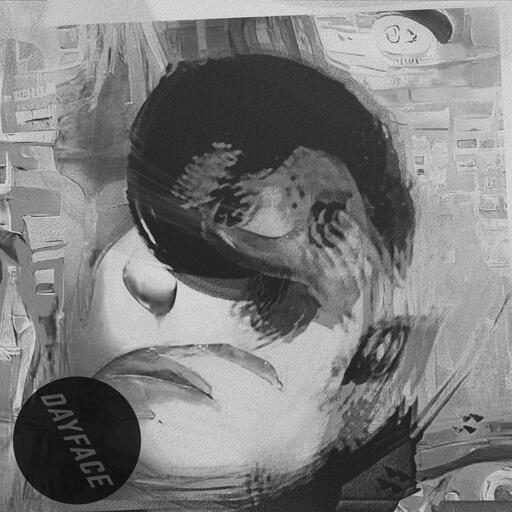
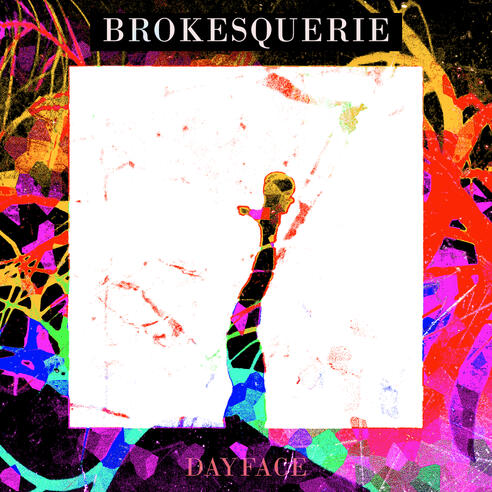
SINGLES
• (2024) 12 Dreams
• (2024) Shortcutcircuit City
• (2024) Punch the Sun!!! (Data Well Spent)
• (2024) Planet Los to Noiz
• (2024) Merge the Hemispheres / Gogh Get Your Digital Pen
• (2024) ROPATIN

• (2024) we were cold, but TOGETHER WE SPARK A FIRE
• (2024) SUPER ROBO STARPOWER!!! <GO! GO! GO!>
• (2024) Antenna MK2
• (2024) Moonkick Malfunction
• (2024) Synchronicity

• (2021) Moon? Not Tonight - Demo
• (2021) The Story of a Mother - Demo

VIDEOS

UNPUBLISHED WRITING• (2022) Mirriad
a short story / eulogy involving symmetry, magicians, palendromes, and snakes.• (2022) The Spiralling Shell
a short prose piece on nausea and spirals.• (2022) IUIOIUI: Limerence
a sombre poetic-equation on limerence.
AVAILABLE BOOKS
• (2022) DELIRIUMS
a delirious, febrile rewriting of Other Obsessions - the final form of those stories.
• (2019) Phantasomniphobia
a debut (juvenile) novel about dreams, time, dichotomies, etc.
UNAVAILABLE BOOKS
• (2023) Know Thyself (King Monster #1)
a delayed epic poem unifying Beowulf, The Book of Revelations, and William Blake.
• (2019) Other Obsessions
a reworking of Second Glance Meadow with amendments and additions.
• (2017) Second Glance Meadow
a debut anthology concerning obsession and interpretation.
• (2017) The Will of the Author
a debut novella, and the worst available version of the story.

OTHER• (2026) We Are More Similar Than Dissimilar
a candid interview exploring a vegetarian's views on empathy towards animals.• (2023) Invisible Cities - Thin Beta
an adaptation of Italo Calvino's Invisible Cities into an interactive fiction via Twine.TRACKERS
• Anime
• Books
• Comics
• Films
• Games
• Manga
• Music
• Music^2
• Shows

T|H|E STEINS;GATE RE:BOOT RE/VIEW

First, in conclusion...
I expected what I got and got what I expected because we've known about this for months. You might not like the fresh coat of paint, but it's still on one of the best cars in the world. Technically, almost every aspect of this re-offering is additive and subtractive, by virtue of removing everything (from audiovisuals to script) to replace it with something else...

Which sounds pretty rebuildy to me. I think even all the voice lines are re-recorded?
I've recontextualised this release both as a product for their fiscal quarter to keep their non-AAA struggling subdivision company afloat; and as a concerted effort to unify their releases under the new engine which premiered with Anonymous;Code (so I'm expected Chaos;Head to get this treatment, too, alongside Robotics;Notes).
This engine offers unique audiovisual idiosyncrasies not offered by other visual novels - they stand out far more than Ren'Py games, you gotta admit that - which while some of us might not care, consumers by-and-large do. I'll play Ryukishi07 releases in the original art style, but the 07th Expansion upgrades sell substantially better than the original vision.

Steins;Gate Re:Boot aims to synthesise the anime and visual novel experience to hopefully rope in new players who were otherwise put off by the abrasive (but to me perfect) qualities seen in the original. I felt disappointment at the lack of a CG (Computer Graphic, a picture) of Okabe looking up and down the street from the prologue. An iconic shot. But then I love the way Kurisu actually draws her demonstrations on the board during her time-travel lecture, as opposed to the overlay that appears atop her CG in the original.
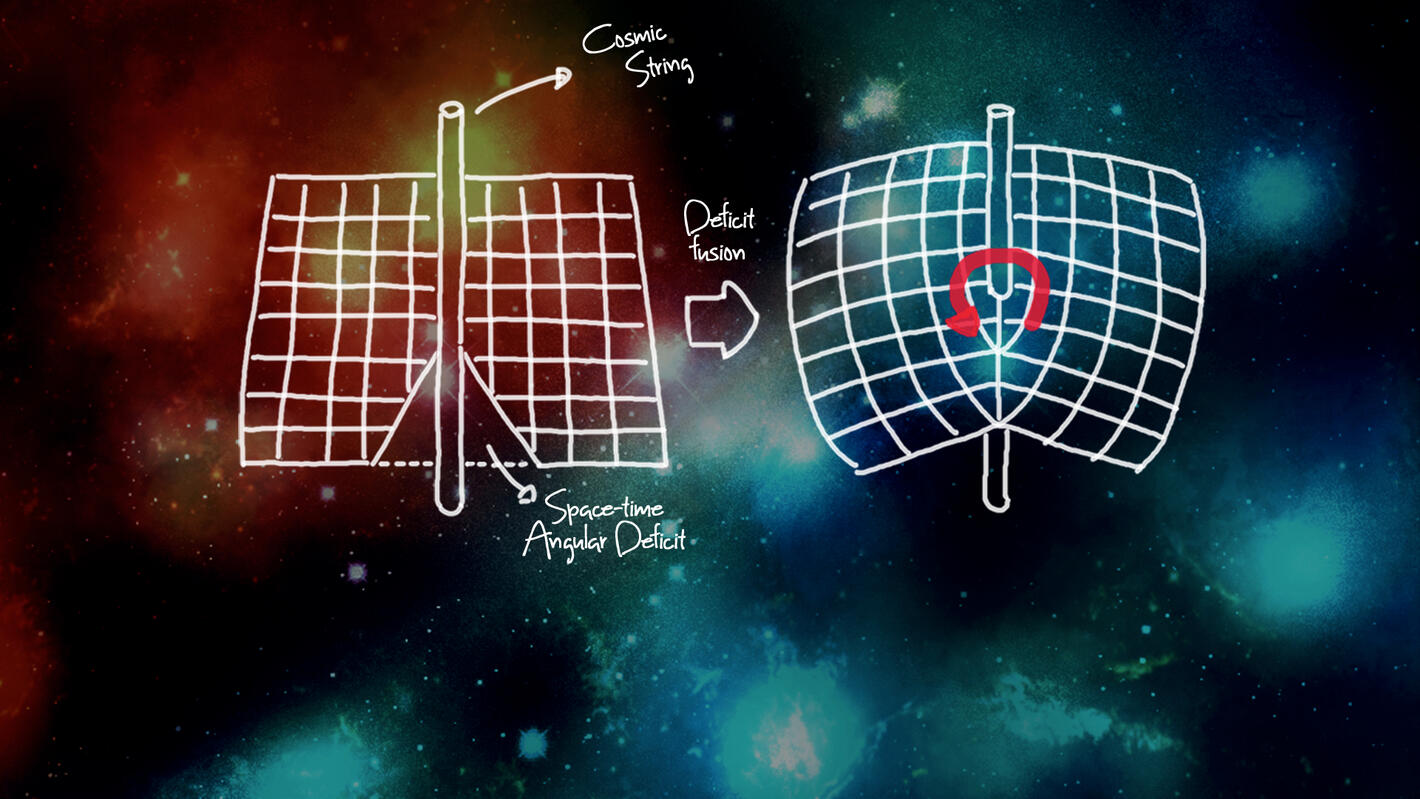
In ten years, I think we'll have a bunch of these new-engine facelifts and see this discussion over-and-over:
"Should I play the New;Gen Sci;Adv or the original iterations?"
The anime abridged the visual novel far more than this has so far and is still rightfully beloved. I think its ability to tell the story in 8 hours is admirable, miraculous, even. I think these middle-ground-density versions (ELITE and Re:Boot) have a right to exist (and are fare preferable to me than the 3 volume manga) though their non-commitment to total abridgement or complete adaptative work do leave them feeling like the middle child with less to offer in terms of quantity, quality, or brevity.
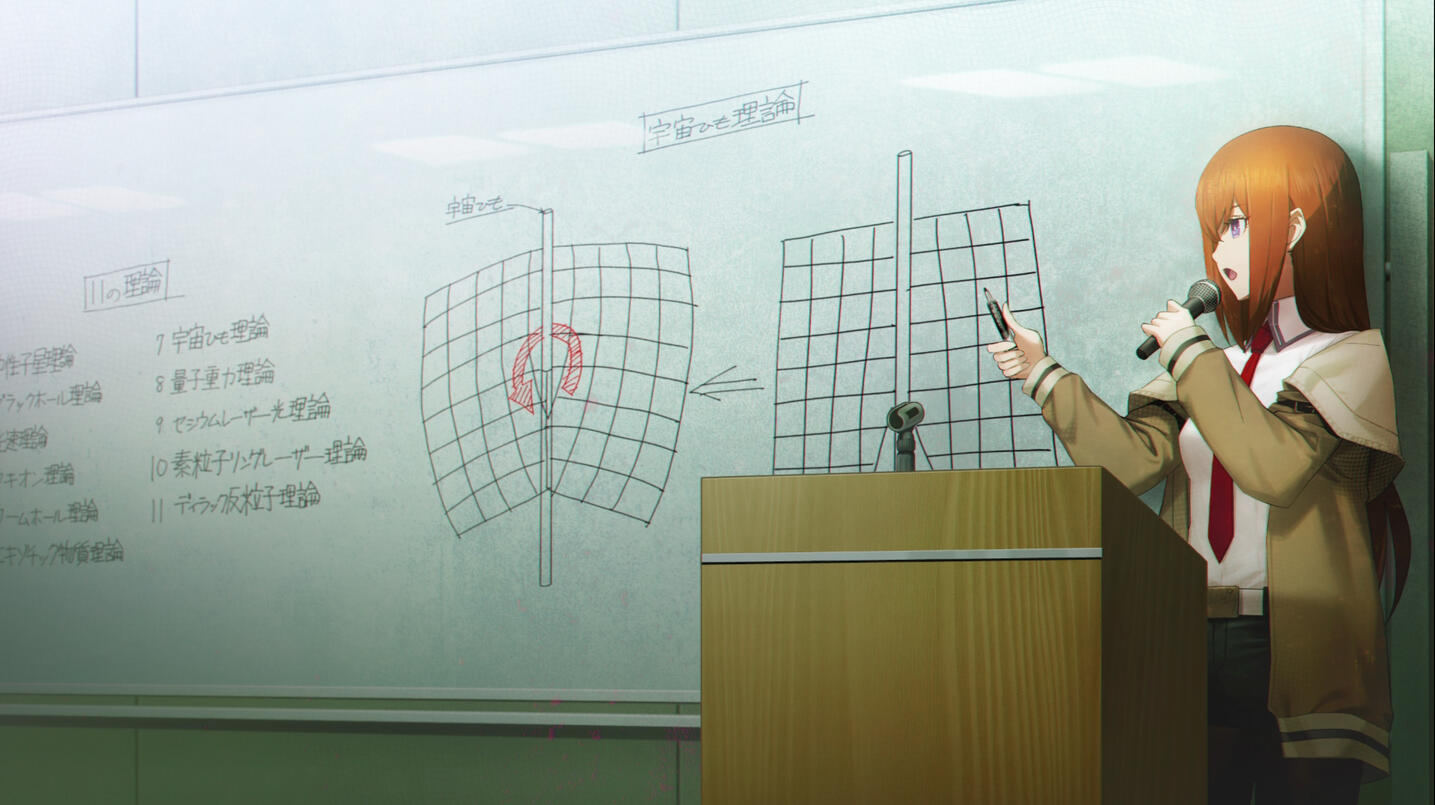
The way it looks...
If you'd been paying attention to Huke's social media between the release of Steins;Gate 0 and Re:Boot you may have been expecting a mutation of his style, too. The changes are compelling, and I do love the new art, but I would have loved to have seen a version of Steins;Gate rendered in the experimental mixed-media style featured on Huke socials circa 2023.

There are elements of the original Steins;Gate's visual identity distorted in the facelift: the (admittedly low-fidelity) urban texture imprinting upon the characters; the gritty streets of Akihabara scattered across clothing; bokeh blotches of sunlight statically floating through spotted threads of hair; nearly-hypnotic galactic whirlpools for eyes.
Steins;Gate (2009)
In lieu of this, the artist goes for a more 'glitchy' aesthetic with a gridded discotheque sheen applied to some characters. For other characters, distorted curvilinear dot density gradients simulate a type of chiaroscuro, equally exacerbating the digital aesthetics by lightly visualizing their vector fields. Background architecture, buildings and fences and staircases, are subtly affected by a moiré patterning to suitably simulate wave interference. You can see this in the spatially aliasing scanline texture applied to Daru's shirt and hat. It's a nice touch.
Steins;Gate Re:Boot (2026)
The textures remain stationary while the stroke outline of the characters move. It's a design choice more common now, but it reminds me in places quite a bit of the art nouveau of Alphonse Mucha and Gustav Klimt, the anime Mononoke, Mahou Shoujo Madoka Magica, Gankutsuou (The Count of Monte Cristo), the animated films Spider-Man: Into (and Across) the Spider-Verse, and Yoshitaka Amano's projects (particularly 1001 Nights) which I appreciate.

Leaking bursts of neon spill from the environment, while the additional background CGs for different weather and lighting conditions capture an idyllic sleepy town summer vibe somewhat missing in the original now I have a direct comparison to make.

An almost-anaglyphic overlay completes the cyber-crayon glitchcore-simulacra aesthetic befitting this remaster's namesake, differentiating it from the grittier, grimier, washed-out tone found in the original. It's a clean direction - more universally appealing, perhaps - that doesn't sacrifice too much of Huke's earlier iconic stylistic identity.

Steins;Gate (2009) / Steins;Gate Re:Boot (2026)
With that in mind, there are instances where the style feels forced, incongruous with the scene, environment, or surrounding colours, thus distracting me in the process. Once upon a time I may have felt that way about some visual aspects of the original. Time will tell how I'll feel about these changes. Three thumbs up, two thumbs down.
Case in point: the glitchy-stain remaining even when the curtains are drawn takes me out of the scene, though a later point made in this review concerning World Layers leaves me stroking my chin.
That said, the additional CGs add flavour, and the redrawn ones are done in such a way they barely infringe upon the compositional vision of the originals. Many of the CGs feature variations, multiple redraws with minor changes which convey an unanimated illusion of movement. One notable addition, for instance, is a CG of Okabe reacting to the changes Akihabara underwent following Rumiho's D-Mail. Just a shame they got rid of the iconic 'Okabe and the lonely road' CG from the prologue. Again: a step backward to take a step forward, resulting in inertia.

The animations endear me further to the characters. There's one moment in Chapter 5 which used panning and sprite-blocking to provoke a genuine laugh out of me. Unfortunately, there are only a few instances of this and I wish there were more. Whenever Mayuri is ignored you can see her frown, her sense of neglect or purposelessness writ evident across her face. Many online complain about the reduced word count, and while there are some moments removed I wish they'd kept, plenty of those removed words denoted expression or behaviour that the new animations compensate for (or even occasionally improve upon by virtue of key pose instant reaction).
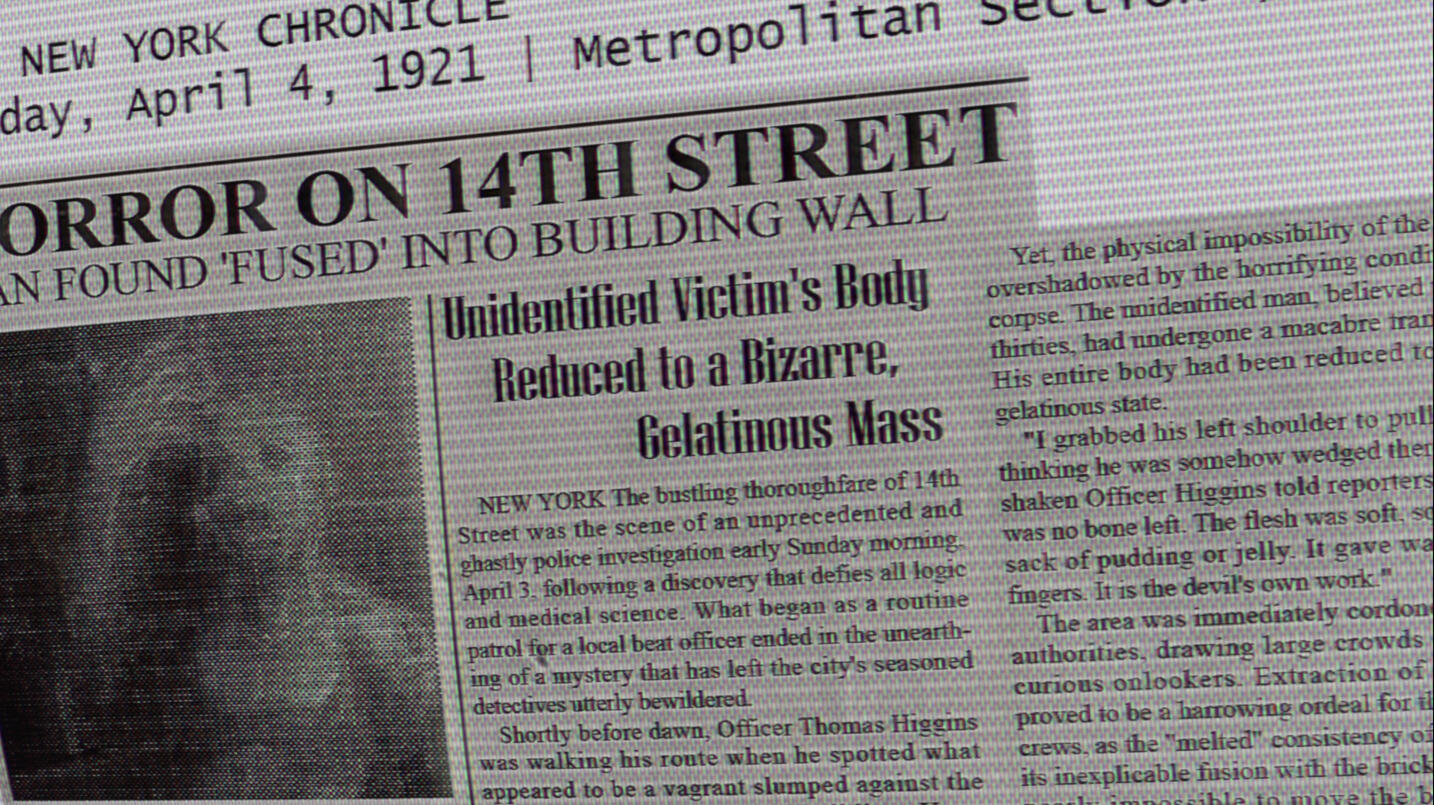
Also, while we're focusing on the art: why is so much drawn-Japanese left untranslated? Kurisu's later explanation of the time-leap machine using the Future Gadget Laboratory whiteboard is rendered entirely through hiragana, kanji, and emoticons... Thankfully, I already knew what was written, and she does go onto explain everything in detail. So, perhaps I answered my own question. When translocating, is it sometimes better to leave the original language if the intent and meaning is expressed elsewhere (in this instance: a subtitled explanation) for the sake of flavour and world-building consistency? At the very least (or to mankind's detriment) any instance of Engrish has been replaced with clearly legible English - the Jellyman reports were fun to read.
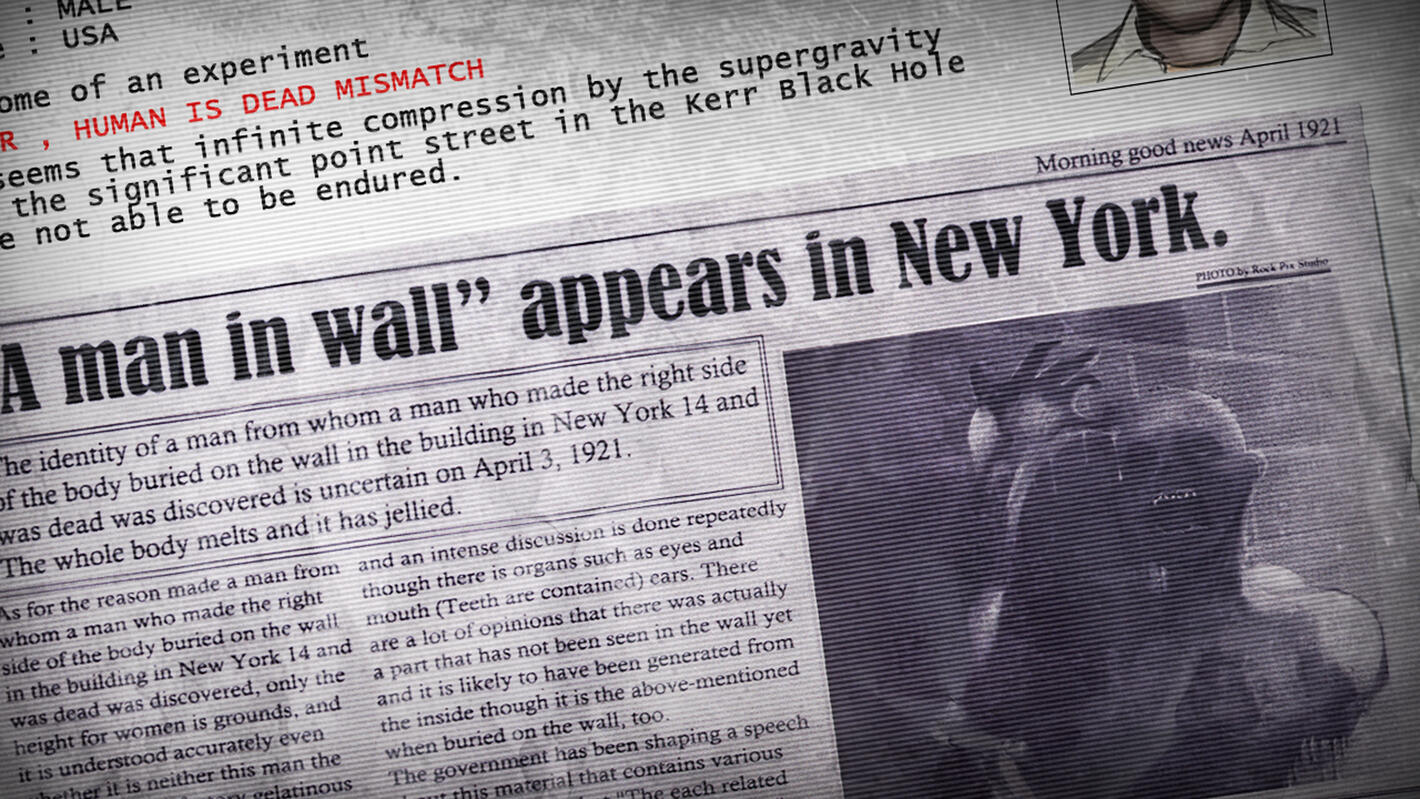
The way it sounds...
The soundtrack arrangement and remaster is wonderful, managing to keep the techno jauntiness of the original while blending in some of the orchestral emphasis you can hear in the Symphonic Reunion arrangements released in 2013. The soundtrack has always meant a great deal to me due to the way it marries the natural and scientific through woodwind, string, and keys paired with produced digital effects. Many of the tracks have extended lengths so some loop notably cleaner than their original counterparts. Though it could be nostalgia, I think I prefer the way the original score invokes a dial-up starry-night soundscape over these more dynamic and perhaps inherently emotionally stirring songs. Compare Select of Sorrow versions to hear what I mean. I can't shake the feeling I'm listening to cover versions of these songs - but that's a stupid complaint, ultimately. I'm also disappointed by the removal of Technovision - it's not in the game or the soundtrack. Farfalla of Fate is also missing from the soundtrack but is thankfully still in the game.

The reboot...
I want to concentrate on some of the changes they made to the climactic incident towards the end of Chapter Five: Dogma in Event Horizon to use as an exemplar for the rest of the game, though some of the changes are a result of the initial ELITE script conversion and not isolated to Re:Boot. I wish I could do a line-by-line comparison but this will have to suffice (I would gladly take on the task were I paid, or otherwise found the initiative to write a book on this franchise).
While they abridged some of Okabe's consternation during the lab invasion, they added a few lines for added suspense and tension. For instance, they added the line [I hear sirens wailing a few streets away] to the bomb-scare scene, accompanied by a Doppler effect-affected siren into the mix. Wonderful, fresh, fun, and sensible. They also added a line concerning Mayuri looking at her pocket watch - at the cost of a line involving her squeezing Okabe's hand. What better example of the strengths and weaknesses of this reimagining of the script, than this omission/addition?
Oh, and, uh, I suppose they also fired the black Rounders like they did in the anime (this time seen without the Court of Owl masks). I think the change to the squad is a good one, in theory - it strengthens the believability of Suzuha's combat prowess.

However, their design and the script itself demote them from professionals, subsequently reducing impact and scope of the literal foreign invasion of an aforementioned idyllic sleepy town summer vibe while deflating the fear of a wider, global conspiracy. And frankly, they look less remarkable. That's without mentioning the truncated tension - the comedian on the TV is gone, they don't raise their hands, no orders are barked, there's a lack of trauma in lieu of immediate shock.
Kurisu takes more initiative, sprinting to the headset and providing less pushback to Okabe's desire to leap, and it makes more sense for Okabe to activate Moad Snake before interfacing with the headset as it exemplifies his ingenuity while providing an atmospheric and narratively sensible smokey visual effect to the screen. Except we don't see them send the text!

Is Re:Boot's depiction of this event better? Personally, I prefer the drawn-out tension of the original, but greatly appreciate some of the other changes. I'd have to watch someone who's never experienced Steins;Gate play Re:Boot, reach this point themselves, and then gauge their reaction against the thirty instances of shock and dread I've seen others experience at this point while watching or playing. I hope readers might now recognize the trade-off apparent in the script conversion while also seeing some of the improvements, and can lament alongside me that we didn't get a synthesis of both. This is a reason for any frustration or barbed compliments. Do you occasionally find the pace of the original languid or belaboured, or do you feel friction between the prose/click-rate and the rate by which events occur? If so, Re:Boot's fluency may appeal to you over the original's density. To me, this is a case of Chiyomaru Shikura 'killing darlings' except we're not in the drafting process: this is a decade old game, and that comes with baggage.
Finally, to begin with...
One criticism I have is the way the player has access to a flowchart/timeline (here, named: World Line Observer) from the very beginning. That should have been given to the player when Okabe receives similar means of measuring divergence. Not only does it break the otherwise considered link between player and character, but it poses the risk of ruining some twists, surprises, subversions for new players. Though, I like being able to scroll up and down it with the mouse wheel, simulating the stochastic breakage of Okabe's linear interpretation of time through plucky loops, bounces and interruptions: a pizzicato movement as opposed to a sustained, continuous note. Though why can we not zoom out?

The tedium of the Suzuha ending, with those two days repeated until both Okabe and the player desire novelty, was the point. Abridging the hour of loops to a brisk twenty minutes weakens our perception of Okabe's willpower and his principles. The turn comes too soon: five minutes of cycling and we're contemplating the imminent disaster of our friends? If they must truncate text for levities sake, then the World Line Observer chart should have consistently reflected the repeated time-leaping underwent by Okabe. I would have loved a messy tangle representing Okabe's chaotic Groundhog day. But instead we are provided with three branches, the three instances we're privy, to summarize and not accurately reflect what should have been hundreds or thousands.

I found the Steins;Gate! All this time... Right before our eyes.
This, coupled with the way we're provided with the World Line Observer function from the moment we click New Game, suggests to me that we are the World Line Observer (a'la Anonymous;Code's Anon), and this chart is representative of what the player sees; not necessarily of what Okabe sees. One could charitably extract from this a generous intertextual reason for the abridgement: that in the instance of Re:Boot, we are operating on a World Layer above the original 2009 release, playing (ironically) a copy of a copy. I can almost imagine we've been tasked with using a Brain-Machine Interface to scrub through the original data like Men in Black or an analyst working for SERN. Supporting this theory: flashback scenes (moments of memory) adopt a frame-layer effect evocative of the original Steins;Gate's soft sunspotted urban decay texture fading into a gridded stereogram. But I digress. Like Cerberus at the foot of the Qliphot, I have a tendency to bark up the wrong tree. Either way, I may write about this some more in a big conclusive essay one day, after I've wrote about every Science;Adventure title individually.

There are other, small things I appreciate about this reworking. They officially refer to Mayuri's condition following the death of her grandmother as aphasia. Again, extrapolate from that the type of revisionism applied to certain terms, words, or phrases, which is reflected in the extended and expanded tips section. I like the additions to the tips catalogue, as they improve the game as both a hypertextual experience and a time-capsule preserving nomenclature from nearly twenty years ago. The original Steins;Gate featured 189 tips; ELITE featured 167, and Re:Boot boasts 290.
And I'm very glad they kept the "Who are you?" "42." lines between Suzuha and Moeka in reference to the 42-inch TV downstairs, as I've always personally considered that a reference to A Hitchhiker's Guide to the Galaxy. It's like Suzuha sends Okabe on his time-leaping adventure with the Answer to the Ultimate Question of Life, the Universe, and Everything. Likewise, at the beginning of the game, Mayuri's "That sounds like you, Okabe!" when discussing the supposedly stolen Upa happens directly before The Scream comes from upstairs, an incidental touch removed in the anime adaptation and thankfully retained here. Oh, and 4°C has had his role reduced down to a single line of dialogue and a mention, so his involvement in other entries might be lost on new players.


REFERENCED MEDIA -
- Gankutsuou: The Count of Monte Cristo. Maeda, M. (dir.) (2004–2005) [TV series]. Tokyo: Gonzo.
- Mahou Shoujo Madoka Magica. Akihiro Shinbo. (dir.) (2011)[TV series]. Tokyo: MBS, TBS.
- Mononoke. Nakamura, K. (dir.) (2007) [TV series]. Tokyo: Fuji Television.
- Spider-Man: Into the Spider-Verse. Persichetti, B., Ramsey, P. and Rothman, R. (dirs.) (2018) [Film]. Los Angeles: Sony Pictures Animation.
- Spider-Man: Across the Spider-Verse. Joaquim Dos Santos, Kemp Powers, and Justin K. Thompson. (dirs.) (2023) [Film]. Culver City, CA: Sony Pictures Releasing.
- Steins;Gate. Hamasaki, H. and Satō, T. (dirs.) (2011) [TV series]. Tokyo: White Fox,- Adams, D. (1979) The Hitchhiker's Guide to the Galaxy. London: Pan Books.
- Paul Wake. (2016). Life and Death in the Second Person. Manchester Metropolitan University.- Anonymous;Code (standard edition). Steam [Game]. 5pb & Spike Chunsoft: Japan.
- Chaos;Head Noah (standard edition). Steam [Game]. 5pb & Spike Chunsoft: Japan.
- Robotics;Notes (standard edition). Steam [Game]. 5pb & Spike Chunsoft: Japan.
- Steins;Gate (standard edition). Steam [Game]. 5pb & Spike Chunsoft: Japan.
- Steins;Gate 0 (standard edition). Steam [Game]. 5pb & Spike Chunsoft: Japan.
- Steins;Gate ELITE (standard edition). Steam [Game]. 5pb & Spike Chunsoft: Japan.
- Steins;Gate Re:Boot (deluxe edition). Steam [Game]. 5pb & Mages. & Spike Chunsoft: Japan.

THE GELNANIAD
NOTE /// This essay functions best as a sequel to my previous essay, Here Dead and Not Dead, Character and Reader.Poly-Mythic PledgeSteins;Gate dares to ask: what if Pandora's box were a microwave machine?
It's a retelling of The Myth of Orpheus, with Okabe in the position of the titular hero leading his beloved Eurydice(s) out of the abyss; a subsequent result of his katabasis, a true descent into darkness, his dark night of the soul. In a similar vein, he is Demeter out to rescue a Hades-bound Shiina Persephone. But he's also being led like Theseus out of a labyrinth of his own making, while SERN, his hubris, and the looming insistence of fate - like the Minotaur Asterion (of the stars) - follow him as he follows them, prey and predator losing semblance through an ever-shifting, Escher-esque maze of infinite spatio-temporal causal consequences. Daedalus made the maze, yet the Daedalian inventor-figures of this story are primarily Daru and Kurisu, rendering Okabe an Icarus against infinite suns.Here, Ariadne takes many forms (Suzuha, Faris, Luka, Mayuri, Kurisu) but the (Unmei no Akai Ito)^1 red-threaded route to salvation she provides goes by only one: Steins;Gate.The Fabulous TurnSteins;Gate is a retelling of The Boy Who Cried Wolf^2 where the villagers - after little resisting and convincing - believe the boy has, indeed, seen the wolf because those villagers are compassionate and emotionally intelligent, resulting in an act of self-actualisation through redemptive salvation from the boy: incessant looping to rescue them from a lupine fate. It's a retelling of Frankenstein (or, The Modern Prometheus)^3 where the patrilineage (God > Viktor/Prometheus/Okabe > Creation) is explored further by pairing God, or Father Time, with contemporary non-secular quantum considerations towards chronology. Kurisu is both another Frankenstein, and the bride reanimated.It's a Faustian bargain story with the devil-deal explored through a Djinn/Genie or Monkey's Paw mechanism, where a wish is re-contextualised as - well - a re-contextualisation: a distortion of prior antecedents to arrive at a preferable present. And much as in those stories, the life of the wisher is ultimately affected by unconsidered, unwanted causal distortions, and therefore, like those stories, reflective of the law of karma found in Buddhism, Hinduism, Jainism, Sikhism, and other practices and systems of belief. It's a thorough examination of prophethood, and distorted memories; a discussion on the Cassandra Complex and the Mandela Effect as experiential phenomenon written prior to that term's coinage. The latter term, that is. Not the former. Kurisu does not predate Helena of Troy.Steins;Gate 0, then, follows Orpheus-in-half, having glanced back on the way out; gored Theseus who elected to surrender his Ariadne to an island alone; Viktor after the creation kills itself without the Antarctic chase; Cassandra bound aboard Agamemnon's ship; flattened Sisyphus (what a solution - rock and roll, baby!). Billy Pilgrim: so it goes.A Scientist's PrestigeReturning to the conclusion of Steins;Gate, our [much-turned, much-turning] Odysseus Rintarou is guided home through assistance of the strategic, thread-untangling wisdom of Makise Athena: both cat-in-the-box and girl-in-the-chair. He must reject, then accept, the chūnibyō name he gave himself - Hououin Kyouma / Phoenix of Evil Truth - to respawn time and time again as a missionary of hope in response to the ever rolling boulder of immutable observation. His resurrection towards the end, following Steins;Gate 0, is an act of resistant Amor Fati against the Nietzschean Eternal Recurrence he is condemned to (best exemplified via the Suzuha route). And like Albert Camus before him, Chiyomaru Shikura's suggestion to the plight of Sisyphus is relative in nature, and involves a change of perspective: perhaps a little self-deception. Though, I imagine Okabe would have been quite upset and further confused had he received a message from a future iteration of himself suggesting, as a solution, the relatively pithy, "one must imagine Kurisu is not dead."The greatest trick Steins;Gate/Okabe ever pulled was to make us suspect Kurisu had died, and this was done in the unusual spirit of Keyser Söze: with devilish detail. Operation Skuld involves Okabe becoming something spiritually akin to a temporal Maxwell's Demon, except tasked with sorting information states at the boundary of the event horizon by impossibly staving off a seeming inevitability (predesignated entropy: Kurisu's death as ordained by convergence). He does this by satisfying the universe's observable requirements, manipulating imperceptible micro-antecedent variables (a stun gun and blood surrogate) while avoiding the otherwise ordained undesirable consequence. Okabe writes himself out of the dilemma like Houdini with an adept understanding of Novikov's Self-Consistency Principle: by tricking the audience's and past-Okabe's understanding of a key past event without changing the perceptual presentation of the event itself.Lying. Lies affect the eyes.If the observer can be deceived, then a world-line's reality is not absolute."How can mirrors be real if our eyes aren't real, Moeka?"Steins;Gate dares to ask: what if a jellied banana symbolised all the potential evil of Scientific Mankind? A high-in-potassium end extent to 'single vision & Newton's sleep.'^1 - Interestingly, Kurisu has a sewing kit in her possession at the opportune time to mend Okabe's lab-coat. They lampshade the happenstance of her wandering around with a sewing kit within the text, but it's heavily implied (and confirmed in the Steins;Gate: Babel of the Grieved Maze (Steins;Gate Aishin Meizu no Babel) manga) that the sewing kit was a recent purchase to ingratiate herself with Mayuri and her cosplaying habits. She had red thread (Unmei no Akai Ito) black thread (Moirai and their threads of fate) and pink thread (which possesses some modern symbology but no arcane or ancient meaning from my research). In the dark, she chooses pink randomly.
^2 - In one text, Kurisu warns Okabe of The Boy Who Cried Wolf to ensure sincerity from him.
^3 - "We may have created a monster, here..." Kurisu says upon realising the ramification of her invention too late.

REFERENCED MEDIA -Unknown. (----). Greek Myth.
Homer. (-800). The Iliad.
Homer. (-800). The Odyssey.W. W. Jacobs. (1902). The Monkey's Paw.
Mary Shelley. (1816). Frankenstein (or, The Modern Prometheus).Paul Wake. (2016). Life and Death in the Second Person. Manchester Metropolitan University.Steins;Gate (standard edition). Steam [Game]. 5pb & Spike Chunsoft: Japan.
Steins;Gate 0 (standard edition). Steam [Game]. 5pb & Spike Chunsoft: Japan.
Steins;Gate ELITE (standard edition). Steam [Game]. 5pb & Spike Chunsoft: Japan.
Steins;Gate Re:Boot (deluxe edition). Steam [Game]. 5pb & Mages. & Spike Chunsoft: Japan.

HERE DEAD AND NOT DEAD, CHARACTER AND READER
When I heard the learn’d astronomer,
When the proofs, the figures, were ranged in columns before me,
When I was shown the charts and diagrams, to add, divide, and measure them,
When I sitting heard the astronomer where he lectured with much applause in the lecture-room,
How soon unaccountable I became tired and sick,
Till rising and gliding out I wander’d off by myself,
In the mystical moist night-air, and from time to time,
Look’d up in perfect silence at the stars.- When I Heard the Learn’d Astronomer, by Walt Whitman
Why Do I Love Steins;Gate?
“Polytropos,” Wilson said [...] pointing to the fifth word — πολuτροπον — of the 12,110-line epic poem [...]. “The prefix poly,” Wilson said, laughing, “means ‘many’ or ‘multiple.’ Tropos means ‘turn.’ […] So the question [is] of whether he’s the turned or the turner."- On Odysseus; The First Woman to Translate the Odyssey into English, by Wyatt Mason
Steins;Gate was one of the only time travel stories of its time to sufficiently consider relativity in a way I find satisfying. It did this by narratively mechanising the ideas of wave function collapse into the story and gameplay while affording equal care to neuroanatomy and neuropsychology. It discusses the inherent romanticism at the heart of synchronicity (encounters, themselves: incidents, moments) by considering every (co)incident within its narrative to be important. Then it bundles those themes and concepts into a story of outcasts and geeks influenced by high-speed internet/messaging and otaku culture to drive home the core emotional message: connection requires sincerity, and our attention dictates our understanding of reality.This textual marriage of pre-deterministic fatalism and libertarian, agentive free-will speaks to those in the audience who are scientifically minded but cannot shake the predisposition of cyclical in-escapism, or even of a spiritual component (God, in a way, does exist within the Science;Adventure series - depending on your perspective^1). This reminds me of morphogenetic field theory - which I initially learned from the Zero Escape franchise, though I've read Rupert's work since. In this way, and others, I consider Virtue's Last Reward and Steins;Gate twins separated at birth.
Ergodic WeightErgodic literature, gamebooks, video games, and other contemporary examples of ludo-logical narrative, permit a non-linear observation of the text akin to navigating a labyrinth or maze. This is exemplified via the rogue-like genre of video games (The Binding of Isaac, Hades), or the emergent LLM narrative scene where 'infinite replayability' is the raison d'etre. The seventh-generation of video gaming consoles popularised bilateral ‘morality/karma systems,’ climaxing perhaps in popularity with the release of Mass Effect 3 and its ending, which portended the simplified forking of Telltale Games’s games and Life is Strange – all of which were heavily inspired by visual novel bifurcation (itself, ultimately, inspired by eroge games (and the Oulipo movement (Jorge Luis Borges’s The Garden of Forking Paths (The Arabian Nights (reality))))). Most films or novels, for example, are linear and incapable of observation beyond what is permitted. However, productions like Action Button’s Cyberpunk 2077 Review, Rayuela, One Hundred Million Million Poems, and Bandersnatch test the interactivity of such content. Likewise, the existence of paratext – from accompanying material all the way to fanfiction – lends itself to a seemingly endless amount of content. Branching narratives mirror the experience – the weight – of general relativity and causality: how our choices matter.Please, permit me be cringe when I suggest we are Players of Life. This is what Erving Goffman meant by sociological dramaturgy in his book The Presentation of Self in Everyday Life.
All the world's a stage,
And all the men and women merely players;
They have their exits and their entrances,
And one man in his time plays many parts- As You Like It,* by William Shakespeare
Life as we know offers no New-Game+ and too many quests, side-quests, and diversions for the playtime permitted –
Life's but a walking shadow, a poor player,
That struts and frets his hour upon the stage,
And then is heard no more. It is a tale -- Macbeth,* by William Shakespeare
Okabe finishes that soliloquy off himself verbatim during a moment of impotence, flipping Shakespeare's quote so it's not directed at the world or God - but himself, his rage, his ranting which he describes as "[..] pointless. Sound and fury, signifying nothing." Life is the greatest narrative tree we will all relatively know. We are burdened by our choices, memories, control, and all those of others, too; claustrophobic of the infinite, by a fear of missing branches.
Antipathy and BifurcationSteins;Gate metatextually explores the ergodic structure of visual novels (or gamebooks, even) and therein circumstantially makes a commentary on the countless permutations of life through discussions on pertinent quantum mechanics and general relativity. Consider how it comments on the dating structure of most harem or eroge games Daru might be found playing (a'la Tokimeki Memorial), or how all games - let alone visual novels - operate on a check-pointed trial and error > heuristic > algorithmic design, mirrored in Okabe's time leaping and exemplified in Anonymous;Code's Save/Load mechanic. The Walking Dead and Detroit: Become Human are dissatisfying in the way their bifurcating choice system can result in dead ends, bad runs or - at worst - a waste of time. None of that is in the Steins;Gate - everything is important and canon and there's a hopefulness to that approach missing in similar works.Steins;Gate also circumvents any nausea from FOMO (fear of missing out) experienced while playing some ergodic branching narrative fiction. Okabe himself experiences both FOMO and an overwhelming paralysis of choice. Steins;Gate dodges what Paul Wake (in his essay, Life and Death in the Second Person) dubs ‘antipathy’ which denotes a cognitive, ludo-narratively dissonant reaction resulting from non-isomorphic conditions set upon the brain.This is the example Wake provides:
"- Something is not quite right.
- You landed a fair blow on him, but he appears not to have noticed the wound!
- You deduce that this Undead creature is not vulnerable to normal weapons.
- If you are still alive, turn to 201."'Struck by a poisoned dart, the adventurer is the “you” who may or may not be alive, while the injunction “turn to 201” is directed vertically beyond the storyworld to the actual reader. Any attempt to deny the difference between the “you” who may or may not be alive and the “you” who is directed to turn the pages of the book results in absurdity and the reader can only respond – to the adventurer – "I am not you.” The impossible nature of this exchange, an example of what I am calling antipathy, captures neatly the paradoxical nature of the gamebook you which situates the reader in multiple positions at once; here dead and not dead, character and reader.'
Life is Strange, another game loosely about quantum physics, inspires a faux sense of causal reward (there is a canon ending that neglects your choices, much like with the Telltale Games’s games, and many decisions made throughout The Witcher Trilogy), while simultaneously encouraging a replay to see alternate (ultimately, non-canon) content. Whereas Steins;Gate directly address this by incorporating its 'replays' into the one play-through (circles within circles, all within, in fact, a straight line, if you zoom out far enough - which is why I appreciate Suzaha's visual demonstration of time-lines using the ropes in the anime). One of my favourite Fitzgerald quotes is “I was within and without, simultaneously enchanted and repelled by the inexhaustible variety of life” and I feel Okabe might relate.It’s interesting how, in the aforementioned essay (Life and Death in the Second Person) Paul Wake defines antipathy within the context of dissatisfaction from a gamebook, and in doing so accurately captures the nature of Schrodinger’s equation, the observer effect phenomenon exhibited through the double slit experiment. Gamebook antipathy reactive effects within the observing brain conceptually overlaps with the frustrating nature of wave function collapse, eigenstate manipulation, and ludo-narrative dissonance. Zero Escape: Virtue's Last Reward and Steins;Gate attempt to address these areas with an obsessive attention to detail, each featuring characters thrust into relativity thrillers, whereupon the main character and the player’s goals are unified, synchronised: to reach a fixed point in a timeline, achieve accordance of the mind, collapse possibilities down to one and close a loop of causal circumstance. Even skipping through text or loading a save from the main-menu can be recontextualised within the world-building.
Everything Matters (To Me)
"I saw my life branching out before me like the green fig tree in the story. From the tip of every branch, like a fat purple fig, a wonderful future beckoned and winked. One fig was a husband and a happy home and children, and another fig was a famous poet and another fig was a brilliant professor, and another fig was […] and another fig was […] and another fig was […] and another fig was […] and beyond and above these figs were many more figs I couldn't quite make out. I saw myself sitting in the crotch of this fig tree, starving to death, just because I couldn't make up my mind which of the figs I would choose. I wanted each and every one of them, but choosing one meant losing all the rest, and, as I sat there, unable to decide, the figs began to wrinkle and go black, and, one by one, they plopped to the ground at my feet."- The Bell Jar, by Sylvia Plath
In Steins;Gate, the main character is granted a cell-phone linked to a time-machine that can change causal linearity and the nature of reality. At select moments of the game, the narrative splits to provide an option of choice to the player, resulting in multiple alternative endings, all linked and canonical despite their impossible discrepancies, but all nonetheless lacking a sense of closure. It is only by reaching all of these idiosyncratic conclusions that the player unlocks the ‘true end’ – a conclusion which completes the loop and concludes the narrative neatly (there’s even a ‘sequel’ called Steins;Gate 0 which, by its paradoxical nature, operates as prequel, midquel, and sequel, without infringing on the original’s closed loop; The Stanley Parable 2 did something comparably impressive). It’s important to note this ‘true end’ doesn’t operate as simply as the trope it parodies. In Tokimeki Memorial, the ‘true end’ comprises winning the affection of Shiori Fujisaki, and in Sonic Adventure 2 one must complete Team Dark and Team Hero routes respective (likewise, Sonic Heroes requires completion four times via four different routes with minor deviation), to forsake naming countless other examples (I went for a funny one). The 'true end' of Steins;Gate is its namesake: a golden conclusion most satisfying to both player and the travel-weary Okabe.Steins;Gate considers a type of failure integral to success, to winning, and to a sense of reward. Its narrative is built like a complex prism (think: Nineteen Ways of Looking at Wang Wei but the poem in question is circumstance, the translator Okabe, and the 19 translations radically diverging timelines). Much like a Metroidvania, the player/Okabe acquire tools to unlock gates/defeat bosses, and take them to their conclusion, except instead of weapons or equipment like whips, shoes, or power-ups, they collect memories of failure, mnemonically encoded visual snapshots of alternative attempts gone wrong, and use these to manipulate antecedent events and change a circumstance: the ‘bosses’ to overcome are fixed points in time (convergence points in an attractor field). At one point, after numerous attempts to circumvent what feels like fate, Okabe resolves to destroy the PhoneWave in a fit of blind fury - but stops himself last minute. What a macabrely poignant illustration of potential gamer-rage.By the end, the non-linear components to Steins;Gate's narrative are harmoniously neatened into a linear sense of comforting closure by directly addressing this bifurcation antipathy otherwise common to similar branching narratives (via a rational intertextual understanding of Everetts, Bohr, Heisenberg, Einstein, etc - they literally name drop them in conversations about their work) therein circumventing the nausea prevalent in incidental open-loop systems seen in other examples of multi-choice narrative. While arguably imperfect, and regardless of aesthetic taste, these narrative structures shouldn’t be overlooked when researching closed-loop narratives of exceptional size. Furthermore, they attempt to capture the oceanic sense of time’s flow through narrative. Both textually and sub-textually, these types of interactive fictions challenge the statement, “No man ever steps in the same river twice, for it is not the same river and he is not the same man,” and provide a experiential antidote to the bifurcation antipathy prevalent in most interactive narratives.
“Midway upon the journey of our life, I found myself within a forest dark, for the straightforward pathway had been lost.”
- The Divine Comedy, by Dante Alighieri
And finally, somehow, it manages to adapt this 50hr+ experience into an 8hr anime. Danganronpa attempted to squeeze its first game into a 4hr anime. Umineko's adaptation is a disaster. This is one of the many reasons the three volume Steins;Gate manga is the worst way to experience the story. I'm writing this comment/post because I've had parts of an essay sitting around, and a few years ago I schizoposted about my connecting EIGENSTATE = STEINSGATE as a near-acronym while suggesting El Psy Kongroo meant 'The Mind/Wave Function Agrees/Congruency' - and while I love those readings and would love to have them confirmed, I'm growing increasingly worried that may have been apophenia... So, I wanted to post more concentrated and articulated thoughts on one of my favourite franchises to celebrate the release of Steins;Gate Re:Boot!^1 - I would argue the series does have God(s), or at least rationalises divine miracles and synchronicities as 'acts of God' in the vein of Spinoza's 'Deus sive Natura' or Rupert Sheldrake's 'Morphogenetic Fields.' Okabe battles God throughout the course of the series. Probability tuning is the pride and parcel of Chaos Magick, too, but that posits the individual as God. And while I agree with most aspects of autotheism, it can lead the thinker into solipsism, so in the words of Tengen Ozutani from Anonymous;Code, "I don't buy that participatory universe bullshit." Even Einstein said God does not play with dice. The divorce between spiritualism and scientificism, the issues with rigorous positivism and replicable studies can be best exemplified through William Blake's poetry (Newton's Sleep) but I'd recommend Jeffrey F. Kripal's The Flip (or indeed any work by Robert Anton Wilson) for a contemporary re-examination of where mysticism and science intersect (as they ever have) and what we lose by turning a blind-eye to one in favour of the other. I guess that's what Science;Adventure advocates for, too, in many respects.

REFERENCED MEDIA -Unknown. (----). 1001 Arabian Nights. Canterbury Classics:
Various Authors. (2019). The Penguin Book of Oulipo. Penguin:Jorge Luis Borges. (2000). Labyrinths. Penguin:
Italo Calvino. (1965). Cosmicomics. Vintage:
Italo Calvino. (1972). Invisible Cities. Vintage:
Julio Cortazar. (1963). Hopscotch. Vintage:
Mark Z Danielewski. (2000). House of Leaves. Doubleday:
Emile Durkheim. (2013). Suicide. Routledge:
David Foster Wallace. (1997). Infinite Jest. Abacus:
Erving Goffman. (1990). The Presentation of Self in Everyday Life. Penguin Reprint:
Yuval Noah Harari. (2017). Deus: a Brief History of Tomorrow. Vintage:
Yuval Noah Harari. (2015). Sapiens: a Brief History of Humankind. Vintage:
Charlotte Higgins. (2018). Red Thread: on Mazes and Labyrinths. Jonathan Cape:
Douglas R. Hofstadter. (1979). Gödel, Escher, Bach. Basic Books:
Douglas R. Hofstadter. (2001). The Mind’s Eye. Basic Books:
Douglas R. Hofstadter. (2008). I Am a Strange Loop. Basic Books:
Keith Johnstone. (2007). Impro. Methuen Drama:
Nick Montfort. (2005). Twisty Little Passages. MIT Press:
Friedrich Nietzsche. (1884). Thus Spake Zarathustra. Wordsworth:
Sylvia Plath. (1963). The Bell Jar. Harper Perennial:
Carlo Rovelli. (2022). Helgoland. Penguin
Jean-Paul Sartre. (1938) Nausea. Penguin:
William Shakespeare. (1599). As You Like It. Canterbury Classics:
William Shakespeare. (1606). Macbeth. Canterbury Classics:Paul Wake. (2016). Life and Death in the Second Person. Manchester Metropolitan University.A.I. Dungeon (standard, steam). Steam / Web [Game]. Latitude: Salt-Lake City.
The Binding of Isaac (standard, Rebirth). Steam [Game]. Nicalis: California.
Destiny 2 (standard free edition). Steam [Game]. Bungie: Washington.
Fortnite (standard free edition). Epic [Game]. Epic Games: North Carolina.
Hades (standard edition). Steam [Game]. Supergiant games: San Francisco.
Life is Strange (standard edition). Steam [Game]. Square Enix Europe: London.
Mass Effect 3 (GOTY edition). Steam [Game]. Electronic Arts: California.
Sonic Adventure 2: Battle. (standard edition). GameCube [Game]. SEGA: Japan.
Sonic Heroes. (standard edition). GameCube [Game]. SEGA: Japan.
The Stanley Parable (standard, Ultra Deluxe). Steam [Game]. Galactic Café.
Steins;Gate (standard edition). Steam [Game]. 5pb & Spike Chunsoft: Japan.
Steins;Gate 0 (standard edition). Steam [Game]. 5pb & Spike Chunsoft: Japan.
Steins;Gate ELITE (standard edition). Steam [Game]. 5pb & Spike Chunsoft: Japan.
Tokimeki Memorial (standard edition). PS1 [Game]. Konami: Japan.
The Walking Dead (standard edition). Steam [Game]. Telltale Games: California.
The Witcher 3 (standard edition). Steam [Game]. CD Projekt Red: Warsaw.
Zero Escape: 999 (standard edition, Nonary Games). Steam [Game]. Spike Chunsoft: Japan.
Zero Escape: Virtue’s Last Reward (standard edition, Nonary Games). Steam [Game]. Spike Chunsoft: Japan.
Zero Escape: Zero Time Dilemma (standard edition, Nonary Games). Steam [Game]. Spike Chunsoft: Japan.Wyatt Mason, NYTIMES. (2017). The First Woman to Translate the Odyssey into English. [Accessed: 03/02/23 latest]
(https://www.nytimes.com/2017/11/02/magazine/the-first-woman-to-translate-the-odyssey-into-english.html)
Action Button. (27, OCT, 2021) ACTION BUTTON REVIEWS Cyberpunk 2077. [Video] YouTube.
(https://www.youtube.com/watch?v=LnBKXvdYQI)
Yuval Noah Harari. (24, JUL, 2015). What Explains the Rise of Humans? [Video] YouTube.
(https://www.ted.com/talks/yuvalnoahharariwhatexplainstheriseofhumans)

A FEAR OF MISSING BRANCHES
(or, Nauseated by Near-Infinite Mazemedia)
(or, How Steins;Gate and Virtues Last Reward circumvent bifurcation antipathy of branching narratives to provide a paradoxical sense of closure)
• “Polytropos,” Wilson said, in her deep, buoyant voice, pointing to the fifth word — πολuτροπον — of the 12,110-line epic poem that I had come to her office at the University of Pennsylvania to discuss. […] “The prefix poly,” Wilson said, laughing, “means ‘many’ or ‘multiple.’ Tropos means ‘turn.’ […] So the question [is] of whether he’s the turned or the turner.”
- On Odysseus; The First Woman to Translate the Odyssey into English, Wyatt MasonFiction as a Tree'Interactive branching narratives' are named as such for requiring nurture on behalf of an observer upon their nature, designed or planted to blossom outward from likeminded roots (Starting Point), into idiosyncratic branches (Routes) replete with bespoke leaves or fruit (Conclusions/Rewards). Randomly-generated (and, arguably infinite) interactive fictions refer to their algorithmically-determined starting point as a ‘seed’ for this reason. This ‘essay’ concerns a nausea of the infinite experienced, or catacylsed, from engaging with infinite branching narratives.
• “Midway upon the journey of our life, I found myself within a forest dark, for the straightforward pathway had been lost.”
- The Divine Comedy, Dante AlighieriMazemediaErgodic literature, gamebooks, video games, and other contemporary examples of ludological narrative, permit a non-linear observation of the text akin to navigating a labyrinth or maze. This is exemplified via the rogue-like genre of video games (The Binding of Isaac, Hades), or the emergent Artificial Intelligence narrative scene (A.I. Dungeon) where infinite replayability is the raison d'etre.
The seventh-generation of video gaming consoles popularised bilateral ‘morality/karma systems,’ climaxing perhaps in popularity with the release of Mass Effect 3 and its ending, which portended the simplified forking of Telltale Games’s games and Life is Strange – all of which were heavily inspired by visual novel bifurcation (itself, ultimately, inspired by eroge games (and the Oulipo movement (Jorge Luis Borges’s The Garden of Forking Paths (The Arabian Nights (reality))))).
Getting lost in No Man’s Sky was the selling point. Refunds were the result of a broken illusion.
Observers of ‘mazemedia’ can encounter dead-ends, alternate routes, and missable content (and sometimes not see a clear destination), whereas most films or novels, for example, are linear and incapable of observation beyond what is permitted. However, productions like Action Button’s Cyberpunk 2077 Review, Rayuela, One Hundred Million Million Poems, and Bandersnatch test the interactivity of such content. Likewise, the existence of paratext – from accompanying material all the way to fanfiction – lends itself to a seemingly endless amount of content.
Branching narratives mirror the experience – the weight – of general relativity and causality: how our choices matter.• [Turn to 50 / Kill A or Kill B? / You Found the Secret Cave!]
• [You have 4 bullets / Kill 4 Zombies? / You’re out of ammo!]
• [Walk through the park / Left or Right? / That’s where you met!]
• [Go to the hospital / Pull the plug..? / Then what..?]Marketing the InfiniteModern intellectual-properties are switching to multi-verse narratives, constant patching, updates, sequels, and forever content. Owners of these IPs now desire fan-contribution (largely pornographic) to keep their imagined realities alive and thriving. This is a psychodynamically endorsed and currently effective push towards dominating the disciplined practice once reserved for religion. With enlightenment came industrialisation came mass-secularisation came globalization came the internet came fandoms – which is the capacity for an individual to worship what once were decried ‘false idols.’
Fandoms are alive where ‘God is dead’ to many.
Friedrich Nietzsche, John – more popular than Jesus – Lennon, and Kanye – I am a God, Yeezus, Ye – West, understand this overtly. These fandoms contain the social connections required to stave off Durkheim’s anomie (which is, ostensibly, the lonely result of disentangled non-conformity) but also operate as hotbeds for radicalisation and deindividuation. ‘Getting lost’ down the ‘rabbithole’ of something is encouraged, so the observer stays myopically within a single sub-culture (if possible); an echo chamber, and really, a financial ecosystem. This is one of many symptoms evident throughout the death of Western Monoculture (or, indeed, global Monoculture).
Fandoms have subsequently adopted cognitive techniques of ingroup language (wubalubadubdub / slang: take the L, you fell off, get ratio’d), figureheads of love and hate (waifus, Gaben, Anita Sarkeesian, Chris-Chan), gatekeeping and enlisting rhetoric (are you a real fan? / Join the Cause), adoption of practice (purchasing, religious playtimes, liking posts, doxing), proving oneself to the pack (receiptify, achievements, gamerscores, leaderboards) and other such subcultist practices that can foster ostracization, critical thought opposition, conformity, and deindividuation; all to incentivise further tithing (early access, downloadable content, in-app-purchases, donation, limited edition items (millions made)).
And now we make each other famous, idols; Warholian five minute celebrities.
We’ve exploited the infinite. We’ve exploited the finite.
We’ve even exploited a self-awareness of this to lampshade seriousness.Life in MotionBut we also exploit FOMO: the fear of missing out.
Modern-day advertisers (including, advertently, us) utilise this technique to play on a person’s existentialism. Each of us, ‘within and without,’ is an agent of choice, ‘simultaneously enchanted and repelled by the inexhaustible variety of life.’
We are players of Life – this is what Erving Goffman meant by sociological dramaturgy in his book The Presentation of Self in Everyday Life.• All the world's a stage,
And all the men and women merely players;
They have their exits and their entrances,
And one man in his time plays many parts
- As You Like It, William ShakespeareLife as we know offers no New-Game+ and too many quests, side-quests, and diversions for the playtime permitted –
• Life's but a walking shadow, a poor player,
That struts and frets his hour upon the stage,
And then is heard no more. It is a tale
- Macbeth, William ShakespeareIt is the greatest narrative tree we will all relatively know. We are burdened by our choices, memories, control, and all those of others, too; claustrophobic of the infinite, by a fear of missing branches –
• I saw my life branching out before me like the green fig tree in the story. From the tip of every branch, like a fat purple fig, a wonderful future beckoned and winked. One fig was a husband and a happy home and children, and another fig was a famous poet and another fig was a brilliant professor, and another fig was […] and another fig was […] and another fig was […] and another fig was […] and beyond and above these figs were many more figs I couldn't quite make out. I saw myself sitting in the crotch of this fig tree, starving to death, just because I couldn't make up my mind which of the figs I would choose. I wanted each and every one of them, but choosing one meant losing all the rest, and, as I sat there, unable to decide, the figs began to wrinkle and go black, and, one by one, they plopped to the ground at my feet.
- The Bell Jar, Sylvia PlathAnd so we play with fictional animations, representations, illusions, and simulacra of causality to distract us.
• Then suddenly it began to move before my eyes in light, uncertain motions; the wind was shaking the top of the tree. It did not displease me to see something move; it was a change from these motionless existences who watched me like staring eyes. I told myself, as I followed the swinging of the branches: movements never quite exist, they are processes, transitions between two existences, moments of weakness.
- Nausea, Jean-Paul SartreBut as advertising and that illusion of infinity have merged, we have become victims of a mutated self-referentiality. One cannot complete Fortnite, like one cannot ‘complete life’. The 'goal' in many respects – outside of having fun – is to build a portfolio of purchased accoutrements to your experience; yet limited items are incessantly incentivised. It encapsulates infinite capital production: forever and ever churning, a tide of content to wash us from birth to death neatly; a Ship of Theseus from which to spear whales. This is the case for Destiny 2 and plentiful other properties, including the Marvel Cinematic Universe: to lose yourself in their near-nihilistic, corporate universes – their micro-macrocosms – thereby exploiting our cerebral compulsion for closure, a requirement for an ending, until we must create an arbitrary ending ourselves. This includes putting your foot down and saying, ‘no more,’ and stemming the stream, the endless deluge designed to support an ever-growing product. But do any of these trees offer closure?Bifurcation AntipathyBoth Steins;Gate and Virtue’s Last Reward directly concern the structure of visual novels, gamebooks, and circumstantially the infinite varieties of life, through discussions on pertinent quantum mechanics and general relativity. They circumvent the FOMO nausea felt while directly addressing it as a subtext, getting around what Paul Wake (in his essay, Life and Death in the Second Person) dubs ‘antipathy’ (here: bifurcation antipathy) which denotes a cognitive, ludo-narratively dissonant reaction resulting from non-isomorphic conditions set upon the brain.• For example, IV and 4 are isomorphically equivalent; as is the phrase you survive, turn to page 40.
• Whereas, V and 2 are not; in the same way you are dead, turn to page 40 causes a semantic paradox.
• We find accord with symmetry; how our hands mirror; when we possess two eyes; karma. It could explain the allure of Aristotelianism and black/white logic.So, whereas Life is Strange, another game loosely about quantum physics, inspires a faux sense of causal reward (there is a canon ending that neglects your choices, much like the Telltale Games’s games and many decisions made throughout The Witcher Trilogy), while simultaneously encouraging a replay via FOMO to see alternate (ultimately, non-canon) content; S;G and VLR take this into account and incorporate multiple avenues linearly (circles within circles, all within, in fact, a straight line), so as to not waste time, and directly address the paradox of this in the process.
For instance: in Virtue’s Last Reward, you will make multiple choices, take one of many routes, and reach a dead-end, even a Game-Over, whereupon you are taken to the main-menu to try again. This is like any other game, which breaks the continuity Mario-style (he never died!) using checkpoints or the meta-circumstance of New-Game+, or even pausing and quitting. However, in VLR, at a certain point, the main character – Sigma – will experience interlocking memories of the other routes – your memories – therein bridging that dissonance and directly addressing this bifurcation “antipathy [that] captures neatly the paradoxical nature […] which situates the reader in multiple positions at once; here both dead and not dead, both character and reader.”
It’s interesting how accurately Wake captures the nature of Schrodinger’s Equation, or wave function collapse, and how it overlaps with the frustrating nature of wave function collapse, eigenstate manipulation, ludo-narrative dissonance, and gamebook antipathy or bifurcation antipathy’s reactive effects within the observing brain. VLR and S;G attempt to address these areas with an obsessive attention to detail, each featuring characters thrust into relativity thrillers, whereupon the main character and the player’s goals are synchronised: to reach a fixed point in a timeline, achieve accordance of the mind, and leave satisfied having closed a loop of causal circumstance.Closed LoopsIn Steins;Gate, the main character is granted a cell-phone linked to a time-machine that can change causal linearity and the nature of reality. At select moments of the game, the narrative bifurcates to provide an option of choice to the player, resulting in multiple alternative endings, all linked and canonical despite their impossible discrepancies, but all nonetheless lacking a sense of closure. It is only by reaching all of these idiosyncratic conclusions that the player unlocks the ‘true end’ – a conclusion which completes the loop and concludes the narrative neatly (there’s even a ‘sequel’ called Steins;Gate 0 which, by its paradoxical nature, operates as prequel, midquel, and sequel, without infringing on the original’s closed loop; The Stanley Parable 2 did something comparably impressive). It’s important to note this ‘true end’ doesn’t operate as simply as the trope it parodies. In Tokimeki Memorial, the ‘true end’ comprises winning the affection of Shiori Fujisaki, and in Sonic Adventure 2 one must complete Team Dark and Team Hero routes respective (likewise, Sonic Heroes requires completion four times via four different routes with minor deviation), to forsake naming countless other examples (word count forbids intricacies).
Steins;Gate and Virtue’s Last Reward consider failure integral to success, to winning, and to a sense of reward. Their narratives are built like complex mirroring prisms, whereupon failure is integral to completion and not failure at all but simply another step to a greater whole. Much like a Metroidvania, the player/character acquire tools to unlock gates/defeat bosses, and take them to their conclusion, except instead of weapons or equipment like whips, shoes, or power-ups, they collect memories of failure, mnemonically encoded visual snapshots of alternative attempts, and use these to manipulate antecedent events and change a circumstance: the ‘bosses’ are fixed points in time, in the past and future.
By the end, the non-linear components of their compositions are harmoniously neatened into a linear sense of closure by directly addressing this relative bifurcation antipathy common to branching narratives (via a rational understanding of Everett’s, Bohr, Heisenberg, Einstein, etc) therein circumventing the nausea prevalent in incidental open-loop systems seen in other examples of multi-choice narrative. While imperfect, and regardless of aesthetic taste, their narrative structures shouldn’t be overlooked when researching closed-loop narratives of exceptional size.
Furthermore, they attempt to capture the oceanic sense of time’s flow through narrative. Both textually and subtextually, these types of interactive fictions challenge the statement, “No man ever steps in the same river twice, for it is not the same river and he is not the same man,” and provide a narrative antidote to the bifurcation antipathy prevalent in most interactive narratives.
REFERENCED MEDIA -Unknown. (----). 1001 Arabian Nights. Canterbury Classics:
Various Authors. (2019). The Penguin Book of Oulipo. Penguin:Jorge Luis Borges. (2000). Labyrinths. Penguin:
Italo Calvino. (1965). Cosmicomics. Vintage:
Italo Calvino. (1972). Invisible Cities. Vintage:
Julio Cortazar. (1963). Hopscotch. Vintage:
Mark Z Danielewski. (2000). House of Leaves. Doubleday:
Emile Durkheim. (2013). Suicide. Routledge:
David Foster Wallace. (1997). Infinite Jest. Abacus:
Erving Goffman. (1990). The Presentation of Self in Everyday Life. Penguin Reprint:
Yuval Noah Harari. (2017). Deus: a Brief History of Tomorrow. Vintage:
Yuval Noah Harari. (2015). Sapiens: a Brief History of Humankind. Vintage:
Charlotte Higgins. (2018). Red Thread: on Mazes and Labyrinths. Jonathan Cape:
Douglas R. Hofstadter. (1979). Gödel, Escher, Bach. Basic Books:
Douglas R. Hofstadter. (2001). The Mind’s Eye. Basic Books:
Douglas R. Hofstadter. (2008). I Am a Strange Loop. Basic Books:
Keith Johnstone. (2007). Impro. Methuen Drama:
Nick Montfort. (2005). Twisty Little Passages. MIT Press:
Friedrich Nietzsche. (1884). Thus Spake Zarathustra. Wordsworth:
Sylvia Plath. (1963). The Bell Jar. Harper Perennial:
Carlo Rovelli. (2022). Helgoland. Penguin
Jean-Paul Sartre. (1938) Nausea. Penguin:
William Shakespeare. (1599). As You Like It. Canterbury Classics:
William Shakespeare. (1606). Macbeth. Canterbury Classics:Paul Wake. (2016). Life and Death in the Second Person. Manchester Metropolitan University.A.I. Dungeon (standard, steam). Steam / Web [Game]. Latitude: Salt-Lake City.
The Binding of Isaac (standard, Rebirth). Steam [Game]. Nicalis: California.
Destiny 2 (standard free edition). Steam [Game]. Bungie: Washington.
Fortnite (standard free edition). Epic [Game]. Epic Games: North Carolina.
Hades (standard edition). Steam [Game]. Supergiant games: San Francisco.
Life is Strange (standard edition). Steam [Game]. Square Enix Europe: London.
Mass Effect 3 (GOTY edition). Steam [Game]. Electronic Arts: California.
Sonic Adventure 2: Battle. (standard edition). GameCube [Game]. SEGA: Japan.
Sonic Heroes. (standard edition). GameCube [Game]. SEGA: Japan.
The Stanley Parable (standard, Ultra Deluxe). Steam [Game]. Galactic Café.
Steins;Gate (standard edition). Steam [Game]. 5pb & Spike Chunsoft: Japan.
Steins;Gate 0 (standard edition). Steam [Game]. 5pb & Spike Chunsoft: Japan.
Steins;Gate ELITE (standard edition). Steam [Game]. 5pb & Spike Chunsoft: Japan.
Tokimeki Memorial (standard edition). PS1 [Game]. Konami: Japan.
The Walking Dead (standard edition). Steam [Game]. Telltale Games: California.
The Witcher 3 (standard edition). Steam [Game]. CD Projekt Red: Warsaw.
Zero Escape: 999 (standard edition, Nonary Games). Steam [Game]. Spike Chunsoft: Japan.
Zero Escape: Virtue’s Last Reward (standard edition, Nonary Games). Steam [Game]. Spike Chunsoft: Japan.
Zero Escape: Zero Time Dilemma (standard edition, Nonary Games). Steam [Game]. Spike Chunsoft: Japan.Wyatt Mason, NYTIMES. (2017). The First Woman to Translate the Odyssey into English. [Accessed: 03/02/23 latest]
(https://www.nytimes.com/2017/11/02/magazine/the-first-woman-to-translate-the-odyssey-into-english.html)
Action Button. (27, OCT, 2021) ACTION BUTTON REVIEWS Cyberpunk 2077. [Video] YouTube.
(https://www.youtube.com/watch?v=LnBKXvdYQI)
Yuval Noah Harari. (24, JUL, 2015). What Explains the Rise of Humans? [Video] YouTube.
(https://www.ted.com/talks/yuvalnoahharariwhatexplainstheriseofhumans)

COMPOSITE ELEMENTS TO ELEMENTS OF COMPOSITION
Composed as I am, like others,
of elements on certain well-known lists,
father’s seed and mother’s egggathering earth, air, fire, mostly
water, into a mulberry mass,
moulding calcium,carbon, even gold, magnesium and such,
into a chattering self tangled
in love and work,scary dreams, capable of eyes that can see,
only by moving constantly,
the constancy of thingslike Stonehenge or cherry trees;add uncle’s eleven fingers
making shadow-plays of rajas
and cats, hissing,becoming fingers again, the look
of panic on sister’s face
an hour beforeher wedding, a dated newspaper map,
of a place one has never seen, maybe
no longer thereafter the riots, downtown Nairobi,
that a friend carried in his passport
as others woulda woman’s picture in their wallets;add the lepers of Madurai,
male, female, married,
with children,lion faces, crabs for claws,
clotted on their shadows
under the stone-eyedgoddesses of dance, mere pillars,
moving as nothing on earth
can move —I pass through them
as they pass through me
taking and leavingaffections, seeds, skeletons,millennia of fossil records
of insects that do not last
a day,body-prints of mayflies,
a legend half-heard
in a trainof the half-man searching
for an ever-fleeing
other halfthrough Muharram tigers,
hyacinths in crocodile waters,
and the sweettwisted lives of epileptic saints,and even as I add
I lose, decompose,
into my elementsinto other names and forms,
past, and passing, tenses
without time,caterpillar on a leaf, eating,
being eaten.
Manifested within Ramanujan’s ‘Elements of Composition’ is the idea of biological life being endlessly cyclic and ouroboric, even after death. There’s a focus on the passage of time and nature as though they were a river flowing through the individual, which is mirrored in the iambic-trimeter and tercet used that creates enjambment that cascades throughout the poem. Ramanujan ties empiricism and mysticism together to convey the complex processes of changing natural and corporeal life. He inserts personal memories – his incorporeal psychology and consciousness – to progress the poem and further exemplify the multi-dimensional facets to human existence; the ever-changing nature of form and matter; and the dichotomy prevalent through the ‘self’.Considering Ramanujan’s background – a scientifically inclined Hindu Indo-American raised by a renown Mathematical Brahmin father – we can discern ‘certain well-known lists’ in the first stanza to refer to the scientific periodic table and the five elements of the Vedas. Hinduism insists all life to be the amalgamation of those elements, and by dying that entity returns them, to retain the balance of the cycle of life. In the following stanzas, Ramanujan then lists those five Hindu elements - ‘earth, air, fire, mostly / water’ - but omits aether, due to its scientific invalidity; and also to align the Hindu paradigm with the Buddhists. These components are then gathered into a ‘mulberry mass’ or embryo (morula) that synthesizes ‘calcium, / carbon, even gold, magnesium’ to develop a ‘chattering self’ able to perceive time and change.In the introduction, he draws together both disciplines (scientific and spiritual) to basically delineate the biology of composition; then moves onto discussing scenes he’s witnessed in his life through ‘eyes that can see, / only by moving constantly, / the constancy of things’ such as:
Stonehenge; cherry trees; his uncle’s shadow-puppetry; his sister’s face; rioters, lepers, and dancers.
To these symbolic events, Ramanujan writes ‘I pass through them, / as they pass through me / taking and leaving’ further accentuating the symbiotic interactionism he feels between himself and the world around him. This underscores the fundamental concept of the Tree of Life: that humanity and nature are closely linked, and a balance persists to keep that transaction at equilibrium.
‘Even as I add / I lose, decompose / into my elements’ supports this thesis of continual exchange – much like the neurological re-uptake procedure of the synapse. Yet despite this give and take affair between nature and humans, time forces change and decomposition ‘into my elements / into other names and forms, / past, and passing, tenses / without time’ and this repeated metamorphosis of self, both corporeal and incorporeal, is much like the ‘caterpillar on a leaf, eating / being eaten’ featured in the final stanza.
Ramanujan could also be touching on the importance yet impermanence of memory, and the way we ‘pass through them, / as they pass through me’ often without a footprint. Everything comes to an end, and all can be forgotten with time. Whereas one may discover ‘a place one has never seen, / maybe no longer there’ with such distracted disregard, unaware and uncaring of the state of the place before, another person may carry a photograph of the riots he witnessed, perhaps first-hand, before the place was destroyed.Another central theme of this poem is the duality of self. Ramanujan was a deeply mindful and meditative person, even going so far as to indulge in mescaline for academic reasons in Huxley’s footprints. He was aware spiritually, and his belief in and search for altered states of consciousness or enlightenment can be seen in ‘the half-man searching / for an ever-fleeing / other half.’ And this search for an other half can take one through time or ‘Muharram tigers;’ temptation or deception or ‘hyacinths in crocodile waters;’ and religion - ‘the sweet / twisted lives of epileptic saints.’
Perhaps he posits that within us persists a distinct separation of sorts, whether that be between dissonant internal cognitive perceptions; or between the consciousness and the body – the relative reality and nature. Plato considered a split between body and soul, which was reiterated by Descartes with his concept of Cartesian dualism, wherein he suggested a similar division between our physical form and immaterial awareness - ‘I think, therefore I am.’The poem’s distinction between selves, and interpretation of life, is so vivid due to its illustrious imagery and stagnated atypical and occasional rhyming couplets; as well as its capacity to succinctly convey heavy concepts with abstract prose. Upon analysis, the poem is far more than a dissection of the elements of composition of a human – it is a concise summation of our ubiquitous struggles in life, and explores realities relatively perceptible by a human, whilst alluding to realities or life preceding, during, and following that original host’s demise. It is bleak hope.

FREEDOM FROM THE CARAPACE AND THE ARGONAUT
Both ‘A Green Crab’s Shell’ (1995) and ‘The Paper Nautilus’ (1961) repudiate ‘timeless’ art in favour of natural function and aesthetic. They focus on the passing of time, particularly deterioration and evolution, by paralleling the collapse of Ancient Greece and the Roman Empire to the insistence, determination and lasting impression of organic life. Both the narrator of ‘A Green Crab’s Shell’ and the nautilus of ‘The Paper Nautilus’ are struggling with concepts of mortality and entrapment - an organic enclosure or motherly protection - and are comforted by the sustainable aesthetics of nature rather than man-made art.‘A Green Crab’s Shell’ focuses on a narrator who, while investigating a shell, relays their discovering of inner-beauty in a stream of non-verbalised thought. The speaker perceives the shell as something artistic though anachronistic and archaic. Upon turning it, they are amazed by the internal aesthetic, and wonder how death could be sweet were we gorgeous within.
In ‘The Paper Nautilus’ the creature guards its unborn children, concerned with the integrity and sustainability of their shells. Moore uses simile to tie the ‘authorities whose hopes are shaped’ and ‘writers entrapped by / teatime fame’ to the ‘fortress’ made from love by the nautilus. The former prisons are untrustworthy, the latter reliable and true. The nautilus is adamant the young not leave their shells too soon, their fate does not mirror Cancer’s. The cephalopod shell, an evolutionary innovation exclusive to its genus, possessing traits developed unique to the nautilus, cracks precisely when required. As they emerge into safety their discarded carapaces float behind, resembling the ‘lines in the mane of / a Parthenon horse’ – something artistic and tangible, physically present and provable compared to the mythological and fictitious, but still doomed to deterioration.
Here, Moore also contrasts the grandiose state of Ancient Greece at its prime - ‘Hercules’ and ‘hydra’ - to artistic remnants proceeding its abased collapse. This motif of a falling Ancient Greece is used by Doty, too: the abandoned armour is described as ‘retrieved / from a Greco-Roman wreck, / patinated and oddly / muscular’ which parallels a gradual declination from power and prime to weakness and inferiority, like the once-great civilisation.
Comparatively the nautilus evolves, surviving throughout time from a ‘thin glass shell’ to the status of a hero, suggesting shells or ‘entrapments’ that have developed societally – such as writers, authorities, warriors – are less reliable or natural than love-crafted or organically natural constraints. Even if, as the title suggests, that carapace is paper-thin. The narrator in ‘A Green Crab’s Shell’ is concerned with life’s impermanence and the impurity of his own shell and finds relief through the beauty of another life’s remains. The nautilus, faced with protecting its unborn, holds them tight until they escape through force, leaving their remains artistically behind.‘The Paper Nautilus’ comprises five septet stanzas, with a rhyming second and fifth. The rhyming scheme is structured to provide momentum to the long fifth line, climaxing the built-up passion of the lines before. The sixth and seventh lines then continue, providing enjambment into the next stanza whereupon the rhyming scheme rebuilds itself. The lines ‘she scarcely / eats until the eggs are hatched’ for instance, can be read as a macabre alternate fate whereupon the nautilus, a weaker and worse parent, devours the young. The first stanza works as an introduction, of sorts, being punctuated by a full stop, and the second details the egg construction. The third and fourth then comprise the nautilus’ battle to protect the unhatched offspring, the fifth their eventual emergence. Perhaps the structure of ‘The Paper Nautilus’ intentionally resemble its namesake, with an arched shell and small legs protruding outwards. Each stanza’s form waves with its measure and syntax, just as nautilus floats underwater.
Whereas the elegiac ‘A Green Crab’s Shell’ comprises thirteen tercet stanzas, with no rhyming (aside from the appropriately tied ‘die’ and ‘sky’ towards the end). The structure is sharp, with disjointed measure and syntax; short and precise – much like the ‘scuttling’ of a crab’s movements. The disrupted meter moves when reading, back and forth, almost stochastic and autonomous. This forces the reader’s eyes to read in quick and short bursts, driving the rhythm forward with few pauses. The first and last stanzas are also shaped like sharp crustacean foreclaws, with occasional occurrence outside those two instances, presenting a snappy stanza structure with plenty of contextual relevance.
Both poets utilise hyphens. Doty uses them to signify a moment of contemplation (‘what his fantastic / legs were like -’ and ‘if we could be opened / into this -’) and conjure a natural pause before resuming. Whereas Moore uses one as relief (coming from / the shell free it when they are freed, -’) once the young are safe and the danger has been alleviated.
The title ‘The Paper Nautilus’ carries motifs of weakness, purity and delicacy that imply a timid, fragile creature. And while that may technically be the case – ‘thin glass shell […]/ perishable souvenir of hope’ - the subject of the poem is hallmarked by its strength and determination. The nautilus, here, is defined by integrity: a ‘maker/devil/fortress’ who ‘guards […]/ day and night’.
Likewise, the title ‘A Green Crab’s Shell’ is significant, depending on the reading, as the crab may have been granted immortality and returned to life. The shell discovered in the poem is a ‘patinated’ bronze, which means either the crab’s shell was restored to its previous green state, perhaps to honour and respect it. Or the crab was green, and it is the shell itself Doty immortalises.The narrator in ‘A Green Crab’s Shell’ roots the moment as forever occurring, looking at the ‘not, exactly, green’ shell with a history ‘we cannot know’, and musing ‘if we could be opened’ after perceiving the innards. Doty freezes the scene, perpetually suspending the realisation beauty can come from mortality. The words used are optimistic and playful in tone as the deceased crab is regarded as something ‘fantastic’ with its ‘little travelling case’ ‘preserved in kind brine’ ‘size of a demitasse’. The rhetorical question posed toward the end of ‘A Green Crab’s Shell’ brings the poem to its conclusion, comparing the crab’s cadaver with our own bodies to ask, ‘what colour is / the underside of skin?’
In contrast, the nautilus’ poem is told with a closed tone, safeguarded and fearful, matching the personified creature’s thoughts, which are elegant and sophisticated, if not broken or disorganised. The poem relies on contextual knowledge, using referential metaphors, particularly ones regarding Ancient Greece – ‘Ionic chiton-folds’ and ‘Parthenon horse’ – to describe the enigmatic creature also known as an argonaut, which shares its name with a band of voyaging heroes in Greek mythology due to the incorrect assumption they use their tentacles like sails. The words ‘Hercules’, ‘Ionic’ and ‘Parthenon’ intentionally catch the eye’s attention due to their appropriate capitalisation in the way ‘Giotto’ and ‘Greco-Roman’ do, supplementing the connotations of Ancient Greece already contextually prevalent through both poems.
Like fallen Greece, the crab’s demise in ‘A Green Crab’s Shell’ came about despite powerful or ‘muscular’ qualities. Because ‘a gull’s / gobbled’ away at the crab, with its ‘foreclaws’ / gesture of menace / and power’ helpless to stop the crab’s fate. There’s a sense of epiphanic euphoria which builds throughout the poem, climaxing at the exclamation mark in the ninth stanza. The narrator ceases detailing the crab, breathes, then continues: ‘imagine breathing / surrounded by / the brilliant rinse / of summer’s firmament.’Both poem end on a positive tone, with the nautilus’ young hatching out of its many arms – as if ‘the only fortress / strong enough to trust to’ – and the narrator finding relief in death so long as he ‘could be opened / into this […]/ revealed some sky.’ Their fears regarding imprisonment and containment – whether that be bodily aesthetic; fears of an early escape; the self within the body, or even mortality – are conquered by witnessing the remnants of a shell left behind. The discarded carapaces represent relief and humility, natural synergy, and constant evolution for them in a way the art of Ancient Greece failed.

SOMETHING IS WRONG III - EVIL VIE A LIVE
“Karma police,
Arrest this man,
He talks in maths,
He buzzes like a fridge,
He's like a detuned radio.”Baddiwad = Bad
Bugatty = Rich
Dobby = Good
Eegra = Game
Horrorshow = (Dobby)
Jeezny = Life
Millicent = Policeman
Prestoopnick = Criminal
Rozz = (Millicent)
Shaika = Gang
Vesch = Thing
Millicents & The Rulebreakers Of The Eegra“This is what you’ll get, when you mess with us.”If the world is a gameboard, society a game, policy the rulebook; then our belief in a criminal justice system (which itself must represent a referee) is binding acknowledgement towards the significance and persistence of that rulebook. Therefore, a general disdain would be held by the masses towards certain players - the cheaters, the rigged-to-winners, the ‘lucky’ - and a respectful appreciation towards those who played well. The issue is, the eegra is still in development. The rulebreakers of before are the leaderboard conquering bugatty, or are perceived as such. The eegra, The Machine, for an offender, possesses mechanic rules set against the player’s enjoyment and hedonism. The eegra, The Machine, for an offended or law-abiding citizen, possesses mechanic rules there to enforce a horrorshow, fair eegra.The difference between them?
There are numerous reasons to play the game of societal jeezny: to win or lose, to enjoy or despair, to gamble, to compete. The guilty prestoopnick does not care for others rules, and wishes to play the eegra by their own in order to succeed. Their desire is fair, is natural in a way society is perhaps not, however for the sake of harmony within this eegra - which we are all playing - they should and must be tried by the rules of many. Therein, it is how the individual perceives the eegra, with its complex rules - which sometimes seem unfair, rigged even - that determines their likelihood for criminality. And that perception’s original causes are innumerous.
One could attest that the rulebook, with its plentiful pages and threatening repercussions, limits one of his individual freedom; forcing to conform, be as one with everybody else, to wake up with all like in Zamyatin’s We. The question then becomes, in essence, a philosophical one. But first, how are these rules enforced?Shit, The Sheriff / Jeezny In An Android?Our system of criminal justice aims to detect, detain, try, and punish rulebreakers through policing, courts, correctional facilities, and other institutions designed to maintain a social equilibrium through the deterrence and reduction of malfactory behaviour. So, this feud between malfactors and officers is a shaika versus shaika type of vesch, with one side (‘o, our millicent enforcers of law) working seemingly out of justice and harmony, with the other side (the prestoopnick rulebreakers) working from a place of hedonism, or desire. For a long-time reactive policing - that is, millicents handling such baddiwad and prestoopnick behaviour after it had occurred - was the hindsight norm, however naturally most would want such behaviour to not happen at all.Therein in 1980, in response to riots, to improve success-rates and combat reactive critics, proactive police managerialism insisted on the construction of a fair-playing rozz driven through incentive programs intended to appeal to their hedonism. It takes the ethic / value factors of a free-market society, and applies it to the 43 criminal justice forces across the UK in order to be economically viable; efficiently acting; and effectively working. This is closely linked to centre-right community policing, and the idea that an alienated and misjudged rozz is incapable of effectively enforcing the rules. This all emphasises the end-result, rather than the process. But the biased concern for particular prestoopnicks results in an unequal distribution as far as resources are concerned; meaning many rulebreakers are left untried due to their financial or political circumstances; and with an over-reliance on conquering particular stereotypes, discrimination is sure to follow.Managed proactive policing focuses on the stability of community relations and the reduction of crime. To this end, proactive millicent forces employ a variety of inventive and controversially effective methods: strategically patrolling millicents; informant-dealing and information cultivation; undercover investigating; unknowing surveillance, and other means of catching prestoopnicks before they commit their deed. Naturally, critique arose in regards to this: don’t such methods of entrapment undermine ethical freedom, crushing one to be dooby and horrorshow against their free will? Could it not disarm one’s agency, and break one into a rung on the social structure ladder? Won’t paranoia heighten, creating a ‘harmonious’ Orwellian 'utopia’ of fake-smiles and dissonance? And what of the white-collar bugatty prestoopnick!? A reasonable suspicion must be present for a rozz to stop-and-search, for instance, but such a flimsily defined prerequisite is simply not enough. But the rich are rarely reprimanded.In the 21-century, with its overwhelming technological offerings - a vesch of almost magic - proactive policing has entered a new realm of predictive ability, with the assistance of analytical software capable of evaluating and ascertaining patterns in past incidents. Thereby the rozz intend to stamp-out the fire before it begins burning; before it creates victims singed, aflame. By measure of universal safety, this could likely be considered a dolly vesch, but where does it end?Fastforwarding: what does the future entail? Could such strategies be, in fact, an incidental dystopia masquerading as a peaceful utopia? Where’s the expression, individualism, when all must be a certain way? Is all rule breaking wrong; is it not 'there to be broken’? Would a uniform world where all is stable for the rich, where the police are enforcing a system capable of stopping the criminal before the crime - before birth, even - be a good or bad thing? Where’s the game in monotony? Where’s the life in an android?“For a minute there, I lost myself...”Prestoopnicks: People, Pests? Patience“Our crime against criminals lies in the fact that we treat them like rascals.”
- Friedrich Nietzsche, Human, All Too HumanFor now, rewinding:
In 80s neoliberal America and Britain, with Reagan and Thatcher mirroring one another in power as a response to the radicalist wave of revolution that had occured throughout the prior twenty years, right-realist paradigms on malfactory behaviour entered the limelight. Prior to this, the Marxist and Interactionist approaches were popular for their support explanations of criminality, however critics were growing tired of their impractical uselessness when it came to actually managing or reducing crime. And so right-realists rejected many grand theories on deep-structural deviant causation to pragmatically focus on the whole process. This branch of criminology argues the individual possession of rationality in each of us, particularly emphasising founded premeditation and predisposition towards criminal acts. This train of thought was set-off primarily by Cornish and Clarke (1986). Originally spearheaded by James Wilson (and Herrnstein 1975), (ex advisor to Reagan), the right-realist view considers the increase in criminality to reflect the anti-poverty ‘government handout’ programs that had found themselves popular, creating what Charles Murray (alongside Herrnstein) calls ‘the underclass’ - a type of Human spoilt on welfare and unwilling to contribute to society through direct economic currents.
Right-realists place emphasis on situation and environment crime prevention equally. Situational prevention acts as a deterrent through the usage of surveillance and gardening means such as alarms, CCTV, locks. Environment-based prevention methods include zero-tolerance patrols, ASBO, house arrest, guarding, and police community assimilation. The former aims to reduce opportunities for crime to take place, while the latter concerns itself with adjusting the criminal environment. Zero tolerance policing made popular at this time centered on making punition even more frightening and likely, by enforcing correct penalties for crimes as minor as begging, drinking, jaywalking, and possession. By cracking down on smaller issues, right-realists hoped to mitigate the likelihood of street-crime, and sway other people further from the act - though right-realists rarely spend any time cracking down on white-collar criminals.
Wilson (and recurring colleague Herrnstein, 1985) propounds a number of outdated biological theories on the causes of criminality, many based on deterministic predisposition, claiming (a’la Kretschmer et Sheldon) an innate type of body structure (the mesomorphic) is more likely to break the law. They also (1994) solemnly swear by their belief in the single-parent tainting the wellspring of all good in society and African-Americans to find themselves arrested more due to low IQ test scores.Responding in the mid 80s, Lea and Young (and later Elliot Currie) delineated a left-realist approach towards the criminal justice system in their book What’s To Be Done About Law and Order? This attitude strongly resembles the British Labour Party’s approach, focusing on the proletariat and the harmony of a well-working society; however their views diverge when it comes to blame and end-result. Left-realists want a reformation of society through social policy, not disintegration of such societal infrastructures, by admitting the offender accountable - regardless of stratified positionment - and therefore working with the police to assist the victim in the scenario without marginalizing or harming the criminal. To this end, left-realists consider crime and criminal conduct to be bound to occur, regardless of motive, and should be dealt with wisely. In a Marxian way, Lea and Young (1997) insist in a very realised concept of relative deprivation. That is, despite undeniably improved living conditions to have come over the past fifty years; the balance is off due to advertising and consumerism, resulting in a sensation of depravity and failure in comparison to others. They argue this relative deprivation to drive a major amount of crime committed by working class youths, and in that way their responsibility - which is still their own - is rationally also in the guilty palm of capitalism.Both right and left-realist perspectives agree that crime is an issue for a healthy society, but left-realists place more emphasis on present founded theories and the utilitarianism of a criminal justice system, with their opposition preferring archaic mantras which stigmatise the poor. They have massively influenced socio-political perspectives on criminal justice, though not all wish for such a tight and cohesive system of control.Alternatively, abolitionists believe social order breakdown to be at the root of criminal conduct, insisting punitive systems of management to not be the solution, but care and quality service. To this end, they heavily suggest crime to be yet another imagined reality, a concept of historical invention and relevance. They argue that crime is essentially a product of the criminal justice system, that each sustain and feed off one another, like twin snakes.
Based on, inspired by, the act of slavery abolition, this view emerged out of the 60s prison reform movements, and considers imprisonment to be inhumane: criminal, even. They don’t believe fire to successfully extinguish a flame, and some abolitionists (Angela Davis and the ICOPA) heavily emplore the abolishment of all systems of punishment and suggest a concentration on education and social cohesion. It's built on a moral conviction that criminal law is unable to regulate social life, and the system should be reduced in order for other more pragmatic methods of malefactor management.
They believe love to be the answer, in essence. It’s very hippy far-out stuff, but where there is smoke is likely a flame, and there were many hippies smoking in the sixties. This way of thinking about the criminal justice system hasn’t found itself snuffed out yet.Quite similar to abolitionism, Willem de Haan’s redress perspective (layed out in his 1990 authorship The Politics of Redress) critiques the penal system, with its high recidivism rates, to extensively rationalise a political strategy focusing on more on reformation. He advocates for conflict resolution and interpersonal reconciliation, as well as rehabilitation and re-acclimatization. This method of restorative justice emphasises alternate methods of resolution in order to make the criminal more aware of their actions, increase empathy and understanding, and perhaps unlock some remorse. These methods have proven to work in a multitude of European countries. See: Norway.But is there not a type of prestoopnick who wishes to act so-called baddiwad; to be a black-sheep among the horrorshow crowds; to defy the millicents with their bugatty owners? One who feels no remorse, because they are playing the eegra of jeezny and they see it as a dooby vesch? Certainly. However, ethically, would conditioning such a criminal be a good thing? Or a bad thing? To whom?A Crime CoefficientFastforwarding, once more:
Our Humanist game must have a rulebook. The growth of policy, and with it the criminal justice system, has served to protect the interests of Humans from themselves - and it is effective at doing so. However, we must never find ourselves so lost in the convenience that we neglect to remember something of intrinsic importance: that evil is in the eye of the beholder, itself a mere contrast to the good found behind the beholder's eyes. The line between dogmatic plutocracy and a free democracy is oh so, so very thin. Especially in the 21st-century --Where our doppelgangers reside online; where our personality is uploaded digitally, reconstructed with great accuracy, then sold and analysed; where CCTVs hang in orb-like structures, following and watching; where confidence can be castrated by body-worn cameras; where our locations are measured, and we are bound to impressionable long terms, conditions damning us with permission; where our DNA, logged and tracked by overlords, can be followed by forensics teams. The Karma Police still exists under a different name, post-Snowden revelation, for privacy is a vesch of the past. Technology is a tool; the hammer, also a tool, is useful in the hands of a craftsman - but in shaking psychosis hands?In this new-age of Science-Fiction consists a genre dealing with the very real threat of quantitative values placed on the personality, with a dataistic regard for Humans rather than qualitative, and the ensuing glitches with such a system. Gen Urobuchi’s acclaimed Psycho-Pass (or even K. Dick’s Minority Report and to an extent A Scanner Darkly) entails a dystopic future wherein an individual's latency towards crime is measurable on a quantitative level, and in order to 'keep the peace’ enforcers are tasked with apprehending or executing the potential threat. Naturally, there is an ulterior - rather fictionalised - motive behind the operation of the ruling Sybil-System; but it is that 'naturally’ which conveys such dread. Humans have proved their ability to imaginatively construct fantastic systems with devastating flaws time and time again. Similarly, Brooker's popular Black Mirror expresses the mirrored ideas of the masses: the possible slow dehumanising that comes with technology. These franchises are recent examples of such a genre, reflecting the fears of the Human race with regards to societal change and scientific accomplishment. And Science-Fiction has time and time again proved itself more prophetically accurate than The Bible.“People sleep peaceably in their beds at night only because rough men stand ready to do violence in their behalf.”
- George Orwell

SOMETHING IS WRONG II - RAGS FROM THE RICHEST
RulebooksEvery game needs a rulebook to work effectively. Every machine requires a set algorithm behind it to function as intended. Social policies are drafted then implemented via parliament and primary legislation through voting and consensus. These policies - directives established in order to reach a welfare objective - are constructed by the state in order to distribute and partition resources among citizens. They primarily focus on health, education, employment, housing, and social security, through social services such as the free market, laws, regulations, benefits, and charity. To that end, social policy is the state-supervised retaliation to societal problems, small and large. The degree of concern exhibited by the state varies based on country and society, with the parameters of welfare thought dependant on values, desires, and exercised authority of the state and government.Within the United Kingdom (a unitary state marginally directed by a central government) are a number of different agencies tasked with respectively different responsibilities. These include: parliament and its focus on primary legislation; the treasury, regarding the economy and government finances (through HMRC, taxation and social security contributions); the cabinet office’s concern for public service reform; the department of health, subsequently the NHS; the home office, concentrating on the retainment of public order; the ministry of justice, similarly retaining order through law, prison, and probationary services; the department for communities and local governing, focusing on local governments and housing, as well as urban policy; the department for education; and the department for work and pensions, which manages national insurance, employment, and provides a host of social assistance such as jobcentre, pension, disability and carer support.Gnawing on Marrow“I am still a little afraid of missing something if I forget that, as my father snobbishly suggested, and I snobbishly repeat, a sense of the fundamental decencies is parcelled out unequally at birth.”
- The Great Gatsby, F. Scott Fitzgerald, 1925The Poor Laws, originally passed in 1598 (though officially in 1601 with the Poor Relief act), administered by the parish, dominated much of British social policy until 1948. These laws were despised for their inconsistencies and general disdain for the poor or unworking. The 1834 Poor Law Amendment act aimed to dissuade poverty and able-bodies laziness through the policy of less eligibility, making the conditions in workhouses worse than any labour outside, with the pauper needing to be destitute to qualify for any relief. The individual seeking workhouse refuge would only do so if it were their last option; that was the intention. However at first the workhouses were too alluring. Food, accommodation, and clothing - almost entirely free - was certain to attract more than just the destitute. Therein, the houses were redesigned to look like prisons, with the prisoners inside given monotonous routines, derogatory discipline, and irksome labour. Commissioners also took the view that, due to such destitution, a pauperised man relinquished his right and obligation to look after a family, and so families were divided. This stopped them from breeding, humiliated them, stripped them of further prerogatives, and kept them docile despite hostility. Children were blameless for their poverty; they still suffered.
One such infamous example of inhumane treatment could be found in Andover, 1845. Across Victorian Britain paupers in many workhouses were instructed to crush bones of dogs, horses, Humans, and other animals for the production of local farm fertiliser. However the malnourished paupers of Andover possessed different aspirations for the bones of the dead creatures:“Q: During the time you were so employed, did you ever see any of the men gnaw anything or eat anything from those bones?”
“A: I have seen them eat marrow out of the bones.”
- The Select Committee on the Andover Union: Interview with Charles Lewis, 1846In 1929, the Local Government act was set in motion, breaking up the framework of the Poor Law act by transferring the responsibility of the poor to the local councils. Over the course of the next twenty years, a marginal amount of sick paupers were reclassified as ill patients and gradually the concept of less eligibility was phased out.Gradual AdjustmentIn London (1886-1903) and York (1899-1901), Charles Booth and Seebohm Rowntree helped overturn the long-lasting belief that poverty was at the fault of the impoverished by performing the first serious studies into it. Booth and Rowntree arrived to the conclusion that approximately 30% of people living in London and York persisted in poverty, with reasons they could not be blamed for. Only 3% of those below that poverty line were receiving assistance from the Poor Law act. The causes, they discovered, consisted of casual labour, total unemployment, extensive families, sickness, age, and low pay; not thinly veiled inequity masquerading and regarded as fact. Their reports assisted in the heightened awareness of poverty and its causes, subsequently changing most of Britain’s stance on impoverishment from disregard and disdain to concern and care. This coupled with the humiliating loss against the Boer Republic in 1899, wherein despite three years execution of decadent maneuvers they failed miserably due to 40% of British military forces suffering from illness.With the working class getting sicker, Britain’s military strength weakened from malnourishment and undercare, the impoverished no longer capable of being scapegoated, and a rising extension of franchise, the elites were left in a precarious position: do the work themselves; treat their subordinates with more respect and protectivity; or face a future society unable to compete with Germany, Russia, the USA, and other industrial nations rising further and further to prominence. Naturally the tie stayed on, cuffs remained buttoned, and the health and welfare of the population was spurred into improvement for the sake of national efficiency.The Beveridge Report of November 1942 suggested an expansive notion of national insurance derived from employment status; a fully functioning NHS; and family allowance. It was a cornerstone government report in the founding of the welfare state, addressing the five ‘evils’ of society: ignorance, desire, idleness, disease, and squalor. The report sparked a major revisement of many social policies by both parties, and with the 1945 election of the Attlee-ran Labour Government a number of acts were introduced in retaliation. Among them: the 1944 Education act; the 1945 Family Allowance act; the 1946 National Insurance act, including the Beveridge scheme for consideration and social security; the 1946 National Health Service act, and the 1948 National Assistance act, finally abolishing the Poor Law and providing support for welfare services. All three of the latter acts came into force on the 7th June 1948, resulting in a healthier and more productive economy.Approximately around the same time (1945-1979 est.), British politics was evolving in retaliation to the recent World War and socio-politico revelations, leading to a marginally agreed-upon unprecedented consensus for the introduction of more coherent and revolutionary social policies (many Keynesian in nature) which had been promised throughout that combatal period. This period of brief alignment between the Labour and Conservative governments - regardless of ideological differentiation - helped to maintain Britain’s appearance, performance, and status post-war.
This changed significantly with Margaret Thatcher’s Conservative party. Her policies reduced the generosity provided by the welfare state through the post-war consensus, and focused on privatisation, monetarism, economic sustainability (primarily for the higher-class) and dismantlement of the then-discredited (due to its inability to handle stagflation) Keynesian management.
Since the inception of the welfare state, two substantial reforms have occured within regards to its administration. The first, encompassing the 60s and 70s, reformed central government for better tracking and control of public expenditure, aiming to improve the managerial efficiency of the treasury via reallocative measures. The hope was for a more synergic, productive yet cheaper method of resource distribution. The second reform was established throughout the 80s and 90s, and primarily concentrated on the restructuring of civil services. This new procedure of welfare administration (called ‘new public management’) intended to introduce further managerial running of government agencies, now intended to perform like economic markets separate from one another for more precise individual assessment.The welfare reforms were followed by more extensive measures rich in draconian undertones, such as the constant and perpetual privatisation of the NHS; politically under-invested, superfluous to the wealthy who have access to more supreme healthcare. Because of this, the infamous British NHS A&E waiting-time has became a hallmarked staple - but at-least it’s accessible, affordable.
Conservatives possessing austere policies - such as Margaret Thatcher, Theresa May, David Cameron, Boris Johnson, Philip Hammond, and George Osborne - have openly repudiated the NHS despite the critical necessity of the welfare state towards the British economy (and subsequently, eventually, their wallets). They argue over its sustainability, concerned not with supporting the masses, but keeping them compliant, conforming, working and not complaining. This traditionally feudalistic ideology leans heavily on a natural order of things, essentially hierarchical in nature. Understandably, the rich who have been born into wealth would wish to retain that privilege even if they didn’t earn it completely themselves.Viruses of The Machine“I look at Libya, it’s an incredible country. Bone-white sands, beautiful sea. Caesar’s Palace - obviously, you know, the real one. Incredible place; it’s got a real potential and brilliant young people who want to do all sorts of tech. There’s a group of UK business people, actually. Some wonderful guys who want to invest in Sirte on the coast, near where Gaddafi was captured and executed. They have got a brilliant vision to turn Sirte into the next Dubai. The only thing they have got to do is clear the dead bodies away.”
- Boris Johnson, 2017All of this text is built upon a key cognitive foundation: deserving and undeserving. The deserving poor were considered as such due to illness, accident, age, or the genuine current unavailability of work. On the other hand, those undeserving were lazy, or dealing with personal issues like addiction. Victorians tried to concentrate on the assisting of deserving poor people, without encouraging or spawning undeserving poverty - and that, generally, is the aims of most current governments; particularly Conservative in nature.
But this all begs the question: if there is such an undeserving poor - measurable by their sloth-like hedonism - then surely there must be an undeserving rich?
David Lloyd George worked his way up from little into becoming (alongside Thatcher and Churchill) one of the recognised trio of great British 20th-century leaders. He taxed the rich to socially insure the poor, and introduced the 1911 National Insurance act. He turned the Conservative mantra of ‘undeserving and deserving poor’ upside down, in order to crudely analyse and attack the rich for their hypocrisy. He avoided the alleys of socialism by making a clear-cut distinction between those his party believed to have earned their wealth, and those who had simply inherited. Thusly he doubled death duties, believing “death is the ideal time to tax rich people” in order to maintain an equal, prosperous society wherein you can’t simply be born into privilege. Naturally, the aims of George weren’t fully succeeded - there are still a number of minorities who live a valuable life unearned - but that distinction of his was necessary and appreciated by the masses, a sharp cognitive weapon wielded by the centre-left. Michael Gove (2015) also made a clear distinction between the two types of rich people, but it's quite self-explanatory. The deserving rich have earned their money through honest hard work, adding value to society with their imagination and creativity. The undeserving on the other-hand fiddle with the stock-markets, ‘know-a-guy’, rig rules, and earn their superfluous cash through devious means not much greater than drug-dealers and con-artists.This gap, so say Gove and George and many, many others, is the detrimental flaw to a healthy and humane society. Those who exploit it throw the entire system into question. They are Trojan Viruses, sticks and twigs in the gears of The Machine.“Let me tell you about the very rich. They are different from you and me. They possess and enjoy early, and it does something to them, makes them soft where we are hard, and cynical where we are trustful, in a way that, unless you were born rich, it is very difficult to understand. They think, deep in their hearts, that they are better than we are because we had to discover the compensations and refuges of life for ourselves.”
- The Rich Boy, F. Scott Fitzgerald, 1926

SOMETHING IS WRONG I - MANIFESTED FANCY
“Freethinkers are those who are willing to use their minds without prejudice and without fearing to understand things that clash with their own customs, privileges, or beliefs. This state of mind is not common, but it is essential for right thinking.”
- Leo Tolstoy, 1887
Pygmalion and EmethSociety is a product of the collective Human imagination. Matter of fact, most accomplishments and great problems of this species can be attributed to the imagination. Gods, demons, laws, morality, economy, language; all products of the cognitive revolution. Agriculture, magic, technology, fiction, psychology are all macro examples of manifested fancy. But the micro proves just as intriguing, as we - on the individual level - are also products of our imagination.Case in point: The Pygmalion (or Rosenthal) and Golem effects are cyclic phenomenon which, when in effect, possesses the de facto capacity to alter the individual’s personality through a series of events. Put simply; one’s actions can impact the beliefs of others, causing them to then retaliate and reinforce one’s beliefs, in turn adjusting one’s actions. Therein, if A believes in Z, A is likely to then engage in Y which results in Z, proving A correct in their belief of Z - despite Y being the paramount variable in the formation of Z.
In 1963, Robert Rosenthal and Lenore Jacobson carried out a series of rudimentary IQ tests on second grade students in California. At random, they then selected a number of students to be marked as possible academic bloomers. One academic year later, Rosenthal and Jacobson surveyed the results to find that those randomly chosen students had, in fact, bloomed - despite the earlier prediction being an unfounded falsehood. Rosenthal and Jacobson later concluded that the reinforcement provided by the teachers (believing in the potential of those chosen students) and the results helped the students fulfil the expectations set upon them. And, likewise, the Golems of the class turned to stone through a sense of inferiority and less conscious grooming.This philosophy rings true throughout most of society and Human culture: be who you wanna be, Barbie girl; fake it ’til you make it. Even Oedipus, Voldemort, and Macbeth, fearful of prophecies set against them, took steps towards preventing it, eventually constructing the very means to ultimately lead to their demise.
The muggle sociologist Robert Merton developed the concept of the self-fulfilling prophecy, arguing that the micro-individual definitions of a particular entity can, in turn, integrate into its later developments: spinning a web of causality whereby eventually the entity becomes the definition - regardless of the legitimacy of the definition to begin with.So, we can deduce from this that the conjured, cognitive and corporeal realms are homogeneous; playing off one another, intertwined like perpetually extending and rotating metaphysical snakes indistinguishably slithering in a circle, with the same symmetry and synergy of a perfected tennis rally.The Mind FilterIn a similar, somewhat less flowery vein, the Human attitude is a symbolically interactive psychological construct for the apprehension and categorisation of particular entities. They can be explicit and implicit. An attitude develops out of socio-psychological foundations tied to an emotion or memory associated with the entity. As such, the sometimes illogical gut feeling is emotional in origin, and thusly lacking in substantive rationality. Many attitudes are born out of exposure or a value system; beliefs (religious, moral, micro, macro, educated or not) which entail a certain code, regardless of any blatant irrationalism or oxymoronicism rampant within that code. Conditioned through positive / negative operant and classical reinforcement and sensory reactions, an attitude can be formed in order for us to evaluate certain entities. This can range from an aversion inspired by past events, to an attraction based on aestheticism.Daniel Katz argues there to be four functional reasons for the formation of Human attitudes:
Firstly, we construct and read attitudes so as to make sense of the world and attain knowledge based on assumptive reasoning to assist us in later life. Then, with that insight, we can attempt to predict patterns for easier organisation and mental mapping. Second: to communicate and assert an identity or opinion and cathartically release our mental load. Third, as a prerequisite to interpersonal acceptance, improving the individual’s adaptive rate and likelihood of fitting in. And lastly: an attitude is constructed to defend the self-esteem of the individual. The individual attempts to justify actions or beliefs held for the sake of identity preservation. The attitude then dissipates when its function slackens in redundancy.
If an experience of unusually tense awareness appears due to the simultaneous holding of incongruent cognitions, with behaviour often contrary to the attitude exhibited, the individual is cognitively dissonant. Cognitive theorists contend cognitions to either be consonant, dissonant, or entirely irrelevant to one another. The cognitive dissonant individual can experience virulent symptoms resulting in undesirable physical arousal. They then seek to reclaim harmonious cognition, reforming their beliefs and actions to be consonant. The dissonance is lifted once the individual has added or changed cognitions.Humans don’t need to be in direct contact with the entity for an attitude to develop. They can semantically generalise stimuli in order to flesh-out their perspective. This associative linkage can either be logically founded, or completely fabricated. These cognitive and emotional components present within the formation of an attitude influences behaviour, which in turn affects the cognitive and emotional components, a ‘la Pygmalion et Rosenthal effect.The unreliable nature of cognition is evident through the serial position effect; a phenomenon wherein the recollection of certain items (usually a list of words) reveals a tendency to favour the beginning and end over the middle. These polar-points are known as the primacy and recency effect, benefiting from the cognitive processing capacity of long-term memory and working memory respectively.
The unreliable nature of cognition is illustrated even further with both the Loftus and Palmer (1974) eyewitness reliability study, and the Allport and Postman (1947) schema affect on recall study. In the former, eyewitness accounts of a car crash changed dramatically depending on the semantic structure of the question. In the latter, black and white Americans were separately presented with a picture depicting an argument between a black and white man, and then had to serially reproduce the seen scenario among one another until a conclusion was reached. The white participants tended to alter the tale more, perceiving the well-dressed black man to be at wrong. Adversely, the black participants saw the white man to be the aggressor - least of all because he was carrying a razor. The study concluded that social environment and preconceived expectations can distort both memory and perception.
And so we arrive at stereotyping.Skittish of Shallow WaterThe world is full of information. Everyday, IBM (2017) reported estimatedly 2.5 quintillion bytes of data outputted, and that doesn’t account for the vast amount of relative information provided to the individual either. To handle such a heavy input load, the brain generalises certain clumps of data into fragments. A stereotype constitutes as one such method of generalisation. Evolutionary psychologists consider the xenophobic side of this Human tendency to be a survival trait, assisting in the distinguishment between friend and foe. There are advantages, allowing for a rapid response to particular scenarios based on prior experiences of conceptions; and there are disadvantages, whereby these experiences and conceptions have developed into phobias or fetishes. This can lead to social categorisation and prejudicial biases and actions.Prejudice is a negative and destructive cognitive perception - often passed through lineage - regurgitated from mouth to ear, from mouth to ear. Aside from masturbatorily stroking the group ego for a sense of superiority, a prejudice provides a platform by which to scapegoat another group in an attempt to make sense of current issues. This legitimises and justifies later acts of discrimination, regardless of any lacking pragmaticism or empirical certifiability.
We’ve established how a stereotyped prejudicial concept, conclusive or not, can spin and distort until its borders are fuzzy. But to what end?
Humanism, religion, and egotism all promote a paramount intrinsicality for us, but the truth of it is: we are animals, animalistically breaking as we build. We’re imperfect creatures walking the walk of life. Prejudice is the stepping stone between stereotyping and discriminating. Many Humans have crossed that vicious valley, misguided by the directing stranger, unaware of the bridge further up.An obvious modern example of escalated prejudice would be the Holocaust, and the attempt at genocide extermination against all unbelonging of the Aryan race. The Nazi party targeted Jews and black people in particular, killing approximately two-thirds of the former in Europe. But there are other, sometimes less extreme - sometimes more extreme, examples of mass scapegoating and discrimination. Following the Pearl Harbour attacks, American masses refused to mingle with Japanese citizens, and during and after World War II, it was common and accepted to avoid Germans on the basis that they, too, were likely a Nazi. When the Taliban were in charge of Afghanistan, women were not allowed to receive education, and needed to conceal their faces in public. In Saudi Arabia, women are required to follow their male companion, never aside. British women could not vote like a man until 1928, and rape between spouses was determined impossible until 1992. In North Korea, millions die of starvation in the Worker’s Paradise courtesy of their Great Leader’s prejudicial values. The 1994 Rwandan Massacre epitomised and exemplified how tribal prejudice friction can result in a short-lived but long-remembered killing parade. And the Great Leap Forward of Communist China in 1949 set off a slough of genocidal acts, killing dozens of millions of people. The cognitive bias that homosexuals are uniquely capable of acquiring immuno-deficiency syndrome is still pervasively popular; as is the misconception that autism is a result of child-vaccinations. Institutional racism and apartheid; colorism and ageism; superiority and hate steering; stratification and ableism. The list would go on the length of three essays. Prejudice spirals, spirals, spirals, further from truth.People in BoxesOne could reason that surely a personality more prone to prejudice would exist. One would be reasoning correctly. Hippocrates (c. 400 B.C.) highlighted four main temperaments of the Human personality, each metaphorically tied to bodily fluids (or humors). The bloody Sanguine were considered optimistic, enthusiastic; the Phlegmatic were deemed lethargic and cumbersome; the dirty bile Melancholic exhibited depressive, negative traits; and the yellow bile Choleric angry, volatile, and upset. This oversimplified physiological method of personality partitionnement found itself popularised in the realm of post-Enlightened academia via Lombrossian methodology, and subsequently Kretschmer & Sheldon, among others.
However it wasn’t until Freud that academics attempted to approach these dimensions of Human personality with a genuine desire to understand. Twentieth-century psychological thought had been massively influenced by Freud and type theory, sparking an incessant desire among many psychologists to identify correlatives and congruities between traits, to empirically delineate the seemingly infinite array of personalities existing in the modern world. Thusly, they are called trait theorists.Allport (1936) catalogued over 18,000 individual trait adjectives by scouring dictionaries over the course of almost half his life, suggesting the average Human to possess seven central traits dominative in their behaviour. On a lesser level, secondary traits dwell emergent depending on situation and disposition. And then, finally, he theorized the rare emergence of a trait capable of dominating both the central and secondary traits: the cardinal trait, overshadowing the others to become synonymous with the individual. He developed this hypothesis extensively, eventually simplifying it down to 4,000 with the assistance of colleagues and fellow enthusiasts. In the 1940s, Raymond Cattell managed to reduce the voluminous list down to 16 basic and fundamental characteristics. This inspired a wave of new and alternative theories on personality traits, popularising scales such as Murray’s system of needs and the Myers-Briggs type indicator. Eysenck took all of this a step further, arguing personality to be measured on a paradigm consisting of three cornerstone factors: Psychoticism, Intra-Extraversion, and Neuroticism. Now, in the twenty-first-century, modern trait theorists believe personality to be measurable via Costa and McCrae’s Big Five.Following WWII, with antifascism abundant and fascinating, the psychoanalyst Theodor Adorno (1950) devised a scale measuring fascist traits to determine the probability of an authoritarian personality. Such a personality exhibited features including conventionalism; political aggression; ingroup submission; anti-intraception; superstition and stereotypy; projectivity and defensivity; sex, power, and strength. Many of these traits have descended into redundancy, but the general vibe proposed is a frightened personality with a rigid hierarchical-mind and a swift predetermined tight-fist. Such an attitude is thought to emerge in childhood. Despite its influence in understanding authoritarianism, Adorno’s F-scale was heavily criticised at the time of publication, and has been abandoned by modern scientists due to its anachronism. We now measure such a personality by other means (see above), with political researchers moving in favour of Altemeyer’s right-wing paradigm.The main criticism of trait and type theorising is that it is, ultimately, another method of stereotyping individuals for clarification. This then leaves the gate open for potential later prejudice and discrimination, this time perhaps backed with irrefutable evidence. It doesn't just emphasising the similarities present in us all, but highlights explicitly the differences.
Snake’s Third Eye Stares UnblinkingTo be discriminated against is a relatively awful thing. Whether it be for your skin colour, sexual preference, identity, promiscuity, or tastes and values. The ensuing issues with self-esteem and worth; stress, anxiety and depression can affect the individual in sometimes unprecedented ways. Such as underperformance, physio-psychological problems, an inflated predisposition towards drug use, and adherence to that self-fulfilling prophecy of before. Even some alleged peadophiles and rapists must feel a degree of discomfort when the prejudices held by others, regardless of moral substance, turn eyes of hate against them. But then isn't it suffice to say that our founded prejudices can sometimes, in ways, establish and retain harmony?
The Machine of society is a breathing creature, kept alive and healthy through the people within its belly, and the maintenance of each limb. To that end, the individual regarded with prejudice feels not like a necessary component of society, but an unnecessary detriment to the entire body - so say those surrounding. If founded and harmonious prejudice is similar to eradicating a varicose ulcer upon this body, then misguided prejudice is akin to hacking off a toe, which had been blueing from slight cold. Neither the bodiless toe nor toeless foot benefits, and therefore not the body either. Therefore, in such a case the sickness must stem from the societal brain. Or rather, the confused cognitions prominent within that brain, a metaphysical organ reflective of the brains of the many.In 2007, Ji Young Jung - a Korean researcher investigating connections between mood and contentment - released results of a study on the correlation between life satisfaction and positive thinking. Jung and his colleagues found compelling evidence towards the New Thought Law of Attraction, a universal law (or pseudoscientific collection of generalisations, depending on how you see it) firmly propounding that we, as individuals, construct our own realities through predisposed feelings and desires. This law is mirrored in our cognition, with CBT and cognitive affirmation training (consisting of creating repetitive thoughts to adjust reality) exemplifying our capacity to shape reality with our thoughts. Followers of the spiritual capacity of the New Thought movement (established in the 19th century) firmly believe in the Human ability to manipulate mental imagery, creatively visualising (via simulation of visual perception) with the intent to experience an affect or enhancement. Regardless of your stance towards New Thought, with its spiritual origins and mystic considerations for the nature of Human reality, it is near undeniable that a believer will likely experience results from their creative visualisation. Whether that be due to ignorance, a self-instilled self-fulfilling prophecy, happenstance and working superstition, a positive predisposition, or placebo. Which brings us back to Pygmalion, golems, prophecies and snakes.If I am due to you, it is fair not vain to subsequently suggest you are due to me. That society is due to us, as we are due to its nature and nurture. Throughout this text: a ping-pong effect. With a wiser consideration for the differences in others comes a fairer and happier society, breeding a content and healthier individual, considerate of the differences in others. An incessant relay needn't be negative: those snakes play off one another; they need not grow thin, withering in a spiral. They can slither forward together as one stronger and evolved unit, like the individual threads of a taut rope. The more aware and wise one is, the less frightened and wiser the others.

YOUDENTITY III - SUNCAST SHADOWS
Rite and Rong is RelativeC.S. Lewis considered Christian morality to be important on three different dimensions. Firstly, to ensure a harmonious equilibrium. Secondly, to force a productive kinship in a developing and good society. And last; to stay in good standings to God and successfully ascertain entry into Heaven. For the sake of argument, let’s assume ‘God is dead’. Let’s assume ‘we killed him’ and ‘objective morality’ does not exist.The moral (axiological) philosopher or psychologist attempts to distinguish and highlight different paradigms on Human conduct; define the ethical actions of people, and ultimately delineate and popularise concepts of right and wrong. To Nietzsche - himself not a moral philosopher - the question of morality was an ouroboric and futile endeavour. His esoteric, anti-realistic views on morality highlight a need for Humanity to transcend God, renounce their false-consciousness and transvalue our perspectives on suffering and sin. He argues a long-lasting master/slave morality dynamic adapted by Roman-Christians and Judeo-Christians. The master’s paradigm on good and bad reflected relative usefulness and nobility, with a greater emphasis on heroism and strength. The slaves reactively constructed a moral system of their own, forsaking the views of their overseers to focus on the powerless. They placed greater worth on victimising virtues based on good and evil; the latter marginally representing all their masters believed.Both Nietzsche and Yuval Noah Harari consider questioning these imagined realities; these values born out of the mind of Man, to run tantamount to discussion on the most metaphysically phantasmagorical of arguments. We are compelled to perceive the world through our respective internal moral goggles; there is no universal bad, nor unanimous good. Forever will there be a dissenter. Therein, crime will forever occur. As Durkheim asserts towards the beginning of his 1893 ‘The Division of Labour’; “each moralist has his own particular doctrine, and the diversity of doctrines proves the flimsiness of the so-called objective value.” Whilst we continue to define the nature of something Human, such as ethics, we’re consequently likely to support and propagate the oppositional view; the in-Human. Not that either is right. Morality is relative; and evidently malleable over time.An Ethical ConduitPsychodynamic theorists understand Human morality as depictive of the superego. They argue the ID to fundamentally manifest as anti-social and hedonistic. Therefore, an underdeveloped superego would fail to inhibit such rudimentary yet radical yearnings. Bowlby (1946) found maternal deprivation to lead to a higher latency for criminal behaviour. Likely due to such an underdeveloped superego.Eysenck (1964) argued a high scoring of extraversion, psychoticism, and neuroticism to correlate with a higher criminal likelihood. This is due to a higher requirement of cortical arousal; a more aggressive or passive personality; and a volatile mentality. Through socialisation - particularly as a child - the individual develops so as to not require immediate gratification. Unconditioned unsocialised personalities are linked to high E and N scores, because of a nervous system less susceptible to conditioning.For the cognitive psychologists Piaget and Kohlberg, moral development relies on the individual’s capacity to advance beyond multiple levels of cognitive reasoning regarding egoism and their formation of theory-of-mind. The former (1932) argues children to develop the morality of cooperation around the age of 10. Beforehand - while the child possessed a heteronomous paradigm on morality - concepts of right and wrong were characterised dependant on the child’s conditioning; primarily driven by an avoidance of punishment. Now, at 10 and possessing autonomy, the child can take into account various factors in order to barter and cooperate. For Piaget, moral development finishes once the adolescent is capable of ideal reciprocation over exact. That is, the capacity to view the world through another’s eyes and respond differently depending on context.Kohlberg (1958) refined Piaget’s crucial - yet not entirely realised - thoughts on morality. He devised three levels of morality developed by a Human; with each level consisting of two stages each. At the preconventional level, the child operates much like Piaget’s heteronomous child. That is, constructive of right / wrong paradigms based on obedience and punishment. The second preconventional stage delineates the child’s realisation that different individuals possess different ideals themselves. The adolescent then reaches the conventional level of morality. Within the first stage, the Human’s morality model is malleable; formed through conformity and compliance, with standards internalised in order to retain functioning interpersonal relationships. During the second stage, the individual’s internal compass is swayed by social order. According to Kohlberg, approximately 10-15% of individuals are capable of progressing to the level of post-conventional morality. Few devise moral rules for themselves, with the majority preferring the conventional level. The post-conventionalist renounces universal principles in favour of a unique set, understanding that there are times when certain moral dilemmas must be overturned for a specific consequence / result to, in turn, occur.Factors For The MalefactorTherefore, morality is somewhat of an imagined construct; an ingrained set of principles we uniquely adhere to - which, while idiosyncratic, are still vastly different to one another. Case in point, which is worse than the other: murdering a parent, or child? Raping an elderly lady; or eight puppies? How about two puppies? There is no completely right answer to these radically open-ended questions, but the differences in our respective morality gauges can range from the radical, to the minute. Offenders are Human. Any ‘wicked and depraved acts’ they committed, are only wicked and depraved because we, the empathetic spectators, deem them to be. These acts are Human. Nonetheless, for a working and functionally healthy society to prosper - such practitioners of marginally unaccepted ‘evil’ are to be detained, conditioned and rehabilitated; if not only for the comfortable maintenance of a harmonious civilisation.But what constitutes a criminal? Do such villainous masks exist due to a reason?
Bandura’s (1961) social learning theory promotes the importance of a non-conflict environment for children growing up. The child’s behaviour can - and will - be modelled after the environment and behaviours of others. In a similar vein, Bowlby’s internal working model denotes the importance of a predictable environment, free of volatility and fluctuation, rich in warmth and security. Inability to provide such an environment may result in a distorted perception of self and others; and an impaired attachment system resulting in an inability to function in a relationship. Such antecedents spawn such consequences. The young learn off what they see; that much has been proven. Violence; substance-abuse; inherited offendorial latency. The malefactor is not deterministically born at birth; unless we decide so.That isn’t to say the environment is entirely paramount in the construction of a deviant Human being. Neuroimaging studies reveal prefrontal dissimilarities in the brains of those diagnosed with antisocial personality disorder (making up approximately a quarter of both U.S and UK inmates) and otherwise typical individuals. Likewise, reduced regional blood flow and hypofrontality has been linked to criminal conduct; with 18% less active corpus callosum and an overall 6% increase in thalamus, amygdala, and limbic system activity discovered in a study of 41 murderers by Raine in 1997. Cognitive temperament caused by genetically inherited developmental disorders can be linked to a lacking impulse control, and behavioural difficulties. And, furthermore, an impaired amygdala or serotonin / dopamine neuroadaptive procedure can affect hedonistic indulgence.
Evolutionary psychologists such as Steven Pinker and Konrad Lorenz would contend violence, anger, and aggression to be competition-driven primordial survival instincts of Human nature, developed out of a multitude of necessities, so that the Human can serve atop the animal kingdom. Out of the battle for land and food, the male Human has inherited genes making them more violent than the female. This is reflected in the testosterone fueled assertion of dominance made repeatedly, every-day, by both Humans, and studied chimps.On the other hand, from a sociological angle, strain theorists would suggest stress - usually originating from status frustration - to prompt the individual to ‘achieve’ elsewhere; through criminal activity they consider a solution to the problems in their life and personality. The fresh criminal then indulges in their crimes further to achieve a sense of individuality and autonomy; to achieve wealth or success; or to inherit status and power (Engels, 1848; Martin, 2008; Merton, 1938).
Whereas Marxists would consider the higher-class capitalist to be the real criminal; exploiting and destroying the Humanity of thousands of baby-faced, culture loving, Eastenders watching, TK-Maxx exploring habitual and sentient creatures; pushing the poor to feed off pitiful systems they openly abhor, refusing to utter ‘please, sir, can I have some more?’ as if to admit their ‘inferiority’ like the maggots the right seemingly see them to be. Then, the un-wealthy individual, feeling like a cockroach, insignificant and in the way, feels not like a member of a functioning society, but indeed; like a cockroach, insignificant and in the way!“Why not, then, steal from the criminal as they steal from you!?” screams the criminal.Decadent ExistenceThe right-realists mourn the decline of traditional morality, blaming the liberalisation of the sixties and an over-reliance of the welfare state, among other democratically constructed economies. In ‘Thinking About Crime’ - a 1975 cornerstone book in the formation of right-realist theorists - James Wilson stated billions spent on welfare projects to result in that rising reliance, ultimately creating a lower-class more susceptible to deviance. Both he and Herrnstein (1985) concentrated on inadequate socialisation of youth; particularly those reared by single-parents. Charles Murray (1989) strongly proposed the existence of an underclass - a derogatory slur for such a lower-class; who would rather make money through means unacceptable for a working capitalist society. He also chastices the rising rates of illegitimacy and fatherless children, likely ‘due to the benefits system.’
Their theories influenced and inspired much of 20th-century / early 21st-century right-ran government, such as the anti-social focuses of Tony Blair and the subsequent formation of the blairite policy and ASBO - all systems primarily concerned with the Murray’s underclass.
What’s important to note is the maternal deprivation; high neuroticism, psychoticism, extraversion of the higher-class, also. And so we come onto white-collar crime.Not all thieves walk the street at night, with a sack (dollar sign imbedded) intending to claim your valuable possessions for their own. At the beginning of the 21st-century, WorldCom CEO Bernard Ebbers and other tie constricted senior executives were caught fraudulently claiming overwhelming earnings to conceal declining earnings. Bernard was sentenced to 25 years in jail, guilty of over inflating his company by approximately $11 billion. Jerome Kerviel - employee of a multinational banking and financial company - was sentenced to three years in 2012, following a rogue trading scheme went awry in 2008. He lost his company approximately $5.5 billion. And then there’s Bernie Madoff; scamming thousands of individuals out of $65 billion, and sentenced to 150 years in prison. And these are only the most macro obscene of cases. Embezzlement; forgery; bribery; fraud; deception. All second nature and known methods to the money loaded super-rich.Still, one thing is certainly clear. As bombastic and audacious the crimes of the white collar are, they are not who the masses fear. The conventional moralist - be it master bound, or slave - is far more compliant and complimentary of the slick bureaucratic businessman, though he may steal your cash through dubious means. They fear the violent criminal fed to them through the Newspaper and Television; the one who smashes, lacerates, forces, and pushes. That criminal who acts not just for the preservation of self, but for the extreme desecration of others.Switch OffFurther and further the atavistic criminal of Lombroso, Kretschmer, and Sheldon has faded into pseudo-psychological eugenicist obscurity. The media love to promote a ‘type’ to hate; but one ‘spoilt apple’ should not represent the bunch. The criminal character doesn’t always have tattoos; nor are they always hooded; or black; or fatherless. They walk upright, with eyes, a nose, lips, and a brain.Following the 2018 Parkland school shooting, President Donald Trump did not blame the NRA, or lax gun control measures. No, he blamed video games, once-more; despite the slough of evidence provided that correlation does not indicate causation. In 2018, gaming is more accessible than ever before; yet UK school shootings haven’t risen in the slightest. However with increased graphics and virtual reality, we will have to consider by which point one may depersonalise and over immerse themselves so as to not be capable of distinguishing the real from the virtual. The limited experience of GTA III pales drastically in comparison to GTA V in VR in first-person on a PC capable of running the game in 60FPS with ultra graphics, and no motion nausea. Little over a decade separates the two experiences. What cognitive changes will - most inevitably and unprecedentedly - arise from the developments of gaming? Will the Sony and Microsoft Playbox 3000, released in 2030, controlled via electrodes attached to the temple, connected to a VR headset and body relaxant booth - so the gamer can experience little to no discomfort during his hours of disconnect - be the one to do it?Durkheim considered the sudden social adjustment brought about by industrialisation to create a condition of socio-anomic disentanglement. This social change also affected morality; there were more variants. As different cultures, of different religions, mixed with one another (more or less ‘getting along’) there came to be the autonomous anomic individual - more-so, at least. Much like releasing a tank-born fish into the water; the Human mind, beforehand detained to the cognitive pools of olde, was permitted to swim in the ocean. This has become truer and truer throughout the 20th-century; certainly throughout the 21st-century, with it’s unworldly technological benefactions.Perhaps Nietzsche was right. Maybe our values, twisted and shaped by the events of the 20th/21st-century need transvaluation and solidifying. What is truly rong and rite? The postmodern lines have became blurry. Perhaps Valjean deserved it after all, Hugo?
Who knows?

YOUDENTITY II - SOME SAY SINKING SHIPS STILL SAIL

Less Than ThreeThe two driving forces behind functioning relationships of the modern era, it could be argued, are sex and companionship. The former to sustain a biological and intimately interpersonal requirement; the latter to provide support, partnership, and social growth. Of course, there is also the modern reason: love. But what is it? Nearly all Humans want to feel loved; desired; needed, in some way - and especially by the other Human we foremost want to love; desire; need. Experiences are better had with those you care for, who care for you. And now, it’s easier than ever to get a quick fix of love in some way from your friendly online dealer. Romance, sex, love and all that came with it has changed dramatically, especially with the internet. It’s up to us to redefine it once more.Human GlueHumans banded together to survive, and after hundreds of thousands of years of genetic mutation, they developed a cognitive kinship for their biological creators and fellow offspring; a unity primarily of the mind, designated friends at birth. Post-industrialised Britain in the 19th-century introduced modernity, class, and general consensus. The tight-knit, all under-one-roof dynamic of agricultural Britain moved to a segregated urban life - driven by capitalism to power machinery. We call these Human groupings - of individuals connected through consanguinity, strong empathetic association, or cohabitation - ‘families,’ and structurally study them for their revealing psycho-social insights.The conjugal nuclear family consists of the mother, the father, and the child. This type of grouping found itself the most popular throughout the 20th-century. In the case of divorce, desertion, or death of a parent role; that grouping is considered a single-parent family. Then, were they to remarry; the blended family would be created, incorporating the stepfamily of each party respectively. Beyond that - the cousins, the aunts, uncles, the grandparents, and more - are deemed extensive of the maintree: the extended family.As with most things, these Human bandings exist for a reason. Functional theorists, such as Murdock (1949), consider families to provide a plethora of functions: the socialisation of children, provision of economic and emotional support for all involved individuals, regulation of sexual impulses, and construction of identity. Parsons (1951) optimistically argued this ethnocentric argument further. He claimed future generational society to cease to function correctly, were the parents or family incapable of indoctrinating the value consensus, cultural views, language, knowledge, and morals of their community and society into their offspring. Parsons also believed the constraints, pressures, and expectations of a modern society destabilised the personality; and that clear-cut role division of Human males and females provides a warm-bath opportunity for convalescence, recuperation, and personality stability - primarily for the breadwinning male.Adversely, the Marxists claim this indoctrination necessary for a capitalist system to succeed as a replacement for the primitive communistic behaviour of Human groupings preceding it. Engels (1884) understood the conjugal family to exist foremost for the transmission of private property and possessions. This allows the top-players to pass their status to their young; and the proletariat to give their struggles to their own. In a similar vein, Althusser (1971) also argued the apparatic and functional components of the family to transmit the capitalist ideologies of their beloved forerunners.Due to its functional simplicity, the division of roles was clearly defined by the society of the time. The woman was to play an expressively empathetic, supportive and secondary role; assisting the man with his productive and busy life. Rearing of the child was to be left to the woman also. Naturally, this patriarchal partitionment imprisoned the Human woman. They were, mostly consciously; but also unconsciously, controlled and subjugated by the other Humans; a creature nothing if not devious. The physical strength exerted over women since antiquity had evolved into a psycho-sociological strength.The Picked Wings of ButterfliesThe emergence and recognition of prominent feminist activists and writers throughout the 20th-century has incurred a growing follower-base of multi-waved fighters against patriarchy. Tired of the myth commonly referred to at the time as the symmetrical family, feminists argued against the supposed equal functionality the 20th-century nuclear family provided. Young and Willmott (1973) claimed such a family to exist, with 72% of males performing at least one household task a week. Needless to say, in comparison to women this was a paltry sum. Oakley (1974) refuted their keynote points as audaciously overblown, with research consisting of overstated answers to biased and open-ended questions. In her own research, she discovered the average full-time housewife to spend up to 77 hours a week at home domestically working away.They were still expected to perform housework; sacrifice opportunities; please their husbands; and yet also to remain quiet. They were given less say in most arrangements due to their financial reliance - itself a product of capitalist patriarchy - and in many cases made to suffer at the hands of domestic disputes, often involving violence. Duncombe and Marsden (1995) discovered the undertaking of a triple shift by women in British society comprising emotional, domestic, and paid work - all for less money. In a similar vein, Benston (1972) disputed the claims made by Parsons, arguing the nuclear family to fuel capitalist workforces by giving women the domestic chores free of charge. Therein, men are incapable of withdrawing their labour power from fear of disappointing those who rely on his income, and must work harder to retain his career. Ansley (1976) considered this powerlessness and external locus of control at work to then manifest through further domestic aggressiveness, as the male attempted to reclaim control elsewhere. Such as in the case of marital rape, only made illegal 27 years ago.Marxist feminists consider women crucial components to capitalistic patriarchal subjugation, whereas radical feminists consider the patriarchy itself to be an instrumental facet to domestic oppression and control. Bryson (1992) concluded two unique characteristics of the radical feminist movement: that it is a theory free of androcentric domination, and that the theory considers patriarchal systems to be universal.
Contrastingly, liberal feminists battle the misguided discriminative idea that women are less intelligent and capable, and fight for the reformation of many legal and political systems. They strongly infer that the social structure of gender roles has socialised the young to adhere further to capitalist patriarchy; but remark on the steady overcoming of such socio-psychological barriers as indicative of a more egalitarian society.The integrated conjugal roles to come out of the emergence of true symmetrical families in response to feminist thought is one of the greatest sociological feats of the modern Western world. Due to fewer extended families and weakened gender roles, couples are more alone and less judged, able to avoid traditional roles their parents may enforce and work as communicating partners. Women are gaining more respect and acknowledgement, especially over the last half a decade, and are more are employed full-time than ever before, allowing total independence and self-reliance. This rise of individualism, for Beck (2001), violates the subservient traditions of patriarchal relationships by giving the individual opportunities to act based on their own motive, rather than the motives of their partner. Giddens (1992) sees the rise of contraception to change the reason for many to have sex. Besides having intercourse for reproduction, the couple can safely engage in spiritual and intimate sex, further strengthening the relationship and bond.
Finally, Western Humans are - far and large - treating one another equally regarding their sexual orientation or gender identity. That isn’t to say the controlling cry of patriarchy is mute; but it is quieter…Different StrokesOne major change of the modern family is its privatisation. The grouping is far more isolated, and respected as cohabiting individuals rather than a named component of a neighbouring community. Due to the geographical mobility required of the male in relation to his occupation throughout the 20th century, families were fractured - sometimes across the globe - resulting in disconnected nuclearisation with fewer extended extremities. Any success ascertained through the individual’s career could then further splinter the solidarity; as they increase their social mobility, the distinguishment between the different lifestyles, identities, opportunities, and classifications can cause tension.Another considerable adjustment to Britain is it’s multiculturality. The Rapoport’s (1982) believe British families to have adjusted to the multiculturality and alternating lifestyles to form a pluralistic society. This diversity has assisted in our departure from marginally conjugal formations. They consider there to be five types of diversity among families of the postmodern era: generational diversity, which highlights the differences formed based on age; organisational diversity, concerning the multiple approaches towards the division of labour and roles; cultural diversity, focusing on the way different ethnicities structure their families; social-class diversity, comprising of the studying of family distinctions based on their stratified positionnement; and life-route diversity - the differences of Human families dependant on where they are in their current life, socially and personally.The Dissolution of Traditional LoveNaturally, as a result of postmodern thinking, the nature of marriage; love; the family, has warped considerably. As of 2017, there are 19 million families living in the UK. There were 16.6 million only twenty years before. That’s a substantial amount. In 2010, the ONS reported 2008 to hold the lowest rates of marriage in England and Wales since 1862, with a decrease of approximately 100,000 (360,000 > 260,000 rounded) between 1980 and 2006. Comparatively, in 2013, they reported 240,000 marriages, with the mean age of the recently betrothed to be in their thirties. That number rose steadily towards 250,000 throughout 2014; however almost 5,000 of that year’s marriages consisted of same sex couples; possible only since 29th March 2014.The total number of yearly adoptions by LGBT people keeps rising - despite a recent small dip - indicating a growing tolerance and acceptability of non-hetero parenthood. And recent studies suggest that the taboo of failing children reared by non-hetero couples is somewhat unfounded; at least in the modern era, with results proving no social or educational problems, an open-mind towards sexuality, but a subsequent predisposition to any issues those in the LGBTQ community face.
The stigma regarding single-parents is all but gone by 2018. There are currently two million single parents in the UK, constituting towards a quarter or total families with dependant children. Less than 2% of that figure consist of teenagers, and 68% have an income and job. However, 47% of those children in single-parent families live in relative poverty, compared to the 23% experienced by those in couple families.Interestingly, they reported an increase in the number of divorces, too. Cohabiting families are similarly growing more and more popular. Between the years of 2001 and 2011, the ONS found a 0.8 million increase of opposite sex cohabiting partners; with a 0.5 million increase in dependent children living with said partners. Between 1996 and 2016, cohabiting couples had more than doubled from 1.5 million to 3.3 million. Between 2016 and 2020, that number has only risen.
We can extrapolate a constant decline of long-lasting matrimony since the Divorce Reform Act was introduced in 1969 and Matrimonial and Family Proceedings Act in 1984. The reasons can vary from 20th-century secularisation, increased life expectancy, sexual liberation, and the rising expectancy cast on relationships; all the way up to online dating, growing pessimism, and the online ‘HookUp’ cultures of the 21st-century. Divorcing and flinging has never been cheaper or easier. That’s not to say it’s harmless. The heartache and internal/external conflicts that appear during divorce can have dire effects on mental health.The rise of divorce and changes of the family over the past fifty years has arguably benefited the individual adult, but what of the potential child? Unmarried families are reportedly more likely to disintegrate than consecrated ones, constituting for more than half of all separations in the UK. With the parents’ relationship left unsanctified, the opportunity for breakdown and breakup is higher. The subsequent increase of cohabiting couples has resulted in an 8% rise in family breakdown over the past decade. Disintegration of their known grouping can result in emotional, mental, and economic difficulties for any kid involved. The fallout between the parents - itself bewildering for the young - could leave the child feeling disregarded and secondary. This can then have detrimental consequence on the self-concept of the child, further affecting their educational prospects and long-term health. These issues can persist into adulthood, entirely altering the psychology of the individual in retaliation to their family-life in the past.Il L’amore Viaggio“The chase is always better than the catch; and there are plenty of fish in the sea.”
Why do many avid fishermen spend so long with their bait in the water, and oft fruitlessly? For the same reason the love story exists. The common ground between each, is that the conclusion is not paramount; it’s the journey which pushes one to the lake, and to install OKCupid, and to haunt a bar where their interest frequents. Though such actions come with expectations, the pursuit itself is where the idealistic interest remains - as proven by mass-media and pop-culture. These platforms promote the continuous chasing of true-love to the lonely Human. But very few envy the domesticity and boredom of an expired or deteriorating companionship. Nor the experience of that catch likely swimming away. And what if, with the activity paused - their catch in one hand after so much chase - the fisherman realises he requires both hands to efficiently fish? Therein lies the dilemma to all monogamous partnerships, for some; the infinite sacrifice. An author experiences writing each story only once, dreaming of that final full-stop. We must reframe our views on relationships: it is the conclusion we must want. To know that person entirely. To bring happiness, receive happiness, until one day we feel ready to continue elsewhere. Communicating that expression successfully is what the Western world must learn. Even better than the chase? The release.All this makes one wonder: is the journey better spent elsewhere? Will these modern advancements destroy commitment? Have the unrealised liberal seeds of healthy polyamory burst through the serial monogamous changes of this past century to blossom as a new oak in the next? As we step further from God, His rules relinquish their grip. ‘Death do us part’ is a large demand in this day and age of seemingly limitless experiences, an increasing rate of survivability and, as always, existential anguish. How will such a change affect inheritance, property laws, child care, post-separation rights and other such establishments of a relatively conservative civilisation? If consecrating an interpersonal desire is an act of faith; what, then, in a faithless society?

YOUDENTITY I - PLAYING PEOPLE
The Sisyphean VeilDue to his arrogance (a disdain towards death), The King of Ephyra - Sisyphus - found himself condemned to roll a boulder for eternity up a hill. Towards the precipice, the large rock would roll away from the dispirited King, and the process would listlessly repeat ad infinitum, ad nauseum. He was granted immortality of a sort, but was he actually happy? The absurd and constant struggles we humans experience - many of our own making - can be allegorically compared to the myth. This Greek tale of Sisyphus can be paralleled alarmingly with the futile persistence of human life. For all these troubles we are bound to a conclusion; for dust we are, and to dust we will return - to paraphrase Genesis.Nonetheless, the French existentialist Camus posited an alternate philosophical perspective on the myth. Indeed, the storms of life can come unexpectedly and harshly, the destination sometimes obscured by waves of woe and doubt, but ”one must imagine Sisyphus happy” to carry on with moderate contentment in their voyage. If this fallen sovereign is symbolic of each of us; then smile, we must.
In the mid 20th-Century, Goffman pioneered the modern day dramaturgical concept of us all as actors. He perceived inhabitants of developed societies to be playing parts; characters in a pantomime; with the mask perhaps removed only when alone. These masks are multitudinous - too many to manage naming - and are changing all the time. In our Sisyphean journey, we wear disguises which make us frown; disguises which make us smile.A Fear of JudgementThough ever evolving in its nature, the process of conformity can establish a general social consensus and make it easier for one to identify the role played by another. For instance, due to any subcultural trademarks (hair-dye; tattoos; fashion; aesthetic) the actor can more readily apprehend the stranger before them. Language; accent; statement. They are all extensions of the inwards personality. As if a stamp across the forehead, identifiers such as badges; uniforms; titles; and consumerist habits, enable the actor to know who to ask, who to avoid, who to approach. Therefore we must assume actions and signifiers manifested within the physical realm to be the key to any locked potentiality for companionship. Through conforming the actor can find solidarity in performers suited to roles much like their own.
Kelman (1958) outlined three different types of conformity. Compliance, internalisation, and identification. The first, compliance, manifests when an individual publicly agrees with a majority group under pressure; the second, internalisation, occurs when the individual agrees with the opinions of the majority group, even in private when the pressure has been lifted. And identification denotes the individual conforming due to the expectations of society and the role provided.In 1898, Norman Triplett conducted the first social psychology experiment. He set out to discover whether the perceived presence of another can affect, hinder, or improve the performance and behaviour of an individual. When watching cyclists race - firstly against the clock; then one another - he noted their increased speed and performance when under competitive strain and observation. Triplett then elected to replicate this in a controlled laboratory environment by asking children to reel in a fishing line. Initially the child was given the task independently and alone. When partnered with another child, yet instructed to remain independent, the children reeled noticeably faster. These experiments epitomised the effects of the co-action and audience phenomenon, proving adjusted task performance ascertained through observation and peer involvement. It calls to mind the militaristic homosexuality practiced in ancient Greece, wherein lovers fought together; driven by the attention of their partner. As Plato once famously transcribed in The Symposium; “no man is such a craven that the influence of love cannot inspire him with a courage that makes him equal to the bravest born.”
On the other hand, Cottrell (1968) considers the mere presence of another person to be secondary, in that it is in fact our perturbation regarding evaluation which primarily drives an enhanced performance. Each theory supports the empirically founded Yerkes-Dodson law (1908) which promulgates that over-arousal of one’s psycho-physiology can blunt performance. Or, cause stage fright.However, conformity features double-edged sharpness. Bands are susceptible to outgroup Trojan horses - viruses which can destroy or manipulate the solidarity of a group from within - and therefore bound to the potential threat of polarisation or radicalisation. Nonetheless, the healthy conformist must strive to follow in the footsteps of other healthy conformists, lest the cycle break. It is often at the source of devious pandemics. But without a degree of it, we would have utmost social alienation; anarchy, and isolation. Though of course one need only review the results founded by Asch, Hofling, Milgram, Zimbardo, more, to understand any uncertainties with conforming.Nod AlongIn the 1950s, the social and gestalt psychologist Solomon Asch directed an array of studies focusing on peer pressure and conformity. He aimed to understand the social influences capable of manipulating another’s opinion in a group, and whether unanimity within that group was paramount to an individual conforming so as to avoid social ostracisation. In the original experiment, eight subjects were instructed to sit around a table and judge the length of numerous lines. Seven of the participants were confederates equipped with a series of pre-rehearsed responses - many incorrect. The unknowing, confused, eighth candidate (from a selection of fifty volunteers) was then judged last based on his response. Under such pressure, would he defy his peers to speak his mind and the truth? Or nod along to blatant inaccuracies? On average, over the course of 12 critical evaluations, 75% of subjects conformed, with 36.8% of the total answers incorrect.In further trials, Asch adjusted independent variables to deduce situational factors capable of altering the conformity rate of the subject. When instructed to write the answer rather than declare it, conformity dropped drastically. Similarly, having a dissenting confederate ‘ally’ by which to identify with decreased that rate significantly (as much as 80%). Hogg and Vaughan (1995) credit Asch with at least one valuable and rigorous discovery: the size of the majority group is of the utmost importance. When the majority group was at a total of three, conformity seemed the most likely. Any less, and the rate would decrease. A group of more than three would incur no greater chance for conformity, but could risk making the minority paranoid of collusion.
Asch found unanimity absence within a group can lower overall conformity, depending on the individual’s desire to conform normatively for social approval. When the lines were made visually similar to one another, with the differences more difficult to distinguish, the conforming rate increased; as uncertainty went up, as did the tendency to look to the confederates for confirmation.
After debriefing, Asch interviewed the subjects who took part in the procedure. When questioned about their reason for conforming, the participants responded marginally one of two ways: to fit in, or out of self-doubt and a desire to be correct. Both answers are representative of the two kinds of social conformity in the dual-processing dependency model developed by Gerrard and Deutsch (1955); normative and informational.Sceptics consider the androcentric sample of young American males to lack population validity; and it also lacks ecological validity, owing to the artificiality and unimportance of the designated task. Very few humans care about such trivial matters. The gender issue correlates negatively with the popular patriarchal and accepted masks of the time. The then paramount camaraderie among that country's male population firmly enforced the act of conformity for comfortability. Therein the debate persists over whether Asch’ experiment is reflective of an individual’s likelihood of conforming; or of the conservative anti-left mainstream culture dominative of 1950s America. Under McCarthyism and patriotic communistic hate; a 'correct way to think’ consensus had been established. To this end, Perrin and Spencer (1980) later replicated the procedure with British students with vastly different results. Over the course of 396 trials, only one subject conformed. However, the subjects were British math and science students. The more tolerant 80s Britain, couples with the subjects presumably learned tendency to deduce and solve, likely created a more comforting platform to dissent and vocalise. And so they tried again; this time with immature imprisoned malefactors and confederating prohibition officers. They now displayed results akin to Asch experiment. The conclusions made by Perrin and Spencer were that the socio-politico complications of conforming for the individual naturally affect the outcomes. The situation is, ultimately, key, after all.In 2010 Japan, Mori and Arai accumulated 104 willing men and women to also judge the length of lines. But on this occasion, there were to be four subjects tested in twenty-six sets; and many knew one another, under their modernised belief that it improved ecological validity. They were all asked to wear peculiar glasses. Each pair had a polarising filter - somewhat similar to the anaglyph effect of 3D glasses - which could manipulate overlapping rivalrous or contrasting images. Simply put; they allow one to see something that is not literally there. Even though those four individuals were watching the same thing, what they saw was entirely different. There were to be three identical glasses, and one unique pair. The minority member would always publicly answer third. The findings for conformity in women closely matched the original research. However - for a number of generational reasons - males were rarely swayed at all.Innocent Murder“He made me do it. I was just following orders. It wasn't my fault.”
Uttered by children; by adults; by warriors; by prisoners. Considered a phrase of the final resort, often interpreted as nonsense. But is there sometimes truth behind the saying?
Agentic murder is food for the philosopher’s appetite. Could we truly kill another with such little thought? Charles K. Hofling’s 1966 naturalistic experiment with 22 night nurses, wherein a confederate would phone impersonating a ‘Dr. Smith’ and ask the professional to over-administer a fake placebo planted drug to another confederate patient ‘Mr. Jones’, proved how easy a human can be unknowingly convinced to seriously harm another. 21 of the surveyed nurses broke a number of hospital rules when they complied with the fake doctor. When another 22 nurses were asked if they would have complied, 21 said they would not.In 1963, Stanley Milgram, a student of Asch’s, recruited and paid forty male subjects to take part in a notorious experiment on the effects of learning. Two roles were constructed - student, and teacher - and then physically divided from one another. The student - apparently in the neighbouring room, strapped to a chair with electrodes - was a constant planted stooge. The forty teachers were deceived into believing otherwise, and individually instructed by a lab-coat-wearing examiner to ask a series of premeditated questions directed towards the student. If the student answered correctly, the quiz would proceed. Incorrectly, and the teacher would need to reactively apply a shock of up to 450v - a considerable amount more than required to kill a human. The student (in fact a pre-recording) would scream and beg in response to the gradual pain, eventually falling silent altogether. If the teacher protested, the examiner would strongly suggest they continue.Many apprehended and trialled Nazis following the reign of Hitler blamed their actions on orders, refusing to admit they wanted to do it. Milgram was interested in this deference; how could so many people commit so many atrocities under a misguided belief that what they were doing was right? How is it possible for one’s ethical paradigm and perception of reality to distort to such a degree that their actions and logic defy their true-self? Or, to a greater and similar extent, how is it possible for one’s true-self to emerge under the protective command of a superior? Prior to the experiment, Milgram and his peers predicted an obedience rate of under 10%. All subjects reached 300v. They entered an agentic state of mind, assuming the overlooking authority to take responsibility for any of their actions, and in doing so 'innocently killed a man’ in the name of science. Ultimately, 65% of the participants continued shocking the 'innocent student’ past the threshold, past the silent response, up to 450v.The ethical considerations following the publication of his results were almost as widespread as its socio-scientific revelations. While arguably necessary - a baby of post-enlightened thinking in the way the infamous Little Albert experiment had been before it - it nonetheless left a bitter taste in many mouths. In their very nature these experiments were to be dark, as they dissected the more macabre facets of humanity and psychology. Due to this, many of the questions posed in response by following empaths asked “where does the line persist? By what means do we ecologically gather this information - valuable intel on the psychological shadows of the human brain - without 'overstepping the line?’”Imprisoned PerformanceIn 1973 Philip Zimbardo investigated the supposed brutality of many American prison-guards. He was curious whether the situational environment and permitted hierarchy of prison-life was capable of eliciting a sadistic personality, or if the individual’s disposition prior to the role made such barbarism inevitable. Zimbardo selected 24 male college students (from a voluntary pool of 75) and paid them $15 daily to take part in a prison simulation experiment to find out. Though ultimately only 11 guards and 10 prisoners were involved, as one dropped out and two were left on standby.
The participants were given roles randomly (prisoner; guard) and taken to the basement of Stanford University; remodelled and repurposed for the sake of the procedure to closely resemble a genuine prison, complete with a confinement cell for disobedient captives. The prisoners had even been arrested, booked, and analysed by police prior to the event so as to retain a sense of fear and realism. After naked delousing, the prisoners were issued uniforms; a nylon cap, an ankle chain, and a smock with the individual’s ID number. For the sake of deindividuation, these numbers were to become their new names. The guards, on the other hand, adorned khaki outfits and sunglasses, and were assigned billy clubs and whistles. They were instructed to maintain order within the prison by any means aside violence.
Within no time, harassment ensued. The guards exercised their newly-gifted control through demeaning acts of belittlement, via insults; physical punishment; trivial ordering, and other such methods of dehumanisation. The prisoners reacted with, at first, subordination. However, by the second day, matters escalated. Some prisoners began to exhibit the effects of stockholm syndrome, allying with their subjugators for their own safety, and eventually a rebellion was spawned against the guards. They colluded together, barricading themselves within their cells; free of nylon caps and numbered smocks. Once the uprising had been disbanded, they then stripped each prisoner nude and solitarily confined the ringleaders. To further destroy any solidarity formed, they designated one of the (now empty) cells for ‘well-behaved prisoners’ who merely went along with the previous revolt. Such privileged inmates were returned basic human rights as a reward, and thusly envied by their cohorts.
As dependence and reliance on the guards grew, the prisoners were treat with an increased amount of contempt and dismissiveness. At one point, prisoner #819 withdrew into a state of hysterical sobbing and was permitted a resting period in an alternative room. While #819 recuperated, the guards lined his fellow inmates up and instructed them to loudly chant slander against him. When Zimbardo attempted to convince him to depart the experiment, he refused - afraid to be labelled a bad prisoner further by his peers. Zimbardo firmly reminded him of his real identity, and almost immediately #819 was ready to leave.
The prisoners and the guards adapted to their role, so much so that they lost themselves in it. The mask remained worn for so long that it had began fusing with the flesh. Eventually, by day six following a number of similar incidents, Zimbardo was forced to the realisation that he himself was also over-immersed and deindividuated, almost becoming one with the strict overseer he had committed to play, and the experiment was concluded.
There's much to see in Zimbardo’s spectacle. When interviewed afterwards, most of the guards admitted to never knowing such a side of them existed. The general loss of self-identity was also considerably jarring for all involved.The prison experiment has come under a great amount of scrutiny since its debut. Many guards admitted to acting, and the designed setting lacked ecological validity. Similarly, the sample selected consisted of male Americans. The derogatory treatment of voluntary participants resulted in the fortification of ethical guidelines utilised by the American Psychological Association regarding studies, now requiring an extensive evaluation and review beforehand and after the procedure. And the later commercialisation of it in the name of money and fame could be considered perhaps ‘taboo’, and manipulative of any scientific authenticity behind Zimbardo’s work. In a later interview, Zimbardo (2017) - when asked what he would have done differently - replied commenting on the lack of an overwatcher; ombudsmen, and his desire to positively train some guards beforehand to monitor the likely different response. Even the wording of the ad - originally published in a newspaper - has been proven to be somewhat misleading. Carnahan and McFarland (2007) discovered a large psychological discrepancy between subjects who applied for a prison-specific psychology experiment and subjects applying for a more common experiment, omitting the phrase ‘prison’ altogether. Those who applied to the prison-based advert were reported as scoring higher narcissism, authoritarianism, and aggressiveness.But despite the wide criticism, the experiment proved influential and revolutionary for the field of psychology. The BBC (2001) replicated the experiment, only to find opposite results: the prisoners took control. Cognitive dissonance and role deindividuation (or confusion) can be entirely based on the implications and situation. One can easily adapt to the blurry mask; that temporarily induced prosopagnosia of the inner-face, capable of regressing, manipulating, changing, pushing who we are.Trying To SmileIt’s certainly daunting. With such overwhelming evidence against the fragility of our masks, both the unique and similar, the question of ourselves comes into question. Who we are tomorrow may not be who we are today. Perhaps who you are; who each of us are, is a performance. For example, Alfred Kinsey (1948/1953) revealed the hidden sexual promiscuity of the masses, and that revelation follows through in the darkest corners of PornHub and 4Chan, and the Dark Web. The Savilles and Weinsteins of the world live among us in secret. Almost everyday, the mask can slip; can be replaced. We are aware of how far a human will go to smile, or see a smile. Human psychology is fascinating, cruel, wonderful, and wicked.

THE DARKEST WOOD

LostIf one were to lose their bearing deep in a crowded wood, sans guidance, alone with trees surrounding on all sides: they would find themselves hopeless. Great trunks would obstruct the outside world, and the merciless Solaris above would dip ever lower in favour of darkness. Trembling and stumbling, over encumbered for a night or two, a lucky one might fumble to escape. However, for the vast, that wood becomes a home. Perhaps temporarily; perhaps forever. And some - those suffocated by such seemingly open-ended despair, their limits extended, exposed to that blackness - might choose to swing beneath branches.Depression, as a noun, possesses 14th-century roots in French astronomy. Starbound, this pressing sensation was described as depressionem. However its application in psychology, to confer that feeling of the utmost sinking of spirits, only truly and firmly manifested itself within the early 20th-century; coinciding with The Great Depression of America, a subject of economic strife. William Styron suggests in his inspiring 1989 memoir ‘Darkness Visible’ that we rename and unmask the reputation ‘depression’ has received. He perceives it as a force; a malignant shadow across Humanity. Listless scholars, rejoiced literati, renowned artists; exhausted proletariat, afflicted bourgeoisie, subjugated servants, sick masters. All have suffered at the hands of melancholia far before, during, and after that capitalised seductive toxicity. Such a psychologically, historically, spiritually significant sensation - Styron pleads - should deserve a more befitting name.Though the different shades of melancholia, as plentiful as colours or stars, are numerous dependant on the person; psychologists have determined a number of symptomatic traits for diagnosis. Allegorically stated before, the melancholic individual stumbles. Helping hands may do little to lift the weight from above or the sense of nihilistic guilt within. Often, they will experience anhedonia - a decrease in desire; and the entertaining activities from before will no longer be enjoyable. An anomic breakdown between society and their mind further alienates them from any surrounding. The restlessly vapid mind may then express itself through physical vexations; sudden aches across the body, in the head and in the gut. Appetite dissipates with the mood; relationships teeter at the precipice, and the perception of the world alters. Sex becomes a burden, and concentration seems impossible. Remembering brings confusion. To undress, shower, dress; too arduous. Fatigue; somniac stress; a lacking desire: they all inhibit the plagued one. Their relative hedonism rapidly changes, and as too does their perception of time. The blanket we call depression can cover any individual from head to toe. It is one of the strongest of the inner-demons.21st Century NormalityFor the fifth, most-recent (2013) edition of the Diagnostic and Statistical Manual of Mental Disorders - (the continuously revamped ‘psychologist’s bible’ amalgamating the scholarly efforts of past theorists) - the APA have separated its chapter on depression disorders from bipolar disorders, respecting both their symptomatic similarities and etiological dissimilarities in an effort to better diagnose. Now, the DSM-V possesses its own differentiated section on depressive disorders:
Disruptive Mood Dysregulation; Major Depressive; Persistent Depressive (Dysthymia); Premenstrual Dysphoric; with subheadings for even further examples.
Originally heavily influenced by psychoanalytic theory, the first edition of the DSM - released in 1952 and based on the then-contemporary ICD-6 - contained estimatedly 60 disorders; with the DSM-V, the number of possible diagnoses have grown to five times that amount. The DSM-III marks the transition from psychodynamic consensus to a normalised, more validifiable medical model.
Now referred to as clinical depression, diagnosed sufferers must match the symptoms for at least a fortnight and report a significant change in their usual disposition; this is to distinguish it from ordinary despondency. Substance intake and pre-existing general conditions can similarly affect any requirements for diagnosis.The irregular reiterating of the DSM, and ICD, in order to match cultural and scientific advancement, recalls to mind the earlier suggestion; to rename, once more, depression. As we've discovered, it is far more than a pressing-down experience. Melancholia drowns the inner-parchment in ink. It is more appropriate, and respectful, to say ‘melancholy depresses the individual'.
This frivolity with words excessively delineates a current civilisation still so deaf to understanding and consideration - itself an angsty trait - that they continue to professionally use the words 'normal’ and 'abnormal’ in an effort to separate the typical brains of the many against the atypical brains of the few.
Furthermore, in a generation preceded by linear dreams of traditionally succeeded progression, we now find ourselves (for truly the first time) capable of complete independent accomplishment; enamoured by the concept of a life rich with sustained stability, yet potent in excitement and eccentricity. It's quite fair to suggest - in this socially connected, multi-subcultural technological neo-age of liberated individualistic expression - that atypicality is to soon become the new normal.Thusly we come to our second redefining proposal: unprecedentedly knocking down the walls between normality and abnormality. Psychology is no longer a niche subject; it's finally accruing the acknowledgement it deserves as a field. Society is evolving unprecedentedly throughout the twenty-first century. Within many parent’s lifetimes, homosexuality was considered sinful, distasteful, or abnormal. The DSM itself only removed homosexual diagnosis in 1973. Yet now we live in a Britain somewhat more tolerant and accepting. With all that in mind, alteration of specific attributes (terms, meanings) needs to happen, soon for the sake of the future. Much like that past overuse of retardation, the title of ‘abnormal’ is not one the majority desire.MaplessIn 2014, one in six adults reported meeting diagnosis of a mental health disorder. That number has found itself steadily increasing throughout the years. So, for what reasons do we currently determine melancholia to exist?
Aside from the usual yet still very relevant rapid swings of mentality in adolescence, there are countless reasons; an intricate relationship between biological, psychological, and social factors.
Behaviourists suggest melancholia to stem from an undeveloped personality reacting to stressful stimuli. Scarce external positive reinforcement before, or sudden positive reinforcement originating after the onset can further expedite the overwhelming self-awareness accompanying melancholia. With no stimuli to actuate them, sudden lifestyle shifts can leave the individual in a state of reactive despondency out of lack and longing. This can manifest in a vehement spiral of faulty negative schemas and develop into cognitive biases regarding the world and themselves.Childhood trauma, or adolescent adversity - particularly physical, mental, sexual - can result in such an experience. Genetic predisposition or biological malfunction can lead to mental disorders; themselves maintaining the heightened propensity for comorbid depression. Microbiomic imbalance brought on by health issues - concerning bacteria - reminds us, quite strongly, that our physiology and psychology are separate, yes, but nonetheless linked. Within the brain, the limbic system (particularly the hypothalamus) regulates mood, stress, sleep sex-drive, and plays an integral role in the release of hormones. Dopamine, norepinephrine, and serotonin abnormalities (enzyme overproduction and reuptake difficulties), often due to the inhibitory effects of cortisol (brought about by prolonged periods of stress or anxiety) have been found persistently in depressed individuals.
Similar neurological or chemical imbalances can be found in those suffering from grief; the loss of a loved one can manifest itself within the conscious, unaware or not. Lamentation of all kinds - that utmost unbridled sorrow - could be a primary mainspring for the onset. For many, to experience such loss is an unavoidable fact of life; yet it’s also the one most difficult to grasp.Another significant source of sorrow could lie in the footsteps of an intolerant, irrational, but steadily changing society. Individuals identifying as LGBTQ struggle in a world that shuns them inherently for their behaviour and lifestyle. More likely to experience melancholia and contraction of STDs, close to a third of LGB adolescents reported attempts of suicide in 2014. This is indicative of a culture that doesn’t accept or respect another’s life; though the rising awareness of depression and sexual and mental health, in general, could be remarked as a contemporary step-forward. Racism runs rampant, still, however, and that sense of exclusion - for the simple consumption of oxygen - perfectly conveys a stigma-prone hierarchal tendency that wreaths, throughout time, around Human cognizance.While pharmaceutical developments should be recognised for their helpfulness, they should also be reprimanded for their reliance-building susceptibilities and rising capacity to spawn, escalate, and nurture an individual's sensation of melancholy. Due to their relative and subjective effects, coupled with the anomalous nature of any placebos experienced, iatrogenic depression can be linked to any number of prescribed intake, withdrawal, or intoxication.
Since the 20th century, pharmaceutical operations have come under heavy scrutiny for their unwittingly loose advocation and administration of depressogenic drugs. Put simply: almost any medication is 'somewhat-known’. That limp hand in dealing can change a life. The neuroleptic and antihypertensive variety can repress one's inhibition and motivation; as can appetite suppressants and contraceptives. Selective-serotonin reuptake inhibitors (SSRIs; antidepressants) have also, ironically, been linked to the catalysis of depression. Other drugs known to cause melancholy include alcohol, barbiturates, benzodiazepines, and opioids; among others. In fact, 110 medications were found to increase the risk between 1998 and 2011, with varenicline, bupropion and paroxetine reporting the highest probability.And, as we enter the year two-thousand and eighteen, new societal problems vast, alarming, and worrisome have emerged. The economy; politics; media; memes; social networking; fashion; classification. These cancerous reasons for needless dejection have metastasised to other parts of the collective Human psyche. We animals, the masses as cattle, feed ourselves diverse anxiety to cope.A Free DawnWith desolation comes an almost fatalistic lack of optimism over treatment or improvement. But it is treatable, in some way or another, and the effectiveness entirely relies on the individual. Simply reading on the disorder, or enlightening yourself on the inner-workings of the brain, can provide relief and hope. An interesting mixture of psychotherapy and medication has proven generally helpful among the British population, but as stated before they contain their own caveats. Cognitive-behavioural therapy is considered a safe and effective method of contemporary assistance. Founded by Aaron T. Beck in the 60s, CBT primarily focuses on internal, theoretical, almost-mantraic dialogue to establish a reframed approach towards particular situations.
The cause for melancholy could be suppressed, hidden deep within the unconscious mind. Dream analysis and confrontational therapy can help with the destruction of defence mechanisms, eliciting catharsis and relief from uncovering long repressed fears. Aversive and conditioning therapies can help disassociate anxiety-inducing stimuli with reinforcement, either systematically or all at once, in turn lowering the latent capabilities of melancholia.
Quite similarly, an interpersonal psychodynamic method of therapy can assist in the battle. The prime concentration for the therapist in this therapeutic route tends to be the interpersonal social life of the individual. Together, they explore the foundations of the person’s life and establish a new personality baseline for the individual to feel fulfilled and content.All of these methods are usually accompanied by some form of medication. SSRIs - fluoxetine, citalopram, paroxetine, sertraline, fluvoxamine - actively work on the reception of serotonin in the brain, and though that has the effect of inhibiting melancholia in some way; it should not be trademarked as an antidepressant magic-cure.
Exercise, showering, smiling and other well-meant advice goes a long way towards a person's well-being. The endorphin release; a momentary sense of reward; cleanliness. They all contribute towards reclaiming a feeling of control. Routine tasks done across a twenty-eight day period can embed themselves into your habitual lifestyle, and there are even notifying mobile applications to help with that enforcement.
And, of course, if suicidal ideation or psychomotor incapabilities are present, the individual can seek hospitalisation and support. Styron writes fondly of the blanketing effect admission possesses; a holiday from life can provide convalescence and recuperation.Finding the correct treatment can be difficult, so it’s important to stress the proactive accomplishments found through unique introspective-centric styles such as journalism, meditation, art, and mindfulness. Completely deliberating over the minute facets of your life, either alone or with guidance, can provide a fantastic platform for individualistic growth and a sense of self-cynosural identity.
There is no quick fix, though; and that statement alone often deters the melancholic. Many correctly approach a mental health concern as if an obstacle standing between themselves and happiness; they then incorrectly presume success to come from swift removal of the obstacle - complete obliteration as if it were never there. Time does not exist as such, and battle scars do not simply vanish. Acceptance of desired adjustment requires change in itself. Nobody will assist you more than you.So how does one escape that wood from before?
They, at first, let the wood become them. Over-time they embrace the trees, rooted in their inner turmoil, with a new perception and a readiness for progression. They develop a new comfortability to lead them to their goal. Listening to whispering assistance in their quest, the individual constructs a mental map of each nook, contour; each crack in introspective pursuit. Eventually emerging, they know now that that familiar night is bound to happen. Similarly likely to occur: a free dawn!
To quote Dante, in homage to Styron:“And so we came forth, and once again beheld the stars.”

BRIEF SOCIOBIOLIGCAL EXPLANATIONS FOR CRIME
A Moral IntroductionIs the action of criminal conduct one of choice, as classical criminologists would agree? Or is deviance predetermined; perhaps due to maladaptive biological - maybe genetic – components, and therefore out of the control of the offender? Are we capable of identifying criminals - those who defy the enforced laws of man - based on superficial attributes such as jaw or body structure? Is the brain to blame? Or is crime simply the latent whims of an innate personality? And ultimately, where precisely does the line persist between the sinful and the law-bound?Throughout history, radical thinkers have attempted to discover a correlating precursor to unlawful behaviour. At one point in time, most would have agreed such activities to be committed at the volition of the offender, and therefore punishable by a higher being; the King, the judge, the God.
Beccaria and Bentham helped revolutionise modern perspectives on such sentencing through ensuring a widespread alteration of views on swiftness and proportionality. However their logic, built on moderated fairness and utilitarianism, relied utmost on the concept of the offender possessing free-will.
This was the majority consensus.A Corporeal ConsiderationIn nineteenth century Italy, eyes transfixed towards the skull of renowned violent convict Giuseppe Villella, the jewish doctor Cesare Lombroso found himself questioning the innate nature of the typical criminal. Heavily influenced by the pseudo-scientific phrenology of Franz Joseph Gall (or later still, the ancient Greek physiognomic practices of Zopyrus); and inspired by French utilitarian sociologist Auguste Comte’s positivistic doctrine - (which repudiates metaphysical, theological or secular thought in favour of logistical scientific quantifiability) - Lombroso founded the atavistic stigmata theory in his signature 1876 book ‘The Criminal Man’.
Based on Darwinist inspired superficial qualities, such as cranium size; asymmetry; tattoos; skin colour, and more, he conferred the idea of a born degenerate. However his samples commonly consisted of destituted throwaways left in prison, some suffering from physically abnormal congenital conditions. Obviously, his methodology was equally unrefined, often built on hierarchal imaginative theorising; superficial over-judgement and folkloric superstition.In his 1914 release 'The English Convict: A Statistical Study,’ Charles Buckman Goring, a disgruntled English physician, set about investigating Lombroso’s brash sentiments. Following the rigorous studying of 3000 convicted and lawful subjects, Goring concluded there to be little to no anthropological link found throughout his research - such as Lombroso suggests. Nonetheless unfortunately, his theory inspired many eugenic supremacy movements; and the uprising interest in criminal observation (in the name of post-enlightened science) has escalated a socio-psychological fetishism for incarcerated malefactors perpetually growing well into the 21st century.At the time, in retaliation to an onslaught of negativity cast upon his mentor's work, the likeable Enrico Ferri similarly rejected Lombroso’s ideology, choosing instead to focus on socioeconomic factors which contribute towards malefactor capacity. He demonstrated this with the publishing of his revered criminological 1884 work ‘Criminal Sociology,’ proposing other, environmental or cultural developments to contribute to the potential onset of criminality.
Lombroso, over time, decreased the criteria required to meet his atavistic stigmata, eventually even going so far as to include sociological factors; and his outlandish claims gradually subsided in grandiosity.
Ultimately, despite the outright racist determinism, it is undeniable that Lombroso’s scientific consideration for the intrinsic biological components a criminal may possess paved the way for later studies of more revealing contemporaneity.Studying SomatotypesGerman psychiatrist, anthropologist, and notable eugenic advocate Ernst Kretschmer in his 1921 work ‘Physique and Character’ conferred a psychopathological typology system which can detect the prevalence of latent criminality. For Kretschmer, athletic individuals were determined most likely; asthenic (tall, thin) least capable; and pyknic (larger to obese) individuals were found in the middle, deemed most predisposed towards the onset of manic-depressive episodes.
Following this logic, Kretschmer constructed three typical personalities to match; athletic persons were considered somatoniac - bombastic, audacious, rash, egotistic; cerebrotonia asthenics exhibited overt intelligence, worry, and an anxious disposition; and finally, viscerotonia personalities found in pyknic samples displayed slowness, anxiousness, and under-productiveness.William Sheldon (1940), a disciple of the acclaimed psychoanalyst Carl Jung, later expanded on Kretschmer’s Lombrosian theory. He constructed a taxonomic approach to Human psychology, conferring a somatic-personality judgement system quite alike Kretschmer’s:
Ectomorphs - tall, thin, delicate - were intelligent, but anxious; Endomorphs - shorter, more under-developed, rounder - were adversely determined slower, messier, and less productive. Mesomorphs were considered most likely to commit crime and engage in impulsive behaviour; owing to their fitter physique, assertive personality, and dominative demeanour. Similarly, his findings revealed those aesthenic qualities to also correlate with the potential for onset schizophrenic symptoms.Sheldon cultivated very little evidence to support his theory of greater criminality in individuals with mesomorphic body structures; his work under inspection revealed the majority of his subjects to be delinquents of dubious nature vastly offending via vandalism, or other minor crimes. Also, Sheldon somewhat ‘shot himself in the foot’ with his verbal - rather loudly voiced - support for selective mass breeding of the Human race.Nonetheless convinced by Sheldon’s logic, Glueck & Glueck (1956) and Cortés & Gatti (1972) chose to analyse offenders of their own, finding the results of their samples to support his theory of linking mesomorphy with delinquency. However this demonstrates an unsurprising correlation between muscular physique and criminality, not a direct link between mesomorphy and a predisposition to deviancy. Owing to this, and the then recent German eugenics movement, both Kretschmer and Sheldon’s theories found themselves vilified and subsequently discredited.
Eventual, around the middle of the twentieth century, the vast majority of criminologists began to repudiate any claim that a link between aesthetic physicality and criminality exists.A Psychometric PerspectiveAfter working beneath other noteworthy psychologists - such as Pavlov, Skinner, and Freud - Hans Eysenck devised a modern psycho-socio-biological metric perspective on innate-personality characteristics based on genetic differences. In his 1964 book Crime and Personality Eysenck inferred the biology of the individual to be precursory to their personality, and the later development of consciousness in adolescence.
Through this logic he constructed a simplistic screening survey to judge individual personality, and subsequently their inert capacity for criminal conduct. In this psychometric evaluation - Eysenck’s Personality Inventory - we can determine personality and deviant latency dependent on three attributes; extraversion, neuroticism, and psychoticism. If the individual surpasses the threshold, he is deemed more likely to commit a crime.Eysenck focused on the cortical arousal and autonomic nervous-systems; determining the sensitivity of these systems to correlate with the individual's susceptibility to environmental conditioning, and therefore behaviour. For instance: a subject with excitable sympathetic; dulled parasympathetic nervous-systems would find themselves startled fast, and calmed slowly. He found extraverts to experience cortical under-arousal, resulting in an often-unreserved hedonism; impulsivity, recklessness, and a resistance to conditioning. Neurotic individuals - characterised by their anxiety and stress - were found to have similarly unstable autonomic nervous-systems. Eysenck included psychoticism into his inventory in the 70s, concerning apathetic values; a solitudinal preference, and aggressive behaviour.This system proved considerably popular, and an updated rendition is even often practiced today despite arguments against its typic linearity and subjectivity. The Five Factor Model - developed by Costa and McCrae in the nineties - was developed out of psychological conclusion that three determinants, and subsequently Eysenck’s inventory, was too simple an approach towards Human personality. The five factors now considered are extraversion, neuroticism, agreeableness, conscientiousness, and openness to experience.Cerebrum CogitationWith the emergence of magnetic resonance imaging came a new brand of criminal investigation; that of the neuro-criminologist. This technology (MRI) has astutely confirmed any prior convictions that hypothalamic maladaptivity or pituitary issues can result in violent tendencies; and has revealed prefrontal damage to result in an increased criminal predisposition - likely due to emotional-moral cognitive process disruption.
Adrian Raine, a renowned neuro-criminologist at the University of Pennsylvania, is considerably fond of using MRI, positive emission tomography and electroencephalography to study the brains of offenders, particularly psychopaths.The first widely accepted clinical definition given for psychopathy was in Hervey Milton Cleckley's sensational 1941 book 'Mask of Sanity', wherein he considered them different to other antisocial citizens due to the engaging facade psychopaths construct in an effort to conceal a cold, sometimes aggressive demeanor.
Determined by their antisocial behaviour; glib grandiosity; apathetic concern, perspective; and a lack of guilt, remorse, embarrassment; psychopaths aren’t considered naturally-selected atavistic throwbacks. Rather, modern researchers marginally agree psychopaths are morally-swayed individuals, inherently obeying an intrinsically socio-biological predisposition.Raine proposes brain de-functionality to be marginally congruent with recidivistic malefactor behaviour; that these atypical components contribute to a dormant desire for offendorial endeavorment. In his 2013 book ‘The Anatomy of Violence’, Raine infers that a low resting heart rate, among other symptoms, can correlate towards an individual's tendency to commit a crime.
He supports this claim with a host of empirical evidence, and implores the instatement of a utopic-driven system of control which he calls ‘The Lombroso Program’; a set of constructed psychometric and biological evaluatory tests designed for crime-capacity screening. Interestingly, he also found peaodophilic sex offenders and incestual fetishists to possess dysfunctional temporal lobes, and homicidal individuals to suffer from prefrontal damage.Noteable psychopathy expert Robert Hare devised the Psychopathy Checklist in the 70s/80s before releasing it in 1991 - a psychometric evaluation with a maximum score of forty in order to screen potentiality for felonious deportment. The PCL found itself re-released in 2003 as the ‘Psychopath Checklist-Revised’ (PCLR), and a checklist designed for youth screening (PCLYV) was later constructed.
Through interviews and other such file-building methods extensive of time, the evaluator assesses the individual on any anti-social behaviour and perceptions; interpersonal neuroticism, and moral disposition. The higher the score; the more likely a psychopath. Hare propounds psychopathy to be biologically originated, renouncing any capacity for socioeconomic factors to profoundly cause the onset.Quite similarly, hormonal dysregulation can - as one would assume - alter this fluctuating tendency towards deviant behaviour further. The neurotransmitters norepinephrine; dopamine, and serotonin all play a key role in excitability, aggression, anger, and other such emotions.
Therefore, one could suggest coffee to contribute to the assistance of some - certainly not all - crime. By matter of scientific discourse on the matter, Gesch (2002) discovered violent recidivists to marginally suffer from reactive hypoglycaemia: an excess of sodium and glucose, usually brought on from excessive sugar intake. So, again; couldn’t one equally propound Coca-Cola, or any other carbonated caffeine mix, as a commercialised - and therefore deemed harmless - facilitator for crime?Further FacilitatorsOf course, as previously discussed, the psychology of the person cannot be ignored when judging their dormant ability for offending. Between March 2015/2016, the ONS reported 4.5 million offences, resulting in an 8% rise in crime - (though remarked on the annual advancement of statisticians contributing towards the increase) - and two or more mental health disorders can be found in most prison populace worldwide; commonly exhibiting traits of compulsive impulsivity, suicidal inclination, and anxious addiction.Drugs - particularly psychoactive substances - make a major contribution to the psychology of criminal activity. Disinhibiting depressants - such as alcohol, opiates, barbiturates, and tranquilizers - bring the sluggish, calmer body functions to the forefront, and suppress neural activity of the central nervous system. Stimulants - caffeine, nicotine, amphetamine, meth, ecstasy, and cocaine - rapidly accelerate neural activity, altering the confidence and mood of the individual in the process. Hallucinogens, or psychedelics; LSD, DMT, mescaline; or other plant, fungal, and synthetic based serotonin-agonist drugs, can manipulate cognitive perception, evoking sensory imagery over actual sensory input. Analgesics - regularly utilised by the global population - are intended for pain relief, fever dissolution and to regress inflammation. They include paracetamol, aspirin, Tylenol, and other opioid derived medicines.Excessive alcohol can impair the amygdala, which can manifest in an intoxicated state of restless uninhibited impulsivity (Squires, 2008). Withdrawal from PCP, crack cocaine, amphetamine, heroin, and alcohol, alongside most addictive substances, can result in irritability and aggression. This neuroadaptive reliance towards a particular drug can then, itself, result in crime. As the addiction grows, as does the individual's desperate necessity to acquire funding-money.In the United Kingdom, pharmacological illegality of drugs are classified into three categories ranging from A-C:Class A drugs - consisting of cocaine, ecstasy, heroin, LSD, meth - are considered the most illegal; possession can consequentially attract up to 7 years in prison - and production or supply can result in life sentence. Possession of the cannabis, barbiturates, or amphetamine of class B can conclude in a 5 year prison sentence; with production or supply warranting up to 14 years in jail. Anabolic steroids, benzodiazepines and piperazines - among others - fall under C classification, with a 2 year and 14 year prison consideration for possession / supply and production.
Recent studies have determined alcohol to be a class A drug; tobacco to be B, and marijuana to be C. As with Coca-Cola, this society's persistent: pursuit of profit; detrimental need for viced dependencies, and overt promotion of mass-intoxication in the name of culture, subtly delineates the anchored priorities of most.On How The Criminal ReignIt’s important to note the fluctuating, often indiscernible nature of neurotransmission and cognitive processing. We have therapies; our cognitive-behavioural, pharmaceutical, psychodynamic, and confession; but we should always remember what it is that we’re trying to treat. Maladaptivity is, as is obvious, an incapability to adapt. To what, precisely, does the maladaptive individual fail to adapt to? This governed society - itself constructed in scorn against nature. While empirical evidence can be cultivated; grand statements thrown from eager mouths with sureness; an absolute fact of our existence, as history proves, can be thusly
Throughout the 20th century the German word Ubermensch (beyond-man, super-man) had found itself mistranslated by baboons brandishing supremacy. To the philosopher Nietzsche, the perfect, superior man is not one of physicality; of corporeal presence. However, the concept of a ‘better man’ has found itself wrapped around the docile brains of the many: thugs, with their multitudinous alternative labels; the American president, and any other fake-news spewing right-racist; the Nazi party.
One motif present in them all, it can be argued, is that cognitive concept of a hierarchical need, and the total rejection of a world built on peace for all. That reigning unacceptability for unequilibrated control; deterministically despair driven; a dominating downpour unwavering and unconcerned - as if a stubborn flood - will quite possibly drown us all.

ANOTHER MACHINE
The Major Social GenusHomo has always been a social genus. They collaborate and subjugate in order to survive. Post-science and industrialisation, Homo Sapiens reign ascendancy over Earth; and society reigns superiority over Sapiens. Where once maintained a necessary complete physical awareness past-ourselves and our surroundings, now persists an inwards need for psycho-societal reflection. As a functionalist would agree: society, with its multitudinous limbs, organic systems and required maintenance of health, is a body. An understanding is thusly required, and in an effort to interpret the customary societal patterns of modern Sapiens, post-enlightened sociologists practice diverse sociological theory; itself an extension of anthropology, the humanities and Western philosophy.Three notable figures paramount to the formulation of sociological theory, or the study of macro/micro social paradigms, are Karl Marx, Emile Durkheim, and Max Weber. All three were influenced by Auguste Comte's positivist approach towards Human progress; that Humans transition through stages of thought and symbolism throughout time. Proceeding Comte and his positivism, this trio dedicated their lives to empirically exposing the inner workings of society, and a majority of current political, economic, or social thoughts can rest their existence on those endeavours.How The Machine FunctionsPioneered by the collective works of Merton, Durkheim, Spencer, and Parsons, functionalism attempted to explain the interconnectivity and equilibration of society. American macro functionalism mostly developed in the mid 20th-century, with Robert Merton dividing the manifest/latent ulterior capacities of societal efforts. They argued the manifest and latent components of civilisation to serve towards its functionality. Religion; family; education; career; and even crime play dual integral and structural roles in the progression and sustainability of the modern order. The modern world - and civilisation at whole - is a well-tuned and infinite Rube Goldberg Machine, with each complex assistive device symbolising a necessary social institution. Within this analogy, a dysfunctional element of society would disrupt the maintained autonomy of the ouroboric contraption. However, as Durkheim argued, these dysfunctional elements are inadvertently themselves functional; due to the consequential fortification and redevelopment of The Machine brought on by their temporary impediments.Therein, functionalists - particularly the late 19th-century Emile Durkheim - strongly conferred the existence of a societal glue, namely social consensus and solidarity. The two systems of solidarity stated in his book ‘The Division of Labour in Society’ are mechanical, and organic. The former is a communal cohesion brought about by majority preference. For instance, the Amish culture keep to themselves in order to exist in their own comfortable bubble; post-collapse countries strive for a common goal of survival; distinguished sects and religious activists willingly choose a castaway life of meditative thinking; and many global tribes take preference in a ‘pre-developed’ lifestyle non adherent of modern Western thought.
The latter - organic - cohesifies society through interdependent reliance, despite differentiated values or beliefs. This form of solidarity is marginally significant of the capitalist global empire of the contemporary era, and can be found in complex societies consisting of individuals maintaining subjective and personalised edifices the world-over.
Durkheim also suggested suicide likelihood within organic civilisations to run congruent with a lack of social bonds and solidarity; however this is dismissive of other mental-health factors in the modern age. Nonetheless, this ‘anomie’ was a remarkable revelation in terms of understanding one another socially, and his prophetic prediction of declining religion and bonds in favour of individualistic expression and understanding, resulting in further anomie, has found itself proven; especially with the advent of technology.Obviously, delineating each institution into individual components completely disregards the complex and elaborate connections consistent between those institutions. And the assumption that inequality must exist to drive the masses is deterministic black and white - “survival of the fittest” - thinking unbecoming of post-scientific thought. It could also be argued that functionalism is, in fact, an attestment towards the dependency between the proletariat and bourgeoisie, advocation of overall mass-socialisation which benefits the powerful. The ‘constructed, synergistic life’ is convenient, yes, but so is cooping a small squad of chickens in a miniscule cage before slaughter. There must be a balance; a true equilibrium, wherein The Machine functions for all.The Laidback Lords“For, after all, how do we know that two and two make four? Or that the force of gravity works? Or that the past is unchangeable? If both the past and the external world exist only in the mind, and if the mind itself is controllable – what then?”Here, a biased toast to the 'ol German renegade Marx. An economist of grand perspective; wealthy (with plenty assistance from Engels), yet completely understanding of the poor. Marx often applied his knowledge of economics to The Machine in order to interpret the social imbalances brought on by their existence. He symbolises an uncanny Human resistance; one echoing throughout time - from Egypt, to Rome, to France, to almost anywhere else- yet one now manifested through peculiar means. That of clever, post-industrial economic-consumer-bound slavery. According to Marx, industrialisation found credit and capital to possess the world; with wage seduced heavy labour driving that force. Due to urbanisation - and the subsequent gradual abandonment of agricultural and communal roots - the masses amalgamated into differentiated levels of existence based on culture, values, and personalities marked by their wealth, possessions, and work ethic. This is all in response to the advent of consumerism and capitalism. To this end, he argues capitalism to first and foremost be a form of social stratification and classification, with few prospering off the change. However the misguided masses are as reliant on their superiors as they are on the many. Therein, we are exploitatively conditioned to depend on our sovereign. Marxists, or social conflict theorists, perceive these capitalists - or bourgeoisie - to control most methods of global production by prospering and piggybacking off the performance of the proletariat, with a relative pittance paid in return.Despite originally cementing his work throughout the 19th-century, Karl Marx’s writings prove amortal; continuously influencing into the now. Late 20th-century American sociologists began to pay more attention to the conflict theories suggested by Marx, consequently spawning movements - antiestablishmentarianism, anarchism, feminism, multiculturalism, and a rise in left beliefs - all indicative of an awareness towards economic faults in The Machine excessively highlighted by the American Dream, the World Wars (plural), Communist Russia, the nuclear arms race, progressive art and music, and revered fictional authors such as Orwell, Huxley, Bradbury, Murakami, Holding, Lee, Atwood, Fitzgerald, Kafka, Dostoevsky, and Brooker.21st-century Feminists - that is, Female Homo Sapiens possessive of ideologies of gender-based equality - can now openly fight for the right of progression, finally possessive of a platform with which to advocate their freedom. Riley (1999) and Chafetz (1997) posit basic principles in approaching feminism from a sociological angle of theory:
Firstly, gender - and all masculine and feminine connotations therein - is a social construct devised by society, and is therefore subject to the scrutiny of politico theorists and equality sophists. Secondly, men and women - bio-socio-psychologically - are undeniably different in the way they think.
More and more Female millennials are repudiating patriarchy, and hopefully matriarchy, in favour of a world focused on individualised identity and liberated sexuality. Insubordination could be synonymous with possessing a free-thinking liberated belief which opposes an authority… In which case; good.But the contemporary capitalist no longer hide their right-wing contempt. Politicians such as Boris Johnson, Thatcher and Bush have pioneered a new age of post-industrial apparent superiority. Neo-Leaders provoke one another publicly over the internet, creating a feedback loop of media produced terror and anxiety from the innocent; and regularly present transparency regarding their societal, political, and financial dominance. The American president is a reckless celebrity; and the governors of Britain fumble miserably in their attempts at dogmatic supremacy masked as feigned equality. The recent Weinstein scandal and subsequent MeToo movement has taken 2018 into an unprecedented territory of penultimate complete equality for Western women. 20th-century celebrities are dead, and as Andy Warhol predicted; those five minutes are more achievable than ever. There and thusly, the Neo-Leaders have failed to charge and maintain The Machine, and the curtains are now closing. The sophisticatedly sustained and deceitful pyramid of Marx’ eyes is crumbling before our own. Who knows what may take its place?In That I Am Due To You“If thought corrupts language, language can also corrupt thought.”The two driving similarities between the conflict and functionalist perspectives is the macro concern for global socialisation. Micro sociologists - such as Weber, Mead, and Goffman - focus on the zoomed-in micro socio-psychological facets of civilisation.
Interactionists and psychologists confer that the symbolic happenings between Homo Sapiens can influence later behaviour. Metaphorically, we define ourselves by what we see in the reflection found in others’ eyes. Charles Cooley considered this the ‘looking glass self’ - a redefining interpretation of individual identity brought on by heavy socialisation.In Erving Goffman’s ‘Presentation of Self in Everyday Life’ he analogically presents the idea of civilisation being an accumulative grouping of different personalities performing. He insinuates the microsocial concept of dramaturgy; we are all actors adopting the role of student; teacher; slave; master; merchant; consumer; proletariat; nobleman; warrior; artist, and more, in an unconscious effort to avoid anomie. The dramaturgical approach could be considered somewhat reductionist or functionalist, however as a concept it holds true; the masks are multitudinous. To quote Haruki Murakami;
“Necessity is an independent concept. It has a different structure from logic, morals, or meaning. Its function lies entirely in the role it plays. What doesn't play a role shouldn't exist. What necessity requires does need to exist. That's what you call dramaturgy.”At the beginning of Murakami’s ‘Kafka On The Shore' the nameless protagonist takes the name ‘Kafka’ upon himself, and sets out on a journey of self-identification and role-discovery. However the concept of dramaturgy predates modern sociological thought. Even Shakespeare understood the theatrical components of day-to-day life.Shakespeare’s As You Like It;
Jaques’ Melancholic Monologue:“All the world’s a stage,
And all the men and women merely players.
They have their exits and their entrances;
And one man in his time plays many parts,
His acts being seven ages;
At first the infant, mewling and puking in the nurses arms;
And then the whining schoolboy with his satchel
And shining morning face creeping like a snail
Unwillingly to school;
And then the lover, sighing like a furnace with a woeful ballad
Made to his mistress’ eyebrow.
And then the soldier....
And the justice....
The sixth age shifts into the lean and slippered pantaloon
With spectacles on nose and pouch on side
His youthful hose, well saved, a world too wide
For his shrunk shank, and his big manly voice
Turning again toward childish treble
Pipes and whistles in his sound.
Last scene of all, that ends this strange eventful history,
In second childishness and mere oblivion
Sans teeth, sans eyes, sans taste, sans everything!”Originally philosophised by Weber in the late 19th-century, sociologists - primarily George H. Mead - firmly adapted the symbolic interactionist perspective in the early 20th-century. Mead and Weber suggested social action behaviour to stem from the interpretations surmised from past subjective dialogue and events. From a psycholinguistic perspective, we already understand the cognitive influence certain words can have on an individual’s past understanding of events (see Loftus and Palmer); and in a similar way, Mead suggests words - and the subjective concepts that assist them - to influence the perspective of people and society.
Following this, Mead re-supplemented the idea of words - and therefore concepts - carrying subjective interpretations, intentions and individual conscious thought within society. For example, were a student to experimentally write the word ‘fuck’ in an essay, or even an author in a book; the reader’s opinion may be swayed in some regards. The likelihood of skim-reader’s eyes gravitating to that word is entirely likely. We then develop these words, these thoughts, these concepts, to construct an external envisionment of internal society, what’s right and wrong, or - to a greater extent - bureaucracy and democracy.That Kafkaesque Icy DarknessAlongside existing in the nightmares of Kafka and K., bureaucracy was a strong concern for Max Weber. Ultimately, he surmised three types of authority found throughout the political world: the sworn-in legal leader; the inherited traditional master; and the charismatic, prophetic figurehead.
Though idealistically capable of establishing equality for all and a perfected level of Human progression; Weber argued in his 1922 essay on the topic, both for and against the authoritative rationality rampant betwixt bureaucratic leaders. Under the liege of bureaucracy, the individual can find itself suppressed beneath a collection of masks and roles almost antithesis of freedom; ultimately losing their sense of self in a stahlhartes Gehäuse - an iron cage - consisting of “a polar night of icy darkness”.The modern day skeptical and postmodern sociologist, equipped with the folly and knowledge of all scholarly predecessors, can take into account numerous factors - such as free will and subjectivity - when observing and judging society. The unpredictable and ignorant nature of Homo Sapiens continues to bewilder and amaze. As too does its accomplishments. Societal norms are falling evermore reliant on individualised ideologies and experiences. The dissolution of the hierarchical infrastructure and vast accessibility of information has revealed a plethora of masks for all to wear. Whether this unified separation will benefit Homo Sapiens, or hamper The Machine, remains to be entirely seen.“It’s a beautiful thing; the destruction of words.”

WAYS TO THINK ABOUT THINKING
Introducing StratificationPhilosophical RootsPsychology - (from the Greek psych & logos; each denoting soul and study) - contains echoing roots traceable so far back as the emergence of Human awareness, in some form or another. Evidence of Human ‘soul-studying’ and mental analysis exists throughout almost all civilisations. Thousands of years ago, Chinese sovereign would carry out the first recorded psychological exams, testing the personality and intelligence of others. Later, the Persian scholar Zakariyyā al-Rāzī (or Rhazes) of Iran would treat and diagnose patients for mental ailments. Even in ancient Greece, Plato - a disciple of Socrates and mentor of Aristotle - spoke often of a split between body and soul, and Hippocrates believed physical factors to contribute to the development of mental disorders. These sentiments were all later acknowledged and reiterated by the 17th-century French philosopher Rene Descartes with his concept of dualism, wherein he suggested a similar division between our corporeal form and immaterial awareness dubbed the Cartesian Split; ‘I think, therefore I am’.Whereas a philosopher may concern themselves with questions frequently unanswered and often rhetoric, psychologists attempt to examine the provable. Evaluating quantitative, qualitative, and replicable data found following standardised procedures, modern psychologists assess facets of an individual's behaviour, attitude, perspective and overall cognitive functions. Utilising that knowledge to then assist society. They conduct regulated surveys, observed experiments (naturalistic or other), and case studies in an effort to better understand the Human brain. Psychologists agree that correlating data does not always imply a direct cause, and therein strive to avoid immediate assumptive reasoning through procurement of evidentiary statistics.
Therefore as an integrative discipline, psychology deviates from philosophy in its empirical methodology and rigorous approach to Human thought, behaviour, and mental processing.The Five PerspectivesNonetheless, psychology only found true recognition as a science in 1879, with Wilhelm Wundt's opening of the first psychology laboratory in the University of Leipzig, following the publication of his signature textbook, The Principles of Physiology Psychology in 1874. Wundt studied introspective psychology (or structuralism), believing that conscious mental states could be scientifically studied through systematic manipulation of antecedent variables, and therein capable of analysis with controlled introspective techniques.
To study psychology efficiently, one should adhere to the scientific method and approach the subject from a number of angles. Popular psychological perspectives change with the passage of time, the advent of technology, and each revolutionary concept. There are five perspectives currently thought relevant:Biological, Behavioural, Psychodynamic, Humanistic, and Cognitive.Biopsychologists are concerned primarily with the physicality of the Human brain, employing scientific discourse, usually in tangent with technology - such as scanners - in order to analyse genetics and neurology. The release of Charles Darwin’s signature publication The Origin of Species in 1859 (and thereupon his theory of evolution) led many psychologists to focus more on biology and its pertinence to the Human mind. Before that point in time, the general consensus rested on the assumption that homo-sapiens exclusively possessed minds. With the concept of evolution came a greater understanding. We now study animals in a field known as comparative psychology, and Darwin’s pivotal theory also reinvigorated interest in heredity, twin studies, and inborn characteristics. Darwin's radical views paved the way for William James’ functionalism (itself created in opposition to Wundt's dated structuralism), and later subsequently behaviourism.Tabula RasaBehaviourists believe Humans to be born 'tabula rasa’ (as a clean slate), and the environment to play a vital, almost cardinal role in Human development.
In 1913, John B. Watson published the article Psychology as the Behaviourist Views It, spawning the term only sixteen years after Ivan Pavlov’s unintentional discovery of classical conditioning was made public. Pavlov found that he could teach a dog to anticipate and even biologically prepare for food by linking two or more stimuli together. Therein Pavlov ascertained that successful pairing of multiple controlled stimuli with a subject could result in a desired response. Watson and Rayner developed this finding with their infamous Little Albert (1920) experiment;
Pairing two controlled stimuli, (the unconditioned sound of a hammer hitting steel & a neutral white rat), with an infant volunteer (Albert), Watson managed to induce a phobia into the subject. Albert would hear the sound, link it to the rat via associative learning and acquisition, and react as conditioned. This generalised fear of white rats, beards, and similar flocculent substances persisted through the child's short life. Though considered by many to be ethically controversial, this necessary case study proved the effects of classical conditioning on a Human child.
B.F. Skinner built on the work of aforementioned behaviourists, conceptualising operant conditioning with the release of his 1938 book The Behaviour of Organisms; a type of learning wherein behaviour is diminished or fortified - dependant on punishment, or negative/positive reinforcement - following a schedule until extinction. He conceived the operant conditioning box (or Skinner box) in 1930; a contraption with which to observe a specimen - usually a bird or rat - in a conditioned environment.
Albert Bandura proved behaviouristic conditioning to be only one of many ways to teach a Human with his ‘Bobo Clown’ experiment in 1961. The experiment helped us to understand Human latent and explicit cognitive learning processes - such as with modelling, moulding, and mimicking. Bandura’s findings helped in the development of cognitive learning psychology and inadvertently played a part in the later great discovery of mirror neurons. The results have also changed the face of media, with more focus on environmental (exposure) factors during child development.
Behaviourism finds itself trustworthy on the merit of conceivable, observational results. It assists in developmental psychology, its replicability speaks volumes, and systematic desensitisation and aversive conditioning have proven useful in the treatment of phobia based patients. However, this deterministic perspective largely revolves around the study of animals, ignores genetic pertinence, and falters at accounting for internal mental processes. Fortunately, Freud's psychoanalytical perspective encapsulated on that last rejected facet.Manifested MechanismsEleven years before Pavlov’s discovery, in 1886, the Austrian neurologist Sigmund Freud, practicing hypnosis in the treatment of hysteria, and nervous disorders, incidentally discovered free association after witnessing his colleague engage in curative discussion with a patient. Witnessing this therapeutic technique eventually led to Freud's creation of psychoanalysis, the introspective study of the Human mind; in particular the unconscious.
Freud believed our personalities to be guided by non-conscious motives, and subscribed to the idea of our personality comprising of three distinct components; the ID (unconscious; inner wanton desires), the ego (pre-conscious; relative interpretation of self), and the superego (conscious; public adaptable persona). Freud suggested the ID to contain a 'pleasure principle’ we are born with, and denial of our unconscious wants could lead to neurosis. In order to cope with this neurosis, the ego constructs defense mechanisms for the superego, so as to reduce stress.
These mechanisms manifest themselves through repression of unacceptable thought; regression of the psychosexual self; substitution of reality in favour of rationalisation; projecting anxieties onto another; displacement of sexual or aggressive urges; and denial.
Freud also suggested we go through psychosexual stages of development in our adolescence in order to reach psychological maturity; oral (ingestion, fixation); anal (retention, impishness); phallic (misdirected sexual impulses, complexity); latency (hormonal, puberty); genital (reproductive development and awareness). He also theorised the existence of an Oedipus or Elektra complex within the phallic stage of psychosexual development, wherein the child finds its unrealised sexual desires directed towards the opposing genetic parent.
This state of unrest, at least for Freud, can lead to feelings of rejection and confusion within the ID. This frustration can sometimes find itself publicised via parapraxes.
Inspired by the risque work of Freud and nihilistic realism of Nietzsche, Carl Jung offered numerous psychodynamic theories still discussed today, founded analytical psychology, and coined a plethora of complexes widely known in the modern world. His archetypical attitude then went on to inspire the works of Campbell, Hesse, and other notable thinkers.
Jung’s teacher, the renowned contributory psychologist Eugen Bleuler, later taught Hermann Rorschach, the superstitious creator of klecksography. Rorschach, the author of Psychodiagnostik, determined his inkblot test to provide insight into the psyche, with famed success. Nonetheless, this form of psychoanalysis is now considered pseudo-scientific in nature.There are many caveats to accepting the dogmatic superstition buried beneath any overt sexual angst prevalent throughout psychoanalysis. The small sample of case studies and lack of quantitative data, alongside Freud's predisposed negative disposition and uncomfortable childhood, leaves psychoanalysis under frequent eyes of scepticism, and many of his superfluous theories have found themselves disproven over time.
Nonetheless, Freud argued the significance of childhood's psychological effects on the adult, encouraged interest in talking therapies, and heavily advocated the importance of oneirology, such as in his gorgeously imaginative 1900 magnum opus The Interpretation of Dreams. Therefore psychodynamic theory still remains a relevant perspective to this day. However in 1957, dissatisfied with the rampant neurotic, fatalistic perspective dominating psychoanalysis and behaviorism, Abraham Maslow and Carl Rogers worked on a more positive Human-centric way to explain behaviour under the belief that change is possible.Self ActualisationThe humanistic approach considers the individual in their entirety, with less regard to mental or introspective analysis. This type of study is referred to as ‘holism.’ Both Maslow and Rogers (1970) found our unfulfilled ambitions and aspirations to act a precursor to anxiety or discontent, and successful ascertainment of pre-requisite needs, (such as hunger and belongingness), would lead to a healthier life, and later self-actualisation.
However due to the non-empirically subjective and unverifiable nature of the humanistic approach to psychology, it never fully succeeded despite its numerous theoretical contributions to the field. Only ten years later, in 1967, humanism and behaviourism found themselves overshadowed by another more advanced form of psychological apprehension when Ulric Neisser helped quicken the evolution of 20th-century psychology, changing the normative psychological model of observable behaviourism and theoretical psychoanalysis to one of cognitive comprehension.Robotic ComparisonOwing to Alan Turing, growing interest in Artificial Intelligence and computation in the 50s led many psychologists to maintain intrinsic, analogical similarities between a computer and a Human. They found every individual possesses a mental set capable of constructing concepts, prototypes, and employing heuristic, algorithmic, or stochastic approaches to a problem.
In 1918, Swiss Psychologist Jean Piaget experimented with Freud's psychoanalytical theory by asking children seemingly innocuous questions. Piaget observed a pattern to childhood fallacies, therein discovering that Humans transition through specific stages of intellectual progression and cognitive development. No longer was childhood misapprehension considered exclusively as a consequence of age or lack of inborn intelligence, but as a naturally sequential and inescapable facet to cognitive development via gradual schematic creation, assimilation, and accommodation.
One integral part of cognition is memory. Atkinson and Shiffrin suggested a model of memory formation, wherein a memory is encoded into the brain then stored. This encoded information persists temporarily short-term without rehearsal, but if the data was transferred into long-term storage, it can then be relearned, recognised, or recalled. Utilisation of mnemonics, acronyms, chunking, and other such memory devices can assist deep processing of a word or concept, semantically encrypting the information so as to avoid shallow encoding. Coded information can be processed sequentially or in tandem with another, providing a dual channel capability in matured cognition.This all displays how pivotal a role linguistics and language play in communicative cognitive psychology. Renown cognitive psycholinguistic advocates Noam Chomsky and Baron-Cohen suggest a cognitive component integral to the understanding of another’s capacity for conscious calculation, conviction, and compassion. This ‘theory of mind’ is believed to be absent in autism, and contributes to our native desire to comprehend one another. Further supporting that claim, Chomsky subscribes to the idea that Humans are genetically predisposed to learn ubiquitous grammatical rules, born innately with the ability to acquire receptive/productive language.
Though despite its remarkable aptitude, Human cognition isn’t unreservedly reliable. Much like a computer, cognition can fall victim to stubborn bias, decay, degradation, and error.Loftus and Palmer’s (1974) study into the reliability of eyewitness testimony revealed how later misleading information can alter a person's perception of an event drastically. Surveying witnesses to a crash, they discovered that different, carefully selected participles within questioning were capable of priming radically alternating recollections in retrospect. This is a deliberated example of ‘the misinformation effect.’
Leon Festinger argued the notion of cognitive dissonance, a theory which implies discomfort or anxiety to be a result of inconsistent and clashing cognitive processes. This dissonance closely mirrors teachings of the Buddha and requires similar methods of cognitive re-framing to expel. Teachings of the Buddha infer a potential enlightenment state of existence, (following the natural stage of Human sufferage), thought only attainable through unabridged abdication of one’s desire.
Tolman’s cognitive-behavioural therapy focuses on adjusting an individual’s framing to treat phobia and anxiety. Talking therapy (à la psychoanalysis), exposure therapies, CBT, and even mindfulness have all manifest to assist in the treatment of various disorders, such as obsessive-compulsive, post-traumatic stress, anorexia nervosa, and bulimia nervosa. Though often lacking in ecological, natural sustainability, the cognitive perspective has been proven useful and successful, owing to its contemporaneity and controlled results.
Deservingly, the cognitive approach is currently the normative model with which to approach psychology. It encapsulates on all predeceasing perspectives, interweaving itself metaphorically within the fabric of this generation. It reminds us that psychology can be found behind any redefining creation, weapon lifted, finger pointed, voice raised, file downloaded.War Fought, Love SculptedPsychology exists at the core of all openness, agreeableness, and conscientiousness, intrinsically breathing within the buried underbelly of society. Every war fought or love sculpted, both hyperbolic and physical, can be attributed to the psychological; every violent or peaceful conclusion the same. As a school, it carries the species from birth to death. It combi

A BRIEF GUIDE TO DOMINATING MAN